
CyberpowerPC's Compal PBL21: The Shark's New Teeth
Introducing CyberpowerPC's Compal PBL21
The last time we took a look at a Compal whitebook (again courtesy of CyberpowerPC), we noted to Compal that their whitebook wasn't a shark, perfect and needing no further evolution. Their 15.6" shell had gone largely unchanged since the dawn of the 15.6" form factor, missing modern connectivity like eSATA and USB 3.0 and exhibiting an aesthetic that seemed like a relic from a bygone era. When Compal updated the exterior of their 15.6" flagship along with the interior update to Sandy Bridge, it sounded like a good opportunity to see just how much the notebook had evolved. Exit the old NBLB2, enter the PBL21.
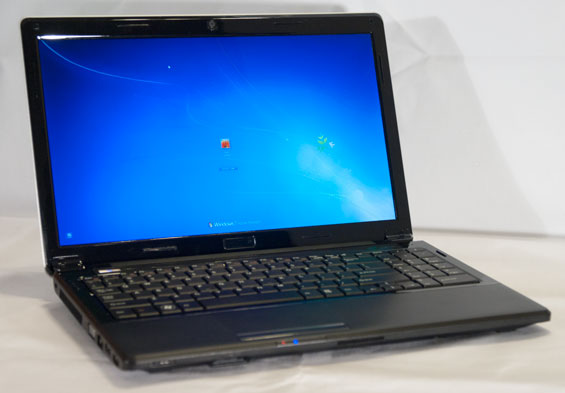
The march of progress has been a long time coming for Compal. Ever since the start of my tenure way back at NotebookReview, people have been consistently curious about their 15" notebooks. These machines always featured high-resolution screens and powerful dedicated graphics in an appealing form factor. The shell stagnated for a long time, but with the PBL21 that era comes to a close. Updates to Sandy Bridge and NVIDIA's GeForce 500M series accompany a healthy change in style.
| Compal PBL21 Specifications | |
| Processor |
Intel Core i7-2630QM (4x2GHz + HTT, 32nm, 6MB L3, Turbo to 2.9GHz, 45W) |
| Chipset | Intel HM65 |
| Memory | 2x4GB Kingston DDR3-1333 (Max 2x4GB) |
| Graphics |
NVIDIA GeForce GT 540M 2GB DDR3 (96 CUDA Cores, 672MHz/1344MHz/1.8GHz core/shader/memory clocks, 128-bit memory bus) |
| Display |
15.6" LED Glossy 16:9 1920x1080 (AU Optronics AUO10ED Panel) |
| Hard Drive(s) | Kingston SSDNow V Series 128GB SSD |
| Optical Drive | DVD+/-RW Drive |
| Networking |
Realtek RTL8168 PCIe Gigabit Ethernet Realtek RTL8191SE PCIe 802.11b/g/n |
| Audio |
Realtek ALC269 HD Audio Stereo speakers Headphone and microphone jacks |
| Battery | 6-Cell, 11.1V, 5200mAh, 58Wh battery |
| Front Side |
Wireless switch Card reader |
| Left Side |
Kensington lock Exhaust vent VGA Ethernet jack USB 3.0 HDMI |
| Right Side |
Headphone and mic jacks 2x USB 2.0 Optical drive AC adapter |
| Back Side | - |
| Operating System | Windows 7 Home Premium 64-bit |
| Dimensions | 14.82" x 9.8" x 1.37" (WxDxH) |
| Weight | 5.51 lbs |
| Extras |
2MP webcam Flash reader (MMC, SD/Mini SD, MS/Duo/Pro/Pro Duo) USB charging |
| Warranty | 1-year limited warranty and lifetime technical support |
| Pricing |
Starting at $949 Priced as configured: $1,190 |
I find the more notebooks I test the more fond I become of Intel's Core i7-2630QM. Last generation didn't really have a proper entry-level quad-core unless you count the Core i7-720QM, and that chip was a rare find south of a grand. But Intel seems to be pricing the i7-2630QM to sell, because I'm seeing it pop up all over the place; on NewEgg you can find it in an Acer notebook for just $699. It's a good thing, too, because while the i7-720QM occasionally found itself having a hard time competing with its dual-core brethren, the Sandy Bridge-based i7-2630QM is plenty fast. It starts at a 2GHz clock speed and can turbo all the way up to 2.9GHz on one core or 2.6GHz on all four cores, and each of those cores is Hyper-Threading enabled.
Strapped to the i7-2630QM's memory controller is 8GB of DDR3-1333 in two DIMMs, and supporting it on graphics duty is NVIDIA's GeForce GT 540M with 2GB of DDR3 (honestly far more than this GPU can really take advantage of). I'm curious to see how well the GT 540M competes with the last model's AMD Mobility Radeon HD 5650. In the Compal PBL21, the GT 540M features 96 of NVIDIA's CUDA cores, with a base clock speed of 672MHz and the shaders operating at 1344MHz. That 2GB of DDR3 is thankfully strapped to a 128-bit memory bus and running at an effective 1.8GHz. It's not blazingly fast, but mercifully the benefit of a 1080p 15.6" screen is that running at a lower than native resolution doesn't look that bad.
For storage duties, CyberpowerPC equipped this review unit with a 128GB Kingston SSDNow V Series SSD. It's not the fastest SSD on the market, but it still beats mechanical storage for speed and it keeps costs down. Connectivity has gotten a small but much appreciated boost with the new chassis, though: the Compal PBL21 is now USB 3.0 enabled (but still no eSATA).
Originally published at https://www.anandtech.com/show/4462/cyberpowerpcs-compal-pbl21-the-sharks-new-teeth (Wayback Machine).