
The Google Mini - A look at Google's entry-level search appliance
- Posted in
- IT Computing
Crunching numbers
The lack of system-performance information from the Google Mini system made it impossible to provide our readers with detailed information on the CPU and memory performance of the Google Mini. However, we couldn't resist testing Google's advertised claim of "25 queries per second." To run our tests, we are using our own software, a suite of benchmarking tools developed right here in the lab, currently code-named APUS (Application Unique Stress-testing). You might remember our mention of this application and a more detailed description from Johan's previous articles. Using a well-rounded mix of both simple and complex search queries, we stress-tested the Mini to see how well it performs.
Throughput
We found that the machine performs remarkably well, considering its aged hardware. It actually performs quite a bit better than Google claims, peaking at 40 responses per second. Mind you, this result is how quickly the actual results appear to the user at the search page, not merely the time it took for the Mini to search through its internal database.
In the graph below, the blue line is the most important. These are the actual responses returned to our software, whereas the red line is simply the amount requested. Under ideal conditions, if we sent the Mini a certain number of requests per second, we would expect it to return that same number of responses per second. In reality, this is not always the case, as the application's response time can be limited by several factors, which makes it impossible to guarantee the same throughput under all conditions.
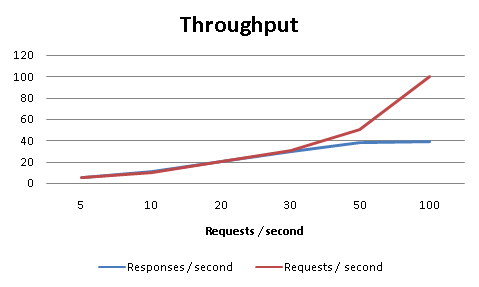
The server actively starts blocking our connections when we push it beyond 100 requests per second, which is a fair limitation considering that a Mini shouldn't ever have to process requests at such a high rate.
Power consumption
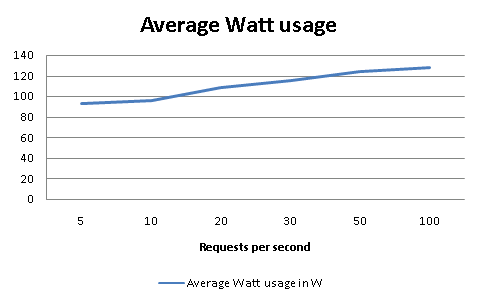
The second thing we found interesting - especially in light of Google's environmental efforts - was the power consumption of the Mini, considering it is a machine intended to run non-stop. As we alluded to earlier, we were initially a bit worried that its hardware setup would be power-hungry, and we were not entirely mistaken. Our main problem with this setup is that, while its power consumption is definitely not over the top, it could still be much better. The CPU choice in particular seems a bit weak in this respect, and we feel that Google could have built a much "greener" machine (for example, by using a Core 2 mobile CPU).
The results below were recorded during the same test as our Throughput graph. Since we cannot measure the CPU load, we provide the power-consumption results as a function of the number of requests sent per second.
General speed
Giving people a sense of the "general" speed of an appliance is never an easy task, since speed is always relative to multiple factors such as CPU load or RAM usage. Since we have no way of quantifying these factors, we cannot simply judge the Mini to be "fast" or "slow" at what it does, but we can try to tell you how long it took our Mini to do certain things.
When starting from an empty index, it generally took our Mini at least 36 hours to build up 50,000 results on our fileserver, at which point its limit was reached. We checked its speed at regular intervals and found the crawling rate during that time to vary between 0 and 15 pages per second.
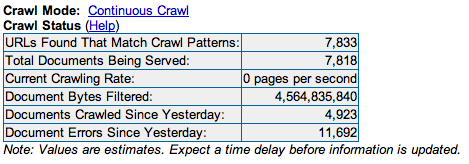
An overview of the crawler's status.
In continuous-crawl mode (which we used during all our testing), we generally had to wait 3-5 minutes before our recrawl commands were carried out.
Originally published at https://www.anandtech.com/show/2407 (Wayback Machine).