
915 Motherboard Roundup: Socket 775 for the Rest of Us
- Posted in
- Motherboards
Jetway 915 PDBG: Features and Layout
| Jetway 915 PDBG Motherboard Specifications | |
| CPU Interface | Socket 775 Pentium 4 (Prescott) |
| Chipset | Intel 915P/ICH |
| BUS Speeds | 200MHz to 255MHz (in 1MHz increments) |
| DDR Speeds | Auto, 333, 400 |
| Core Voltage | 0.8375V to 1.60V in 0.0125V increments |
| DRAM Voltage | 1.80V to 2.25V in 0.05V increments |
| VDD 1.5 Voltage | 1.50V-2.0V in 0.05V increments |
| Memory Slots | Four 184-pin DDR400 Slots Dual-Channel Unbuffered Memory to 4GB |
| Expansion Slots | 1 PCIe x16 Slot 2 PCIe x1 slot 4 PCI Slots |
| Onboard SATA/RAID | 4 SATA 150 drives by ICH6 Plus 2 SATA drives by SiS180 (0, 1, 0+1) |
| Onboard IDE/RAID | One Standard ATA100/66 (2 drives) Plus 2 drives by SiS 180 (0, 1, 0+1) |
| Onboard USB 2.0/IEEE-1394 | 8 USB 2.0 ports 2 IEEE 1394 FireWire Ports by VIA VT6307S |
| Onboard LAN | Gigabit PCI Ethernet by Realtek 8100S |
| Onboard Audio | Realtek ALC880 (HD Audio) 8-Channel with SPDIF in/out |
| Tested BIOS | Award 7/07/2004 |
Jetway supplied early versions of both their 915P and 915G motherboards. The boards are the same except for the integrated Intel DX9 graphics capabilities of the G chipset. While the 915 is the "mainstream" chip in the new Socket 775 chipsets, Jetway did not short-change the features on their 915PDBG board. Included are the trademark High-Definition audio powered by the Realtek ALC880, 2 VIA Firewire ports, and Gigabit LAN running on the slower PCI bus. The Gigabit LAN would have performed better on the faster PCIe bus, but in most real applications today, you won't really notice the difference.

Jetway economized by using the ICH6 south bridge instead of the R version that supports Intel Matrix RAID. Then they added A SiS 180 controller to provide 2 needed IDE ports (total 4) to the 915 chipset and 2 more SATA ports (total 6). The added drives on the SiS 180 controller can be combined in RAID arrays if the user chooses.
The BIOS options and ranges of the Jetway 915PDGB are surprisingly complete. Memory Voltage, CPU Voltage and VDD (Chipset) voltage all have wide and useful ranges. The only BIOS adjustment that could use a boost in BIOS upgrade is the FSB adjustment, which is currently limited to a pretty low 255 setting. Jetway designed the 915P.R boards to use DDR memory to lower the cost of an upgrade to the new Socket T platform.
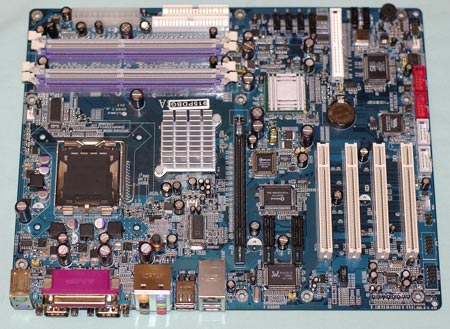
Jetway did a fine job in the layout of the 915PBDG. The board is a decidedly non-flashy standard green with rounded corners, but the components and connectors are in locations where they make sense. The floppy and IDE connector supported by the ICH6 are in the best location at the upper right board edge, between the memory slots and the board edge. The 24/20-pin power connector is in the same area where it belongs. While the 4-pin 12V power connector is between the CPU socket and the IO ports, it completely clears the CPU area at least, making it easier to connect and route around the CPU heatsink/fan. The 6 SATA connectors and onboard headers for features are all along board edges where they belong. It is also worth noting that the SATA connectors are the completely enclosed type, which makes the fragile SATA connector much more durable for day-in/day-out service.
We don't know if the Jetway 915PBDG will ever see the light of day in most world markets. As Anand discussed after his recent visit to Taiwan, manufacturers are extremely disappointed with the very slow sales of 915/925X boards. With supplies of 865/875 drying up, there may be a corresponding boost in 915/925X sales. If there is a boost in 915 demand, then look for the Jetway in the market. The design of the board is very good and Jetway could have a winner here with some refinement - if the market wants a 915P board.
Originally published at https://www.anandtech.com/show/1561 (Wayback Machine).