
Dual CPU Database Server Comparison
- Posted in
- IT Computing
Introduction
Despite its incredible importance, it is difficult to find independent hardware advice on database servers. Only a few major hardware and software vendors publish the majority of the TPC and other benchmark numbers. Although a discussion on TPC benchmarks is beyond the scope of this article, it is clear that there is no substitute for independent benchmarking.Benchmarks that vendors provide have a tendency to be to rosy or perhaps even flawed. Vendors may use hardware setups or software configurations that are unlikely to exist in the real world, yet attain the highest score on a particular benchmark. Benchmarking done by Jason and Ross are a notable exception on the internet, of course.
Because many of our readers are interested or are engaged in this field, we started a new databaseserver benchmarking project just a few months ago.
The primary objective of this project is to determine the hardware that makes sense for a database server of small and medium-sized organizations. We tested DB2, and My SQL on SUSE SLES 8 on many different systems based on four different Xeons CPUs and two Opteron configurations.
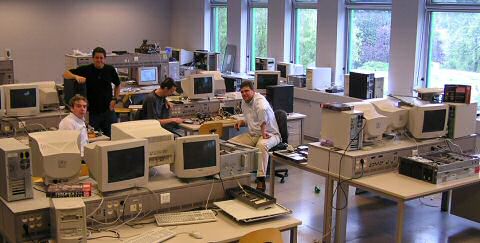
"Servers are all about large caches and fast I/O." This is a generalization that is heard a lot in the IT community and the cliché has been proven, more or less, to be accurate in the high-end server market. But does this common wisdom also apply to the smaller dual processor systems that act as database servers? Should you pay more for a Xeon that has a healthy amount of L3-cache, or will a less expensive Intel without L3-cache do just fine? Does 64-bit really matter? How important is memory latency/bandwidth? Is a hyperthreaded CPU better equipped when the database is accessed by many users simultaneously?
While we still continue to improve the quality of our benchmarks, we decided to report our first impressions.
Originally published at https://www.anandtech.com/show/1559 (Wayback Machine).