
The AMD Radeon R9 Fury Review, Feat. Sapphire & ASUS
Crysis 3
Still one of our most punishing benchmarks, Crysis 3 needs no introduction. With Crysis 3, Crytek has gone back to trying to kill computers and still holds the “most punishing shooter” title in our benchmark suite. Only in a handful of setups can we even run Crysis 3 at its highest (Very High) settings, and that’s still without AA. Crysis 1 was an excellent template for the kind of performance required to drive games for the next few years, and Crysis 3 looks to be much the same for 2015.
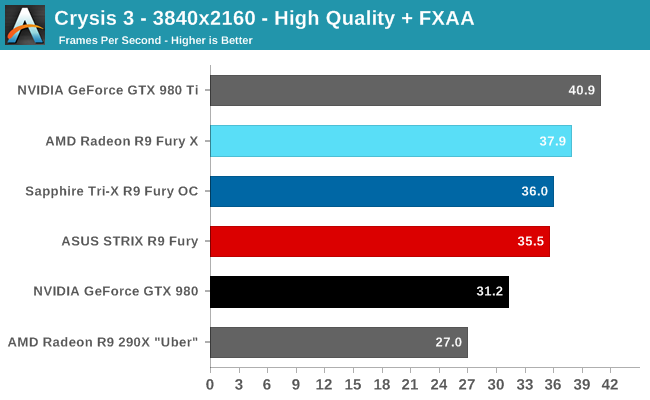
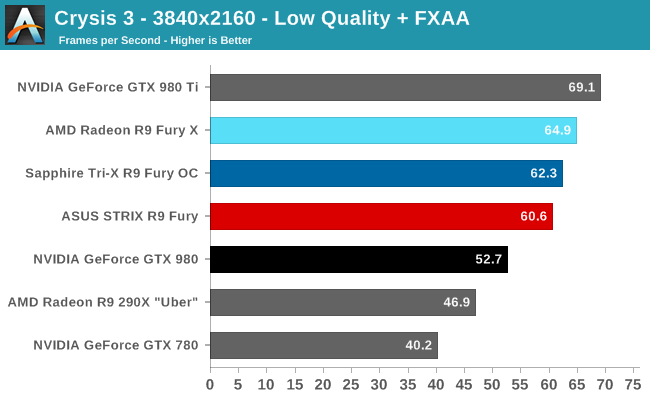
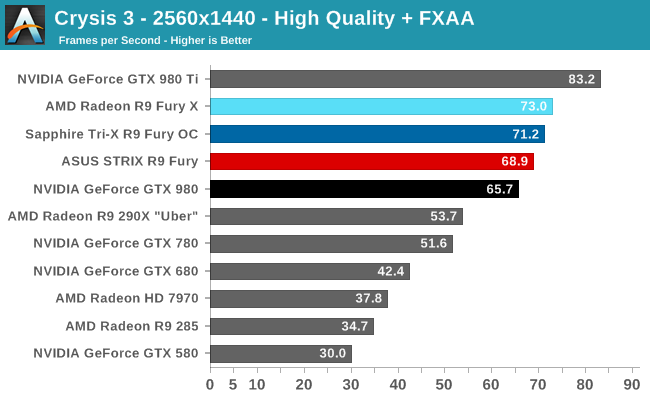
Under Crysis 3 the R9 Fury once again has the lead, though there is a clear amount of variation in that lead depending on the resolution. At 4K it’s 14% or so, but at 1440p it’s just 5%. This is consistent with the general trend for AMD and NVIDIA cards, which is that AMD sees better performance scaling at higher resolutions, and is a big part of the reason why AMD is pushing 4K for the R9 Fury X and R9 Fury. Still, based on absolute performance, the R9 Fury’s performance probably makes it better suited for 1440p.
Meanwhile the R9 Fury cards once again consistently trail the R9 Fury X by no more than 7%. Crysis 3 is generally more sensitive to changes in shader throughput, so it’s interesting to see that the performance gap is as narrow as it is here. These kinds of results imply that the R9 Fury X’s last 512 stream processors aren’t being put to very good use, since most of the performance difference can be accounted for in the clockspeed difference.
Originally published at https://www.anandtech.com/show/9421/the-amd-radeon-r9-fury-review-feat-sapphire-asus (Wayback Machine).