
The AMD Radeon R9 Fury Review, Feat. Sapphire & ASUS
Battlefield 4
Kicking off our benchmark suite is Battlefield 4, DICE’s 2013 multiplayer military shooter. After a rocky start, Battlefield 4 has since become a challenging game in its own right and a showcase title for low-level graphics APIs. As these benchmarks are from single player mode, based on our experiences our rule of thumb here is that multiplayer framerates will dip to half our single player framerates, which means a card needs to be able to average at least 60fps if it’s to be able to hold up in multiplayer.
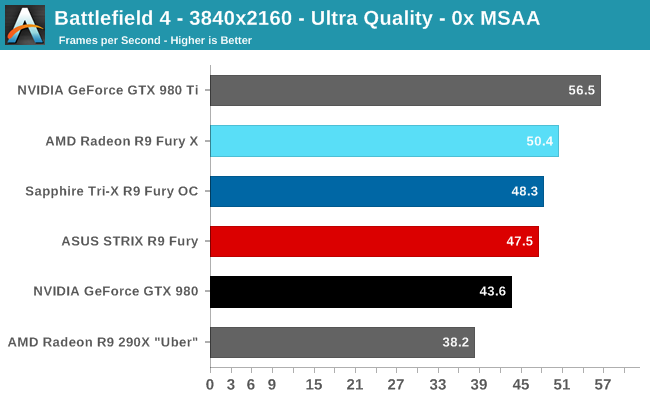
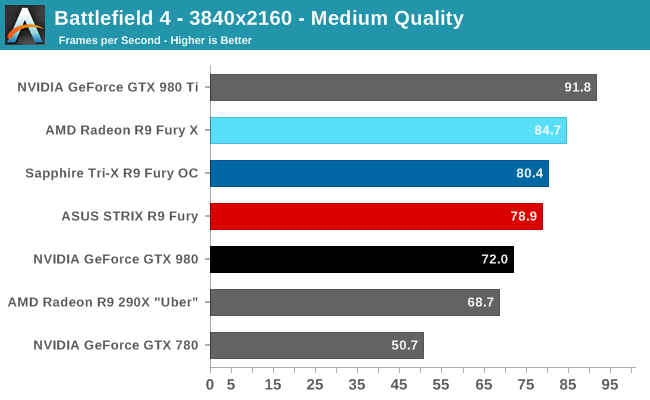
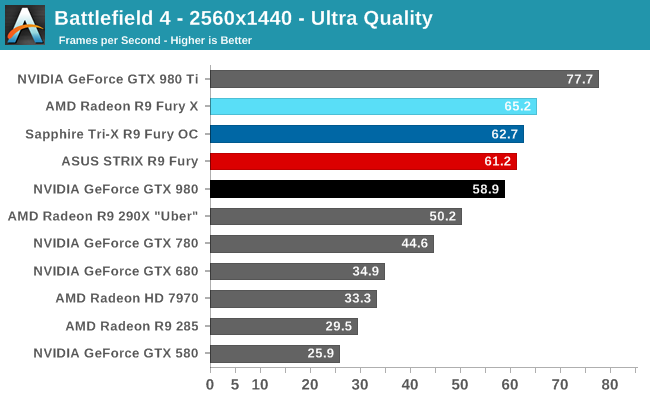
When the R9 Fury X launched, one of the games it struggled with was Battlefield 4, where the GTX 980 Ti took a clear lead. However for the launch of the R9 Fury, things are much more in AMD’s favor. The two R9 Fury cards have a lead just shy of 10% over the GTX 980, roughly in-line with their price tag difference. As a result of that difference AMD needs to win in more or less every game by 10% to justify the R9 Fury’s higher price, and we’re starting things off exactly where AMD needs to be for price/performance parity.
Looking at the absolute numbers, we’re going to see AMD promote the R9 Fury as a 4K card, but even with Battlefield 4 I feel this is a good example of why it’s better suited for high quality 1440p gaming. The only way the R9 Fury can maintain an average framerate over 50fps (and thereby reasonable minimums) with a 4K resolution is to drop to a lower quality setting. Otherwise at just over 60fps, it’s in great shape for a 1440p card.
As for the R9 Fury X comparison, it’s interesting how close the R9 Fury gets. The cut-down card is never more than 7% behind the R9 Fury X. Make no mistake, the R9 Fury X is meaningfully faster, but scenarios such as these question whether it’s worth the extra $100.
Originally published at https://www.anandtech.com/show/9421/the-amd-radeon-r9-fury-review-feat-sapphire-asus (Wayback Machine).