
The AMD Radeon R9 Fury Review, Feat. Sapphire & ASUS
Middle Earth: Shadow of Mordor
Our next benchmark is Monolith’s popular open-world action game, Middle Earth: Shadow of Mordor. One of our current-gen console multiplatform titles, Shadow of Mordor is plenty punishing on its own, and at Ultra settings it absolutely devours VRAM, showcasing the knock-on effect that current-gen consoles have on VRAM requirements.
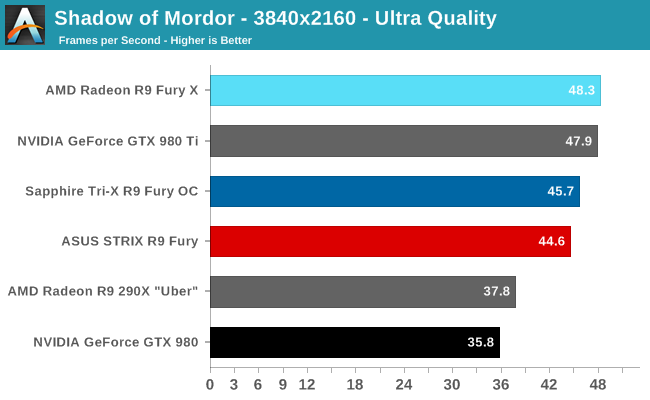
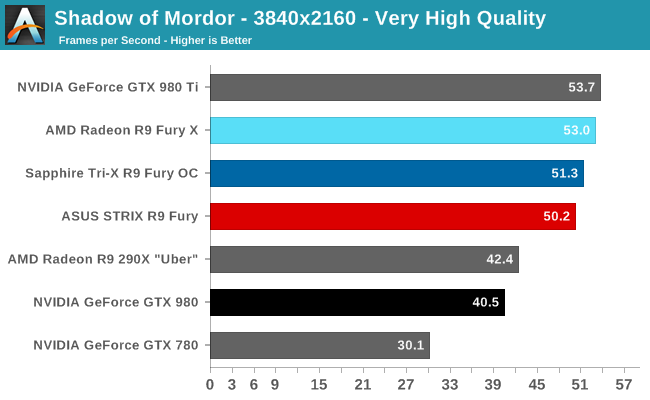
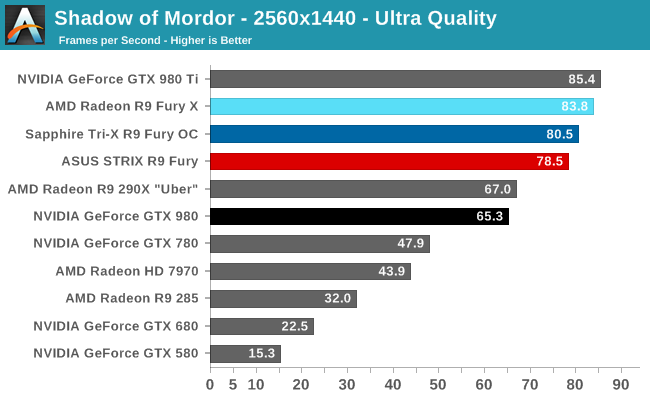
Shadow of Mordor ends up being a big win for AMD, with the R9 Fury cards shooting well past the GTX 980. Based on our earlier R9 Fury X review this was not an unexpected result, but at the end of the day with a 20%+ performance advantage, it’s a great situation for AMD to be in.
Meanwhile the R9 Fury’s performance relative to its X-rated sibling is yet again in the 7% range. So far the performance difference between the two cards is surprisingly consistent.
Finally, since AMD’s last two $550 cards were the R9 290X and HD 7970, let’s take a look at those comparisons quickly. At 1440p the R9 Fury only has a 17% lead over the R9 290X “Uber”, which for a card almost 2 years old is more than a bit surprising. The R9 Fury has more efficient front-ends and back-ends and significant advantages in shader throughput and memory bandwidth, and yet the performance gains compared to 290X are fairly small. On the other hand 7970 owners looking to upgrade to another Radeon should like what they’re seeing, as the R9 Fury’s 79% performance advantage is approaching upgrade territory.
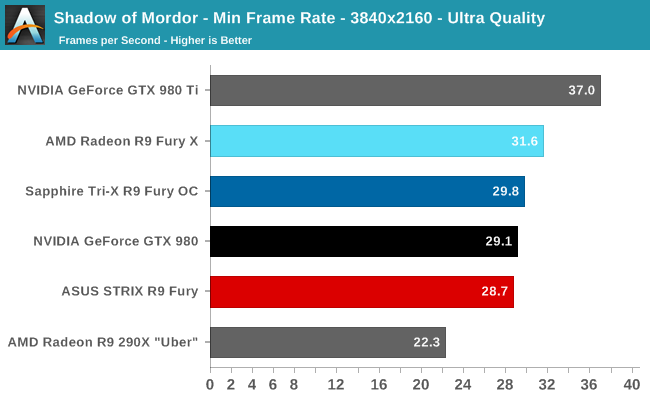
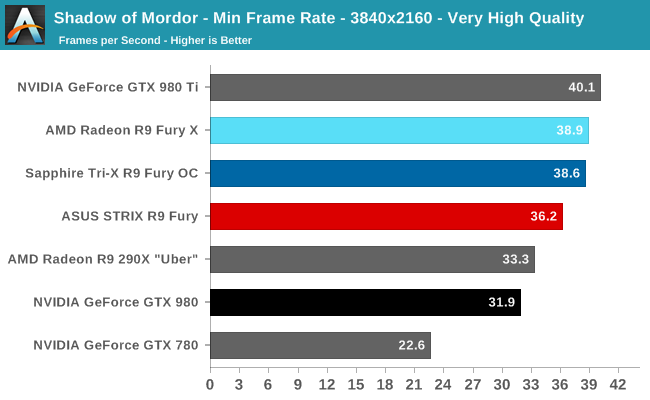
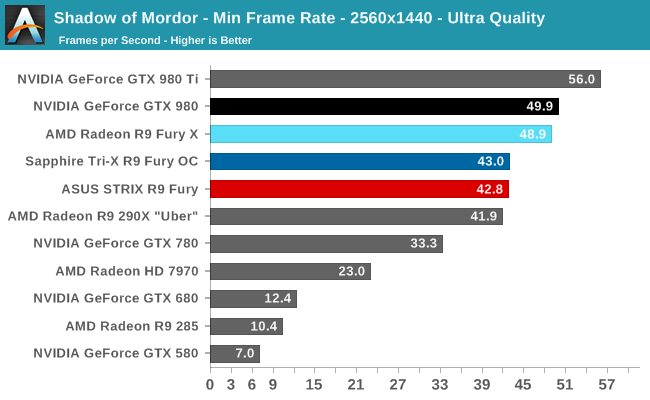
Shifting gears to minimum framerates, the situation is similarly in AMD’s favor at 4K. One of the outcomes of going up against the GTX 980 is that it’s just as VRAM-limited as R9 Fury is, so in a VRAM intensive game like Shadow of Mordor, neither card has an advantage. However it’s quite interesting that once we back off to 1440p, the GTX 980 surges forward.
Originally published at https://www.anandtech.com/show/9421/the-amd-radeon-r9-fury-review-feat-sapphire-asus (Wayback Machine).