
HGST Deskstar NAS 6 TB Review
RAID-5 Benchmarking - Miscellaneous Aspects
Consumers are rightly worried about RAID rebuilds and the scope for drive failures during that process. As one of our evaluation aspects, we randomly yanked out a disk during operation and cleaned it up for rebuild. We recorded the resync duration (time taken to rebuild a 3-disk RAID-5 volume when one of the disks needs to be replaced) as well as the average power consumption during that process. The two aspects, considered together, give an idea of the efficiency of the hard drive. The graph below presents the total energy consumption (Resync Power Consumption (W) X Resync Duration (s)) for the resync.
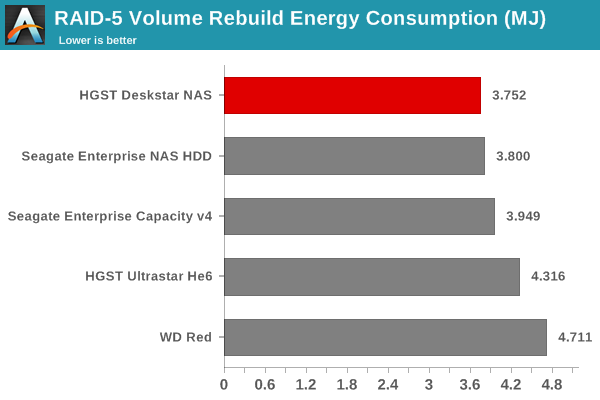
While the energy consumption aspect provides a consolidated view of the various factors, it is still worthwhile to look at the power consumption and resync duration numbers separately. The table below provides the raw information behind the above graph. We had a brief inkling when the temperature of the Deskstar NAS remained around 40 C only, despite more than 240 GB of continous data traffic, but the above energy consumption numbers confirm the fact that the Deskstar NAS is indeed quite efficient. That said, the raw power numbers do not look good for the Deskstar NAS in the table below. However, by getting done with the workloads earlier, the drive can go to the idle state quickly and keep system energy consumption resonable in the long run.
| RAID-5 Resync Power Consumption & Duration | ||
| Drive | Power (W) | Duration (s) |
| HGST Deskstar NAS | 101.46 | 36981 |
| WD Red | 90.48 | 52072 |
| Seagate Enterprise NAS HDD | 101.91 | 37284 |
| HGST Ultrastar He6 | 95.36 | 45260 |
| Seagate Enterprise Capacity v4 | 105.42 | 37462 |
We also measured power consumption during the last stage of our multi-client test. With 25 different clients simultaneously stressing the NAS with different types of workloads, we recorded the power consumption at the wall for the NAS as a whole. The various numbers are presented in the graphs below.
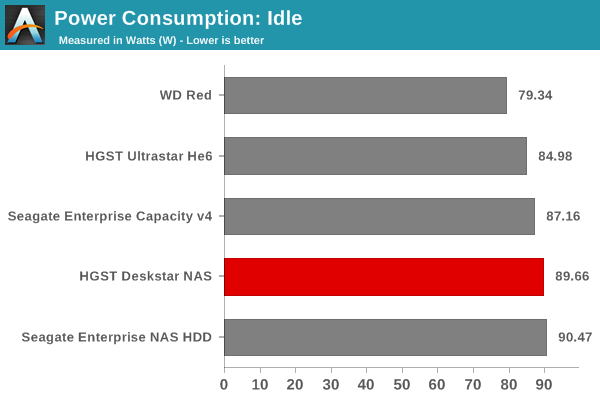
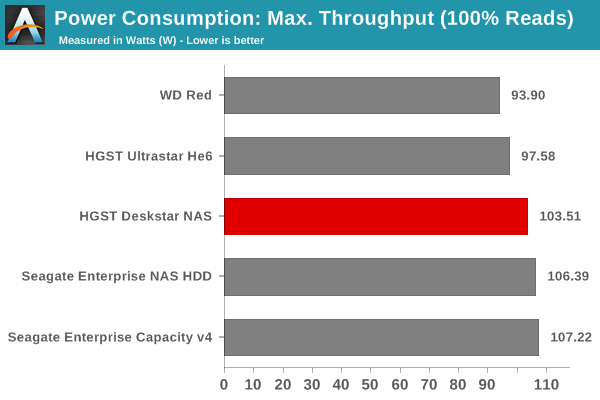
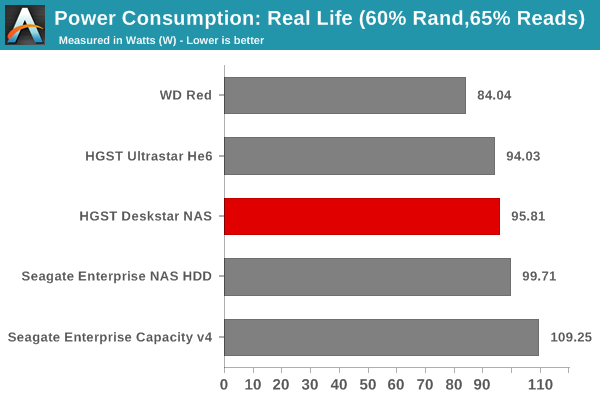
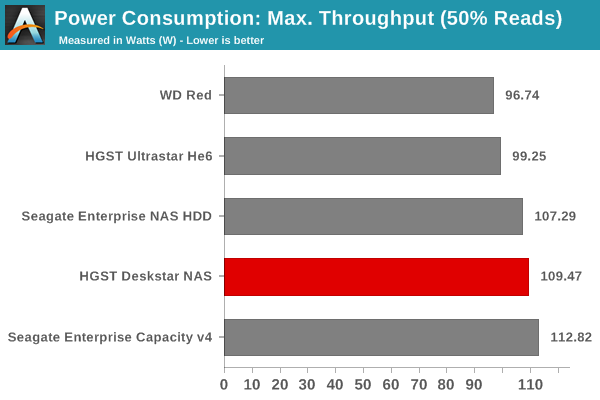
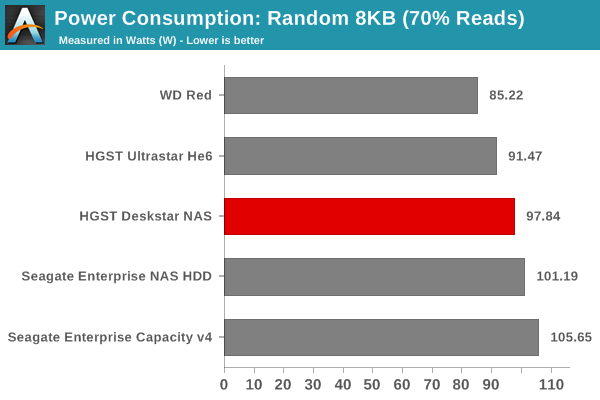
As expected, the units providing better performance have higher power consumption numbers. Amongst the 7200 RPM drives, the Ultrastar He6 is the most power-efficient. This is due to the HelioSeal technology (disks spinning in a sealed chamber filled with helium). Amongst the conventional drives, the Deskstar NAS manages to be the most power efficient for a few of the access patterns.
Originally published at https://www.anandtech.com/show/8794/hgst-deskstar-nas-6-tb-review (Wayback Machine).