
X-Gene 1, Atom C2000 and Xeon E3: Exploring the Scale-Out Server World
Web Server Performance
Writing about micro and entry level servers without a website benchmark would be unforgiveable. Most websites are based on the LAMP stack: Linux, Apache, MySQL, and PHP. Few people write html/PHP code from scratch these days, so we turned to a Drupal 7.21 based site. The web server is Apache 2.4.7 and the database is MySQL 5.5.38 on top of Ubuntu 14.04 LTS.
Drupal powers massive sites (e.g. The Economist and MTV Europe) and has a reputation of being a hardware resource hog. That is a price more and more developers happily pay for lowering the time to market of their work. We tested the Drupal website with our vApus stress testing framework and increased the number of connections from 5 to 300.
We report the maximum throughput achievable with 95% percent of request being handled faster than 1000 ms. Notice that these numbers are not comparable to the ones in the last Xeon E5 server review, where we measured throughput at 100 ms. We assume that if you deploy a full LAMP stack on micro servers, your first requirement is cost efficiency and not the lowest response time at all times. If you do require the lowest response time, it is a best practice to only deploy the front-end of your web server on such a server. We are looking into developing such a real-world benchmark for a later review.
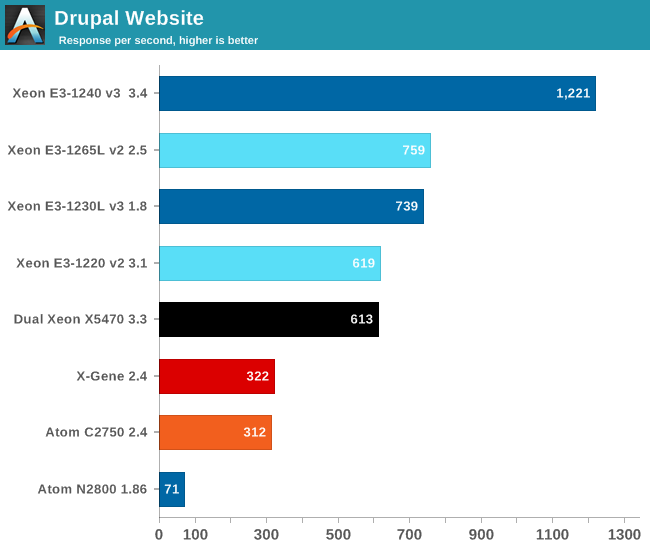
As the website load is a very bumpy curve with very short peaks of high CPU load and lots of lows, the Xeon E3-1200s operate at relatively high frequencies. Website workloads work well with Hyper-Threading as the low instruction level parallelism in one thread leaves a lot of headroom for another thread. Hyper-Threading delivers in this environment: the 8-thread Xeon E3-1265L v2 at 2.5-3.4GHz is quite a bit faster than the Xeon E3-1220 v2 at 3.1-3.3GHz.
We really wonder if anyone ever bought an Atom Saltwell based server of SeaMicro or HP to run web workloads. Those customers were either very brave or very naive; notice how the Xeon E3 is roughly 10 times faster (and as much as 17X faster)!
The Atom C2750 still performs rather poorly and sustain only about 42% of the requests of the Xeon E3-1230L. We suspect that the lack of an L3 cache that allows cores to sync threads quickly is one of the culprits. The MySQL back-end is included in this web benchmark, and this is one of the reasons that our benchmark prefers the Xeon E3. The X-Gene does not benefit much from the rather slow L3 cache and performs more or less like the Atom C2750.
Do not overestimate the effect of including the MySQL backend in our benchmark however. MySQL consumes about 20% of the CPU cycles. There is no denying that high clock speeds and simultaneous multi-threading are a very powerful mix to handle web requests.
According to some academic studies, the Atom C2750 should do better in typical scale-out software such as web search, web front-ends, and media streaming, where no syncing between threads is necessary.
Originally published at https://www.anandtech.com/show/8357/exploring-the-low-end-and-micro-server-platforms (Wayback Machine).