
X-Gene 1, Atom C2000 and Xeon E3: Exploring the Scale-Out Server World
MySQL Performance
For testing real-world SQL server performance with our homemade stress-testing software (vApus), we need a powerful client with lots of bandwidth. That kind of client was not available to us inside the network where the HP Moonshot was located. So we went back to the MySQL Sysbench utility. Sysbench allows us to place an OLTP load on a MySQL test database, and you can chose the regular test or the read only test. We chose read only as even with a flash device, Sysbench is quickly disk I/O limited.
The main reason why we tested with Sysbench is to get a huge amount of queries that only select very small parts (a few or one row) of the tables, so we can see how the SoCs behave in this kind of scenario. Sysbench allows you to test with any number of threads you like, but there is no "think time" feature. That means all queries fire off as quickly as possible, so you cannot simulate "light" and "medium" loads.
The response times are very small, which is typical for an OLTP test. To take them into account, we are showing you the highest throughput at around 3 ms (2.8 ms to 3.3 ms). We tested with 10 million records and 100,000 requests
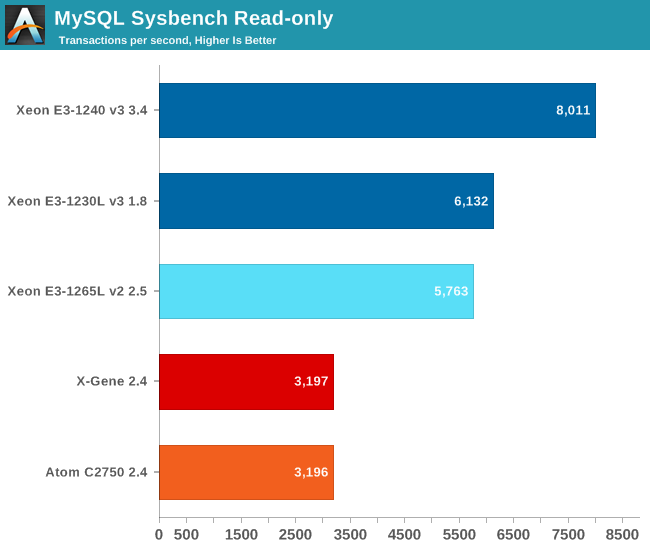
Again, the X-Gene is nowhere near the Xeon E3, but rather a competitor for the Atom C2750. The Xeon E3-1230L v3 outperforms the Xeon E3-1265L2 v2 by a small margin, despite the lower base clock.
Originally published at https://www.anandtech.com/show/8357/exploring-the-low-end-and-micro-server-platforms (Wayback Machine).