
X-Gene 1, Atom C2000 and Xeon E3: Exploring the Scale-Out Server World
Java Server Performance
The SPECjbb 2013 benchmark has "a usage model based on a world-wide supermarket company with an IT infrastructure that handles a mix of point-of-sale requests, online purchases, and data-mining operations." It uses the latest Java 7 features and makes use of XML, compressed communication, and messaging with security.
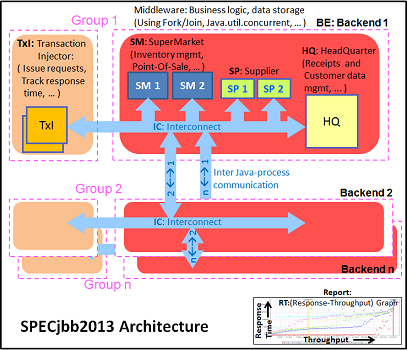
We tested with four groups of transaction injectors and back-ends. We applied a relatively basic tuning to mimic real-world use. Our first run was done with a low amount of memory:
"-server -Xmx4G -Xms4G -Xmn2G -XX:+AlwaysPreTouch -XX:+UseLargePages"
With these settings, the benchmark takes about 20-27GB of RAM. In our second run, we doubled the amount of memory to see if more memory (64GB vs. 32GB) can boost performance even more:
"-server -Xmx8G -Xms8G -Xmn4G -XX:+AlwaysPreTouch -XX:+UseLargePages"
With these settings, the benchmark takes about 43-57GB of RAM. The first metric is basically maximum throughput.
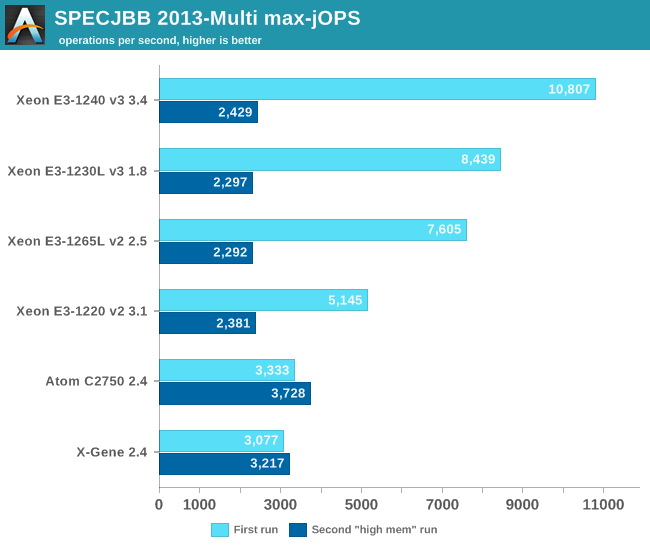
Assigning more memory to your Java VMs than what you have available is of course a bad idea, but now we have some numbers you can use to convince you coworkers of this fact. Although the Atom C2750 and X-Gene perform a little better thanks to fact that they can address twice as much RAM, they are nowhere near the performance of a Xeon E3-1230L if the latter is configured properly.
The Critical-jOPS metric is a throughput metric under response time constraint.
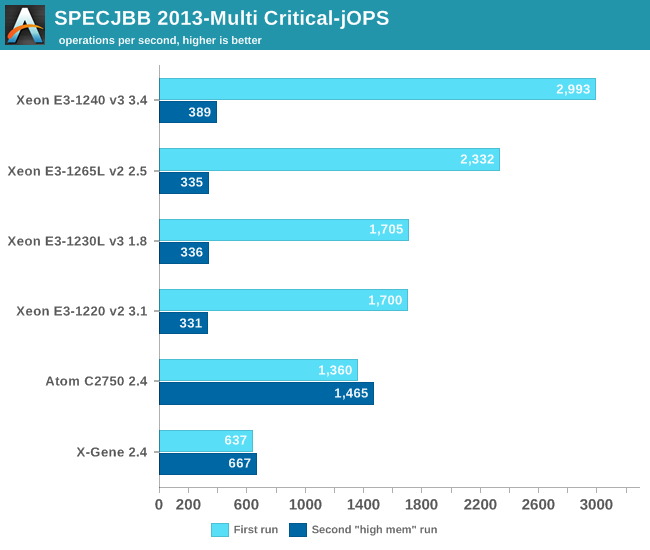
The Xeon E3 Haswell core continues to outperform the Atom by a tangible margin. The X-Gene fails to compete with the Intel SoCs. The conclusion is pretty simple: Java applications run best on a Haswell or Ivy Bridge core.
SPECJBB®2013 is a registered trademark of the Standard Performance Evaluation Corporation (SPEC).
Originally published at https://www.anandtech.com/show/8357/exploring-the-low-end-and-micro-server-platforms (Wayback Machine).