
Server Buying Decisions: Memory
Measuring Stream Throughput
Before we start with the real world tests, it is good to perform a few low level benchmarks. First, we measured the bandwidth in Linux. The binary was compiled with the Open64 compiler 5.0 (Opencc). It is a multi-threaded, OpenMP based, 64-bit binary. The following compiler switches were used:
-Ofast -mp -ipa
The results are expressed in GB per second. Note that we also tested with gcc 4.8.1 and compiler options
-O3 –fopenmp –static
Results were consistently 20 to 30% lower with gcc. So we feel our choice for Open64 is appropriate: everybody can reproduce our results (Open64 is freely available) and as the binary is capable of reaching higher speeds, it is easier to spot speed differences between DIMMs. We equipped the HP with a Sandy Bridge EP Xeon (Xeon 2690) and an Ivy Bridge EP Xeon (Xeon 2680v2). Note that the Stream benchmark is not limited by the CPUs at all. All tests were done with 32 or 40 threads.
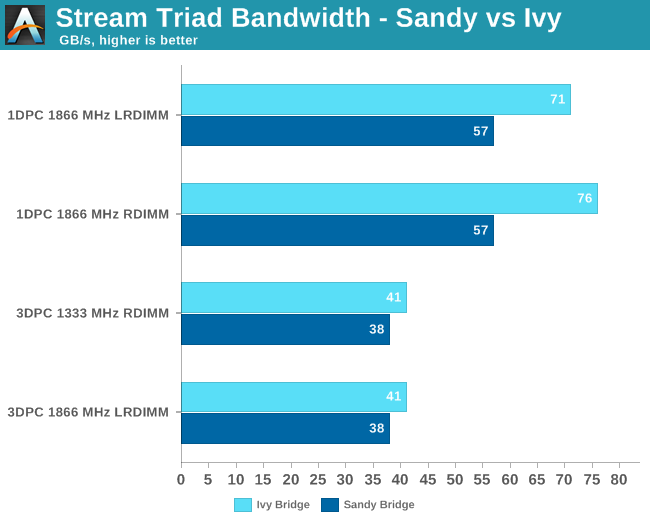
The extra buffering inside the LR-DIMMs has very little impact on the effective bandwidth. RDIMMs deliver only 3% more bandwidth at 1866 MHz, 1DPC. This bandwidth gap is 0 when we run the same test on our "Sandy Bridge EP" Xeon.
At 3DPC, there is no bandwidth gap at all. Both DIMMs are running at the same speed. Also note that the newer Xeon outperforms the older one by 8 to 33% in this test.
Originally published at https://www.anandtech.com/show/7479/server-buying-decisions-memory (Wayback Machine).