
Intel's Xeon E5-2600 V2: 12-core Ivy Bridge EP for Servers
Benchmark Configuration & method
This review is mostly focused on performance. We have included the Xeon E5-2697 v2 (12 cores at 2.7-3.5GHz) and Xeon E5-2650L v2 (10 cores at 1.7GHz-2.1GHz) to categorize the performance of the high-end and lower-midrange new Xeons. That way, you can get an idea of where the rest of the 12 and 10 core Xeon SKUs will land. We also have the previous generation E5-2690 and E5-2660 so we can see the improvements from the new architecture. This also allows us to gauge how competitive the Opteron "Piledriver" 6300 is.
Intel's Xeon E5 server R2208GZ4GSSPP (2U Chassis)
| CPU |
Two Intel Xeon processor E5-2697 v2 (2.7GHz, 12c, 30MB L3, 130W) Two Intel Xeon processor E5-2690 (2.9GHz, 8c, 20MB L3, 135W) Two Intel Xeon processor E5-2660 (2.2GHz, 8c, 20MB L3, 95W) Two Intel Xeon processor E5-2650L v2 (1.7GHz, 10c, 25MB L3, W) |
| RAM |
64GB (8x8GB) DDR3-1600 Samsung M393B1K70DH0-CK0 or 128GB (8 x 16GB) Micron MT36JSF2G72PZ – BDDR3-1866 |
| Internal Disks | 2 x Intel MLC SSD710 200GB |
| Motherboard | Intel Server Board S2600GZ "Grizzly Pass" |
| Chipset | Intel C600 |
| BIOS version | SE5C600.86B (August the 6th, 2013) |
| PSU | Intel 750W DPS-750XB A (80+ Platinum) |
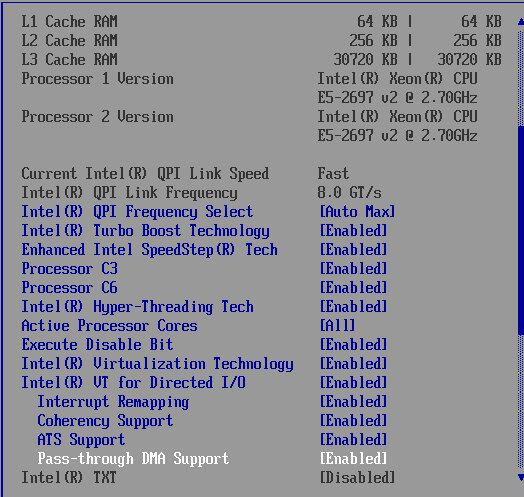
The Xeon E5 CPUs have four memory channels per CPU and support up to DDR3-1866, and thus our dual CPU configuration gets eight DIMMs for maximum bandwidth. The typical BIOS settings can be found below.
Supermicro A+ Opteron server 1022G-URG (1U Chassis)
| CPU |
Two AMD Opteron "Abu Dhabi" 6380 at 2.5GHz Two AMD Opteron "Abu Dhabi" 6376 at 2.2GHz |
| RAM | 64GB (8x8GB) DDR3-1600 Samsung M393B1K70DH0-CK0 |
| Motherboard | SuperMicro H8DGU-F |
| Internal Disks | 2 x Intel MLC SSD710 200GB |
| Chipset | AMD Chipset SR5670 + SP5100 |
| BIOS version | v2.81 (10/28/2012) |
| PSU | SuperMicro PWS-704P-1R 750Watt |
The same is true for the latest AMD Opterons: eight DDR3-1600 DIMMs for maximum bandwidth. You can check out the BIOS settings of our Opteron server below.
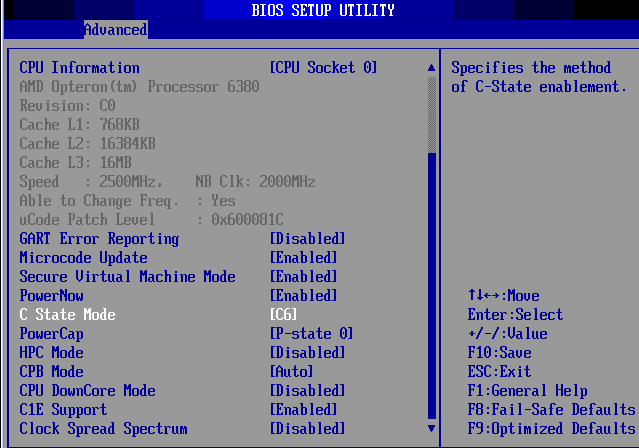
C6 is enabled, TurboCore (CPB mode) is on.
Common Storage System
To minimize different factors between our tests, we use our common storage system to provide LUNs via iSCSI. The applications are placed on a RAID-50 LUN of ten Cheetah 15k5 disks inside a Promise JBOD J300, connected to an Adaptec 5058 PCIe controller. For the more demanding applications (Zimbra, PhpBB), storage is provided by a RAID-0 of Micron P300 SSDs, with a 6 Gbps Adaptec 72405 PCIe raid controller.
Software Configuration
All vApus testing is done on ESXi vSphere 5 — VMware ESXi 5.1. All vmdks use thick provisioning, independent, and persistent. The power policy is "Balanced Power" unless otherwise indicated. All other testing is done on Windows 2008 Enterprise R2 SP1. Unless noted otherwise, we use the "High Performance" setting on Windows 2008 R2 SP1.
Other Notes
Both servers are fed by a standard European 230V (16 Amps max.) powerline. The room temperature is monitored and kept at 23°C by our Airwell CRACs. We use the Racktivity ES1008 Energy Switch PDU to measure power consumption. Using a PDU for accurate power measurements might seem pretty insane, but this is not your average PDU. Measurement circuits of most PDUs assume that the incoming AC is a perfect sine wave, but it never is. However, the Rackitivity PDU measures true RMS current and voltage at a very high sample rate: up to 20,000 measurements per second for the complete PDU.
Originally published at https://www.anandtech.com/show/7285/intel-xeon-e5-2600-v2-12-core-ivy-bridge-ep (Wayback Machine).