
Intel's Xeon E5-2600 V2: 12-core Ivy Bridge EP for Servers
Virtualization Performance: ESXi 5.1 & vApus FOS Mark 2 (beta)
We introduced our new vApus FOS (For Open Source) benchmark in our review of the Facebook "Open Compute" servers. In a nutshell, it is a mix of four VMs with open source workloads: two PhpBB websites (Apache2, MySQL), one OLAP MySQL "Community server 5.1.37" database, and one VM with VMware's open source groupware Zimbra 7.1.0.
As we try to keep our benchmarks up to date, some changes have been made to the original vApus FOS Mark. We've added more realistic workloads and tuned them in accordance with optimizations performed by our industry partners.
With our latest and greatest version (a big thanks to Wannes De Smet), we're able to:
- Simulate real-world loads
- Measure throughput, response times, and energy usage for a each concurrency
- Scale to 80 (logical) core servers and beyond
We have a grouped our different workloads into what we call a 'tile'. A tile consists of four VMs, each running a different load:
- A phpBB forum atop a LAMP stack. The load consists of navigating through the forum, creating new threads, and posting replies. There are also large res pictures on the pages, causing proper network load.
- Zimbra, which is stressed by navigating the site, sending emails, creating appointments, adding and searching contacts, etc.
- Our very own Drupal-based website. We create new posts, send contact emails, and generate views in this workload.
- A MySQL database from a news aggregator, loaded with queries from the aggregator for an OLAP workload.
Each VM's hardware configuration is specced to fit each workload's needs. These are the detailed configurations:
| Workload | CPUs | Memory (GB) | OS | Versions |
|---|---|---|---|---|
| phpBB | 2 | 4 | Ubuntu 12.10 | Apache 2.2.22, MySQL server 5.5.27 |
| Zimbra | 4 | 4 | Ubuntu 12.04.3 | Zimbra 8 |
| Drupal | 4 | 10 | Ubuntu 12.04.2 | Drupal 7.21, Apache 2.2.22, MySQL server 5.5.31 |
| MySQL | 16 | 8 | Ubuntu 12.04.2 | MySQL server 5.5.31 |
Depending on the system hardware, we place a number of these tiles on the stressed system to max it out and compare its performance to other servers. Developing a new virtualization benchmark takes a lot of time, but we wanted to give you our first results. Our benchmark is still in beta, so results are not final yet. Therefore we only tested one system, the Intel system, using three CPUs.
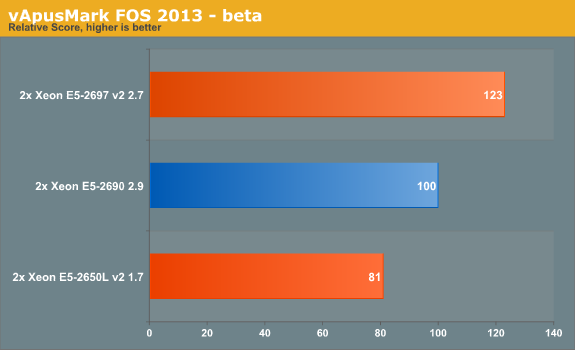
Intel reports that the Xeon E5-2697 v2 is 30% faster than the Xeon E5-2690 on SPECvirt_sc2010. Our current benchmark is slightly less optimistic, however it is pretty clear that the Ivy Bridge based Xeons are tangibly faster.
We also measured the power needed to run the three tiles of vApusMark FOS 2013 beta. It is by no means realistic, but even then, peak power remains an interesting metric since all CPUs are tested in the same server.
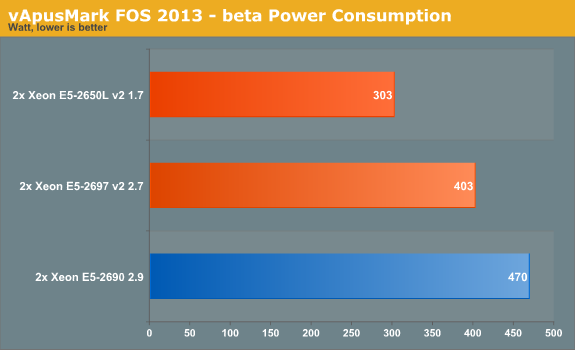
According to our measurements, the Xeon E5 2697 v2 needs only 85% of the peak power of the Xeon E5-2690. That is considerable power savings, considering that we get 22% more throughput. Also note that the virtualization improvements (vApic, VT-d large pages) are not implemented in ESXi 5.1.
Originally published at https://www.anandtech.com/show/7285/intel-xeon-e5-2600-v2-12-core-ivy-bridge-ep (Wayback Machine).