
Amped Wireless R20000G, SR20000G, and UA2000: Routers, Repeaters, and Adapters (Oh My!)
Test Location C Results: Worst-Case Performance
Our third and final test location is at a relatively extreme testing distance of 60 feet, with several walls plus a metal garage door in between the adapters and the routers. If Location B was Nightmare difficulty in Diablo III, we’re now firmly into the Hell difficulty. Anecdotally, I can also state that at this particular location, many wireless devices (e.g. my iPod Touch 4th-gen and a couple different tablets) also have serious problems connecting/maintaining a connection with my Netgear router—once I’m in my car and start leaving the driveway, WiFi gets dropped and I have to go back inside if I want to get a quick set of directions before heading out.
As far as testing this location goes, while I did manage to achieve connections with all three adapters and routers—even with the 5GHz signal—in practice the throughput was quite variable and very low. Day-to-day variance in testing was also even more pronounced this time; at one point I got nearly twice the throughput on one router+adapter combination, but I wasn’t able to repeat that performance so I discarded the earlier results. I also dropped the NTttcp testing for this location; my test script transfers 1.5GB of data, and while that only takes 2-5 minutes at the first test location and twice that at Location B, for this test location I could be looking at 20 minutes or more for some of the test cases this time. Run that five times over 26 router/adapter combinations and—assuming everything even worked out properly—I’d be looking at two solid days sitting out in my driveway. The file copy tests thankfully only use 203MiB and generally correlated well with the NTttcp results, so I’ve just used those tests.
Keep in mind that Amped also claims up to 10000 square feet of coverage for the R20000G; at 60 feet, we’re actually slightly beyond that point, so the question is more whether you think 60 feet from your router is really all that impressive. Personally, I’d be more than a little disappointed if my wireless network couldn’t reach at least 60 feet and through a couple walls. Out in the open, I’d think a couple hundred feet (e.g. in a parking lot) would be easy enough for most decent wireless routers. Anyway, let’s see what happens at our “extreme” range.
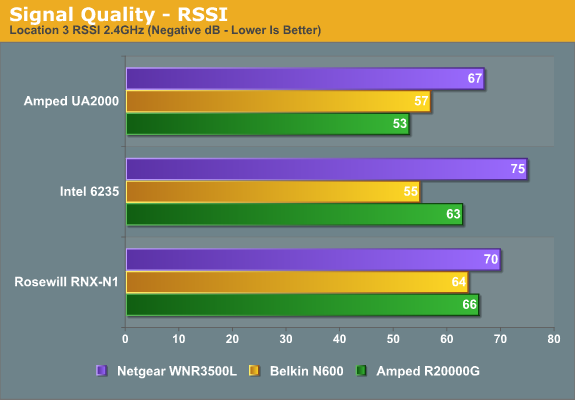
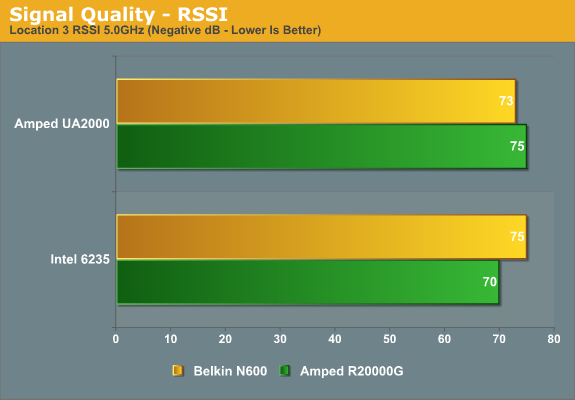
RSSI is now starting to get into the range where connections get flaky, particularly with the 5GHz spectrum. -70dB or higher (e.g. -60dB) is usually sufficient for getting and maintaining a connection, but beyond that I typically see some drops and need to reconnect. Amped advertises the R20000G as a superior “long distance” router, but while the RSSI values are better than those of the Netgear, the Belkin N600 actually claims several wins this time. It’s possible that if the Belkin router is tuned more for distance than throughput, it might actually surpass the Amped router this time.
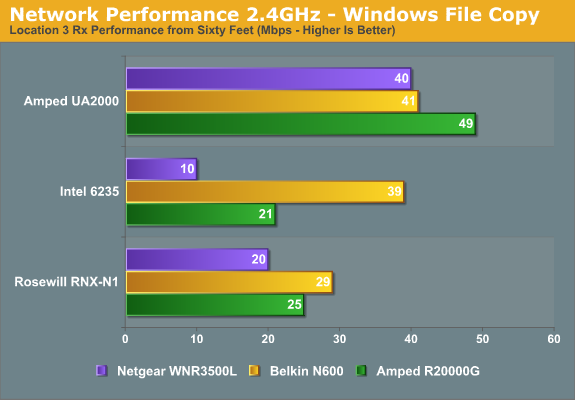
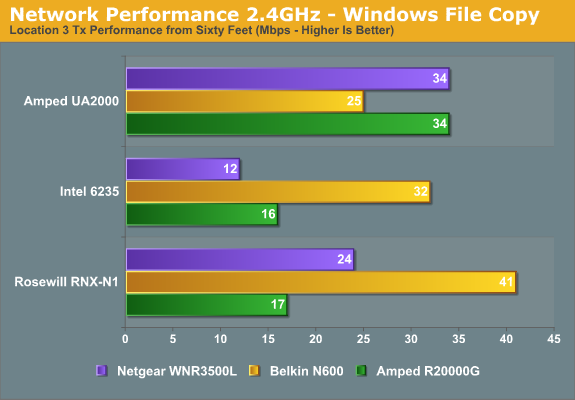
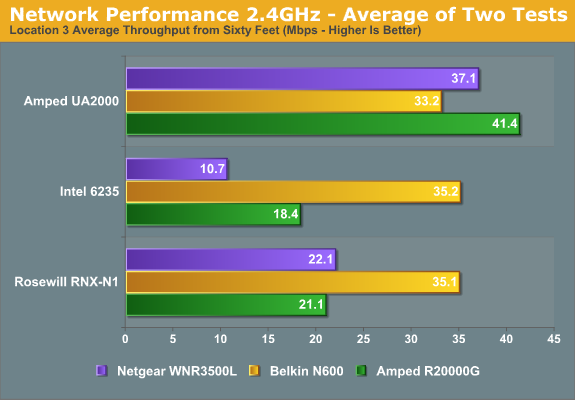
Given that testing was done over the course of several days with different weather patterns, I’m not sure just how much detail we can draw from the above charts. The UA2000 adapter generally beats the other two adapters, but it’s possible some of the results are simply “luck of the draw”. In terms of routers, the Belkin N600 comes out on top this time, delivering relatively constant performance with all three adapters—it ends up nearly 50% faster than the Netgear router and just over 25% faster than the Amped R20000G. Meanwhile, for average performance the UA2000 is about 75% faster than the Intel 6235 and 45% faster than the Rosewill RNX-N1. I was actually hoping for even more at this location, considering Amped advertises 600mW transmit power on the UA2000, but a 50% or more improvement is hardly something to scoff at.
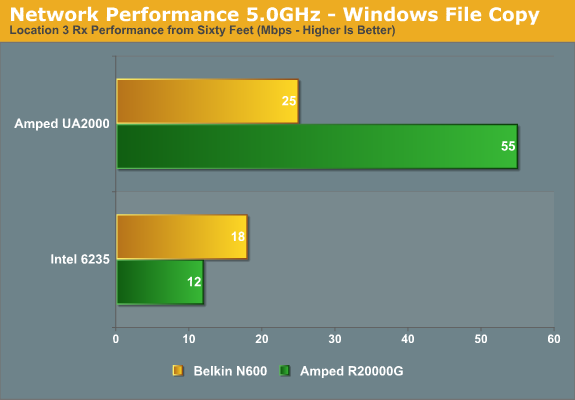
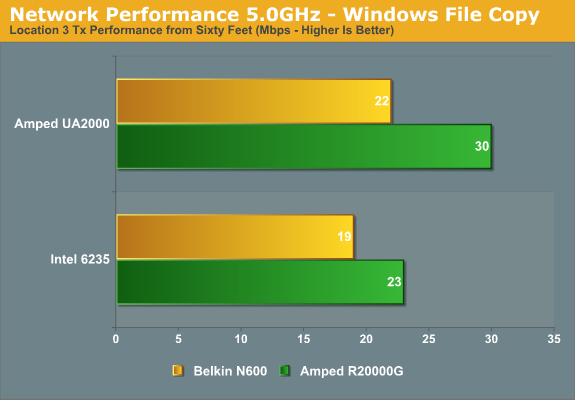
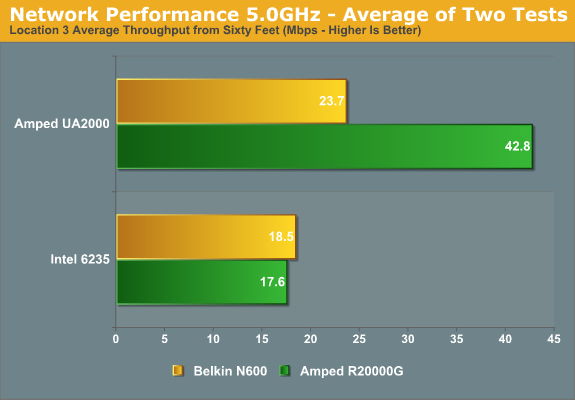
With 5GHz, the Amped + Amped combination delivers some awesome results, but again I have to question if these are reliable results or not given the variability—there were certainly times where the UA2000 managed far less than 20Mbps for example. As it stands, the UA2000 directional adapter is on average 84% faster than the Intel 6235 omnidirectional adapter—and that makes sense as signal strength drops off rapidly as we move away from the source. The R20000G also comes out on top, though that’s largely thanks to the stellar result with the UA2000; it ends up being 43% faster than the Belkin N600, but it’s really a case of nearly equal performance with the Intel 6235 (with the Belkin actually having a small 5% lead) and a massive 81% gulf with the UA2000.
If I had been wise, I would have tabulated all the individual results and come up with a throughput distribution graph (similar to what Brian does with our smartphone Speedtest results), but unfortunately I only considered doing that after the fact. It would also become rather difficult to compare results between routers and adapters using such charts. Still, if there’s enough desire for such testing, I can revisit the subject with a smaller article. Either leave a comment or drop me an email if you’re interested in such testing.
Originally published at https://www.anandtech.com/show/6034/amped-wireless-r20000g-sr20000g-and-ua2000-routers-repeaters-and-adapters-oh-my (Wayback Machine).