
Toshiba X305-Q725: Quad-Core Gaming Notebook
- Posted in
- Laptops
Battery Life
We hope you already understand going into this review that the X305-Q725 is going to have rater dismal battery life. To say that battery life isn't a major focus is a gross understatement. This is evidenced by the battery itself, which is a 6-cell 58Whr unit. The single GPU means that the X305 consumes less power than most SLI notebooks, but with the smaller battery we still end up at just over one hour of mobile usage before you need to plug in.
For battery life testing, we run all laptops at around 100 nits brightness. If you choose to run your LCD at maximum brightness, you may lose anywhere from 10 to 60 minutes depending on the laptop - the latter is mostly for ultra-mobile options while the former is for gaming notebooks. In this instance, we were unable to set the X305 to 100 nits; maximum brightness was 180 nits, but one notch down results in a drop to just 80 nits. We'd really like to see more fine-grained adjustment here, as cutting the brightness in half is far too big a drop for one "step". However, even at the reduced brightness the battery life is poor (and we only lost about 5 minutes by setting brightness to 100%).
We run four different battery life scenarios: Internet surfing (load several webpages using the wireless adapter every minute until the battery dies), DVD playback, x264 playback, and idle (maximum) battery life. For x264 playback, we copy a 720p file to the hard drive and loop playback using Windows Media Player Classic. We will also include battery life results for Blu-ray playback in the DVD chart where appropriate. We've also included web surfing results (and DVD for the MBP) for the latest Apple MacBooks as a point of reference.
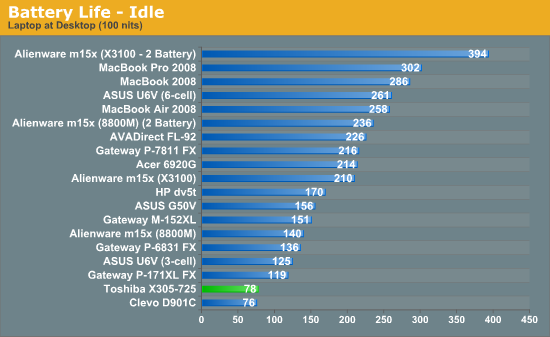
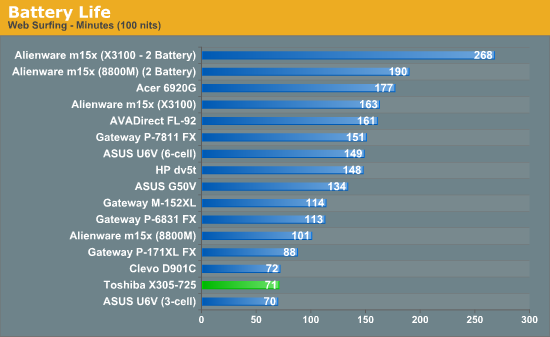
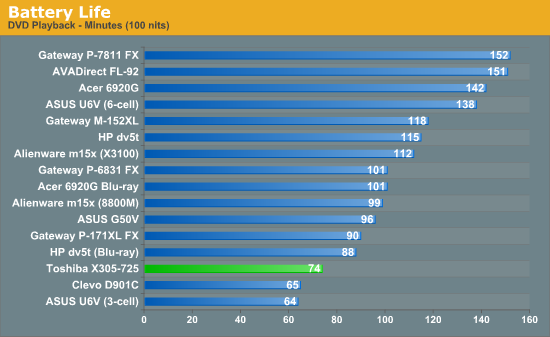
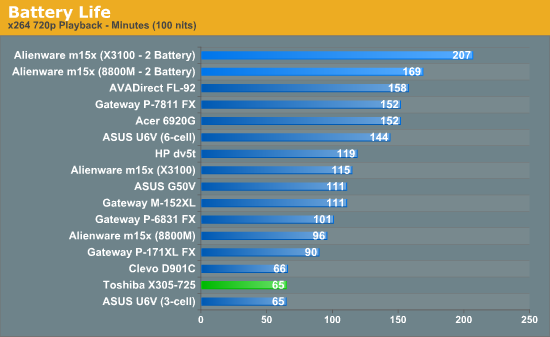
There are a few things that are noteworthy, the first being the very short battery life. What's more surprising, however, is that there doesn't seem to be any reasonable way of increasing battery life. Even our idle battery life test is barely any better than the x264 playback life, suggesting that the laptop never really enters low-power CPU states. The Clevo D901C behaves in a similar fashion, so it appears many DTR systems spend very little effort in improving mobility.
As we've mentioned in the past, Apple's MacBook and MacBook Pro provide an almost untouchable amount of battery life. To give you a true apples-to-Apples comparison, we've calculated the amount of battery life you get per Whr (Watt Hour) of battery capacity:
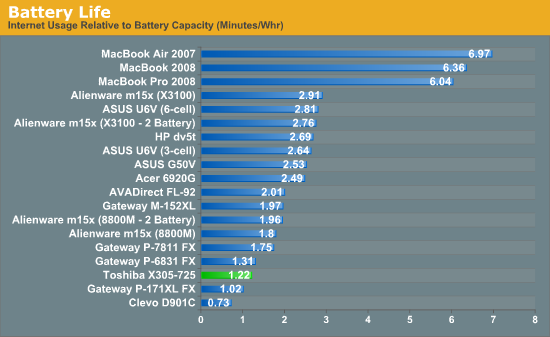
The X305-Q725 actually does better than a couple notebooks in life per Whr, beating the D901C by 67%. The combination of a 45nm CPU with DDR3 memory results in only moderately high power requirements. Obviously, the desktop CPU and second GPU in the D901C really kick the power usage up a notch. It's also interesting that the Gateway FX P-6831 only does marginally better. The older 65nm process and other design decisions make Gateway's original FX line rather inefficient, though the later P-7811 improves things quite a bit.
Originally published at https://www.anandtech.com/show/2735 (Wayback Machine).