
Toshiba X305-Q725: Quad-Core Gaming Notebook
- Posted in
- Laptops
Power Requirements
Power requirements when a laptop is plugged in don't necessarily reflect power requirements when a laptop is on battery power. In particular, high-end GPUs run at lower maximum clock speeds when using the battery power. Keep this in mind when looking at the following numbers. We test under idle conditions, with a 100% load placed on the CPU via Folding@Home SMP, and finally at maximum load by running FAH SMP at the same time as we loop 3DMark06 (at the native LCD resolution).
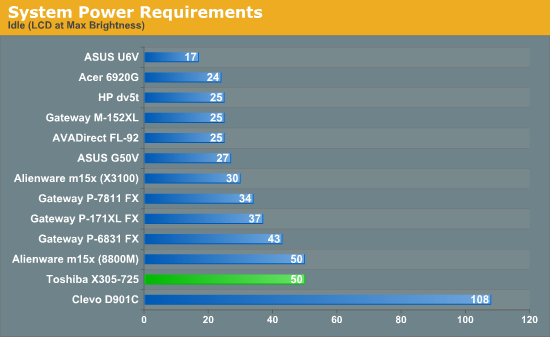
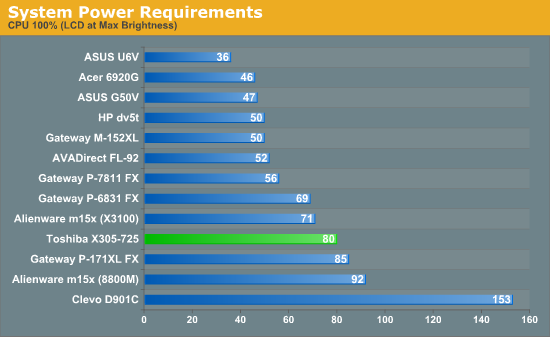
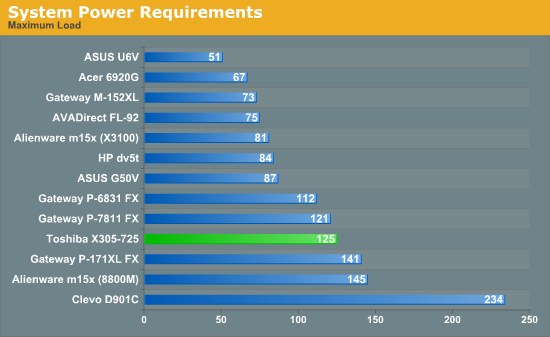
Power requirements are actually pretty reasonable, considering the components in the X305-Q725. The Alienware m15x we tested last year consumes more power when its 8800M GTX is active, so the 45nm quad-core CPU at 2.0GHz uses substantially less power than the dual-core 2.8GHz X9000 in the m15x. The Gateway P-171XL also has higher power requirements (it has an X7900 CPU), and naturally the Clevo D901C is in a league of its own.
Noise Levels
We also ran noise testing using an SPL meter at 24" under the same conditions as our power tests.
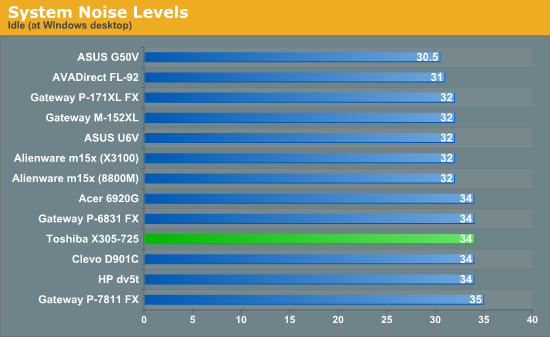
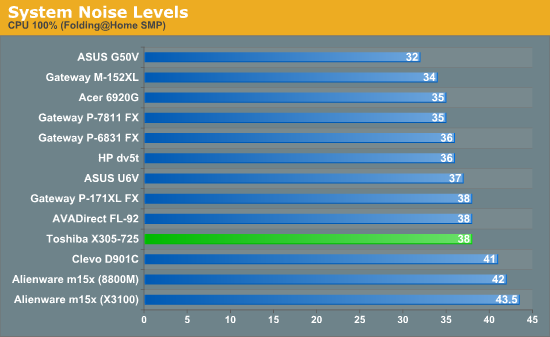
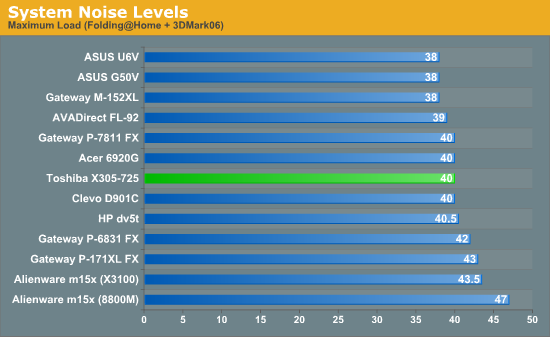
Despite the high-end components, the X305 remains relatively quiet during operation. The large chassis has plenty of room for air circulation, and noise levels are competitive with most other notebooks. The Alienware m15x with its smaller chassis is noticeably louder, for example. Temperatures are also quite reasonable for the X305, with the bottom of the laptop measuring 25-28C under load, except for the very back edge that reached 33C in places. Exhaust temperatures at load are much warmer at up to 45C, however, so you definitely don't want to block the back of the system. While many would assume that such a large, powerful notebook would be hot enough to fry eggs, the reality is that it often runs cooler than midrange options simply because of the size of the heatsinks and fans.
Originally published at https://www.anandtech.com/show/2735 (Wayback Machine).