
Toshiba X305-Q725: Quad-Core Gaming Notebook
- Posted in
- Laptops
General Application Performance
Wrapping things up with our performance testing, we have results from the Futuremark PCMark testing suites as well as some of our own application benchmarking. When it comes to running your office, multimedia, and Internet tasks, most modern laptops are more than fast enough. What follows are a few of the more strenuous application benchmarks - 3D rendering and video encoding - that put more of an emphasis on high CPU speeds. If you don't do that sort of thing on your computer, you will probably find that just about any Core 2 Duo processor is more than fast enough.
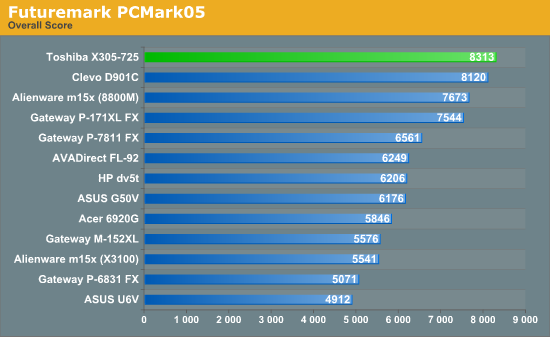
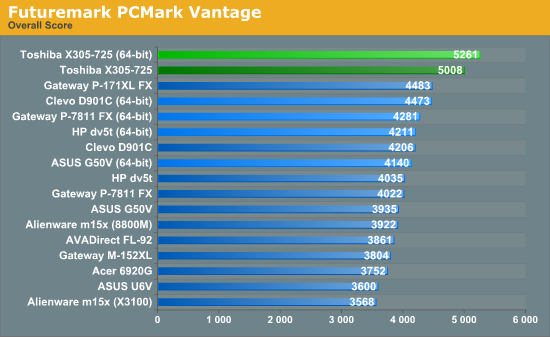
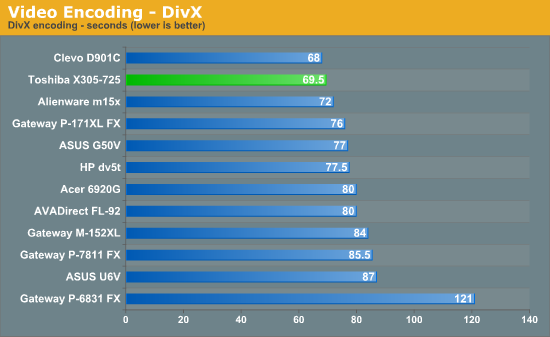
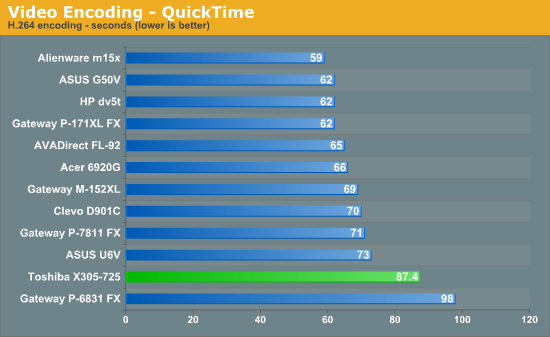
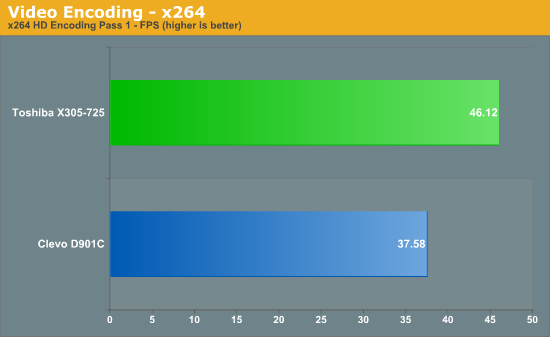
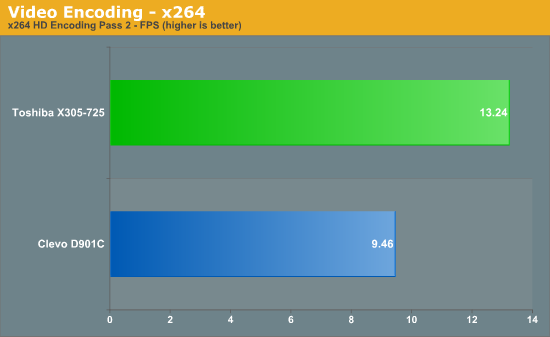
The quad-core CPU in the X305-Q725 does show its muscle in several of these tests, and the SSD helps elsewhere. PCMark definitely benefits the most from the SSD, with several of the tests stressing the ability to stream large amounts of data. Other tests like QuickTime were actually slower with the SSD, because of delays in writing the data. QuickTime also shows a situation that still occurs even with complex tasks on occasion: the lower clocked quad-core CPU ends up being slower than the dual-core CPUs because QuickTime won't utilize more than two CPU cores. DivX also fails to fully utilize the quad-core chip, with the total performance improvement over the E6850 at just 2.2%.
On the other hand, x264 benefits substantially, especially when you factor in clock speeds. Four cores at 2.0GHz theoretically provide up to 8GHz of processing potential, and the two cores of the E6850 at 3.0GHz provide 6GHz of potential, making the maximum theoretical improvement (all other things being equal) just 33%. The E6850 is an older architecture (Conroe instead of Penryn) but the E6850 also has more L2 cache per core; the fact that the Q9000 ends up being 40% faster on the second pass shows that there are scaling benefits from the newer architecture.
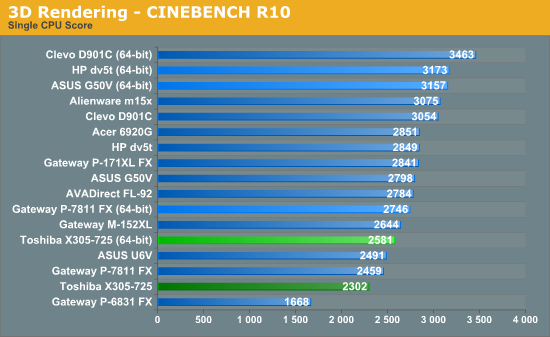
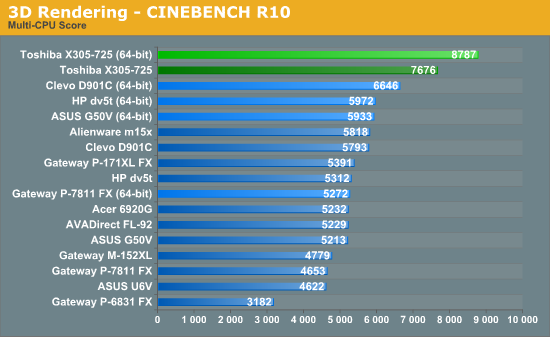
3D rendering is often able to scale almost perfectly up through four to six threads, so CINEBENCH R10 multi-core shows a nearly perfect increase of 32%. It's interesting that the single-threaded CINEBENCH score only shows a 33% advantage for the E6850, so again architectural changes in the Penryn core benefit the Q9000.
Overall, the X305-Q725 with the Q9000 looks like a good choice for highly threaded workloads, and the SSD can help in a few instances as well. However, there are competing laptops that offer similar performance for less money, or more performance for a similar cost, which makes the X305-Q725 more difficult to recommend.
Originally published at https://www.anandtech.com/show/2735 (Wayback Machine).