
NVIDIA's 790i Arrives: SLI Rides Again
- Posted in
- CPUs
EVGA NVIDIA nForce 790i Ultra SLI Board Layout and Features (Cont'd)
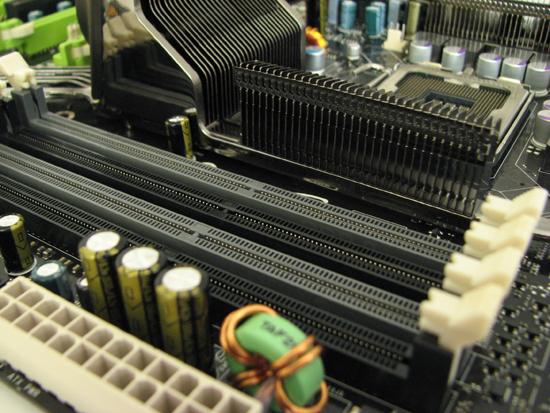
The four DDR3 DIMM slots have been moved slightly down the board in an effort to locate them as close as possible to the 790i SLI SPP, minimizing memory data and control signal trace lengths. Considerations such as these are crucial to the development of memory subsystems with enough signal transfer margin to support data transfer rates well in excess of standard DDR3 specifications. The use of DDR3 also removes the need for an array of onboard termination resistors and frees-up valuable board space for things like additional control transistors, improved copper pours for ground and power plane placement, extra bulk capacitance, and the freedom to more intelligently optimize signal routing wherever possible. If fact, much of the additional speed realized through the use of DDR3 over DDR2 is due to improvements in the interface specifications more than in actual modifications to the memory die architecture. High-speed data systems are especially susceptible to issues like crosstalk and inductive coupling between parallel data lines, which is one of the reasons why most interfaces are rapidly moving away from parallel buses in favor of low pin count serial connections.
Although not shown here, final-shipping retail boards will make use of two separate DIMM slot colors - grey and black. The two black slots, the second and farthest from the CPU socket, should be primary utilized when overclocking memory above 1800MHz. Above this frequency where it matters most, trace lengths have been carefully matched to some of the internal chipset latencies and timings associated with bank addressing in order to provide maximum signal margin. This translates to better memory overclocks, all without the need for excessive VDDQ voltages that are otherwise needed to force operation at these speeds.
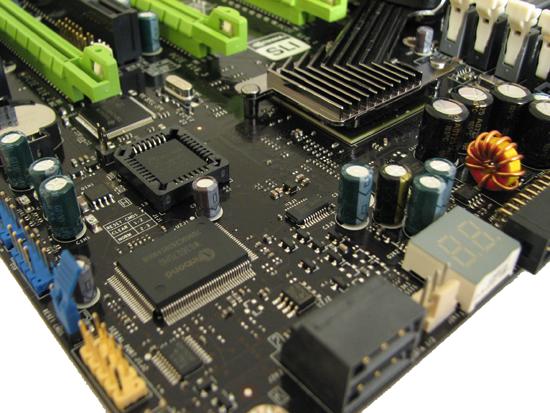
All of the optional USB and 1394a expansion headers are now conveniently located along the bottom edge of the board, unlike past layouts that seem to scatter them to the wind. This also includes the POST status indicator, which was sometimes difficult to view on the 780i board depending on what cards were installed. The same momentary tactile switches for power and reset have also made a comeback, a feature we made extensive use of during our bench testing marathons. The locations of the fan headers also make a lot more sense now. One of the two fan headers grouped at the bottom of the 780i board near these switches has also made a move up the PCB to the back plane area. We really like this as it means we no longer have to decide between running the included chipset fan or a 120mm fan mounted at the back of our case.
Finally, we would be negligent not to mention the placement of an additional SATA port, seen just above the top PCIe x1 slot. This is perfect for those out there that either install a SATA-to-eSATA port adapter or want the ability to run a single deep-storage drive when a 6-disk RAID 5 array occupies every other SATA port hanging off the MCP. It's clear that NVIDIA has partnered well with EVGA and put a lot of thought into improving their latest product.
Originally published at https://www.anandtech.com/show/2482 (Wayback Machine).