
NVIDIA's 790i Arrives: SLI Rides Again
- Posted in
- CPUs
EVGA NVIDIA nForce 790i Ultra SLI Board Layout and Features
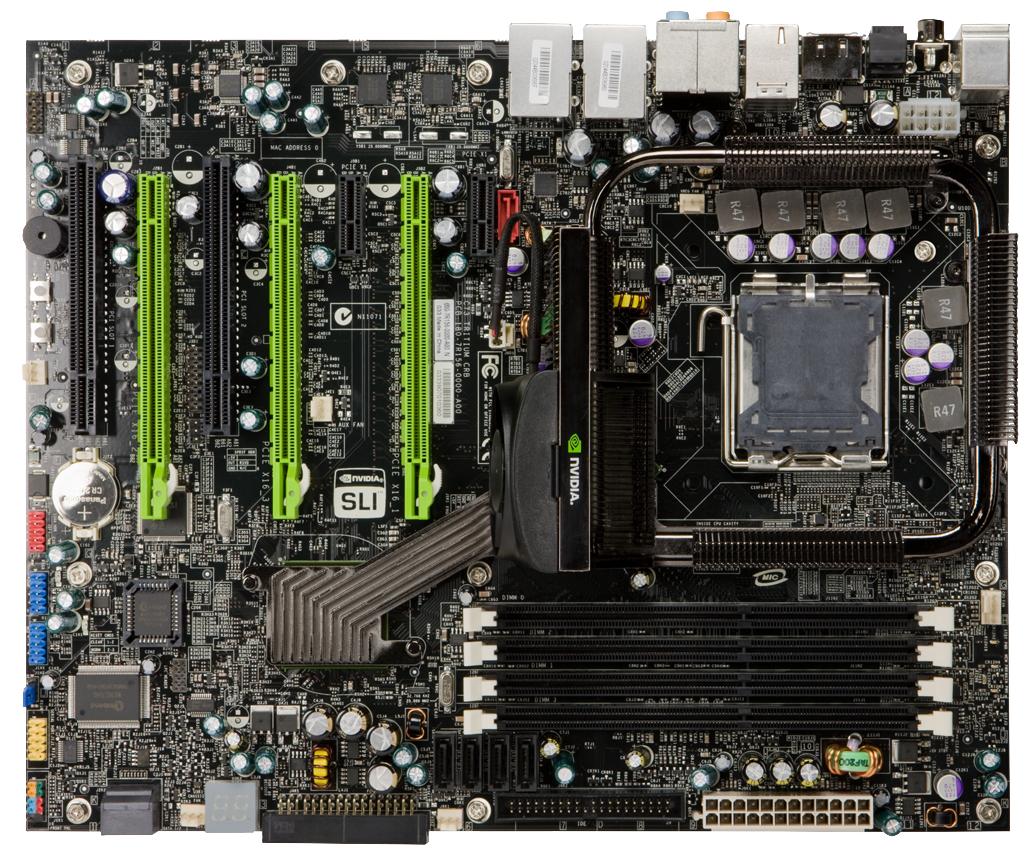 |
EVGA's NVIDIA nForce 790i Ultra SLI motherboard is vaguely reminiscent of their 780i-based product. The first thing you may notice is the size and location of the chipset cooler. Because the 790i SLI SPP now includes native PCIe 2.0 support, the nForce 200 sub-processor included with the 780i SLI SPP is no longer present; removal of this chip provides just enough extra room to move the SPP up and out of the way of an additional PCIe x1 slot seen closest to the backplane. Unfortunately, the added PCIe slot is non-functional when all three x16 lanes are populated with cards. Although the nForce 790i MCP provides up to 60 PCIe 1.x and 2.0 lanes between the SPP and MCP, link configurations rules do not allow for anything more than the cards needed to run 3-way SLI. Those that wish to run their favorite discrete sound card may find themselves out of luck depending on how they fill their expansion slots.
Microprocessor load current profiles have changed to the point that the use of single-phase regulators is no longer a viable option. Nowadays, designing a cost-effective, thermally-sound, and efficient voltage regulator module (VRM) capable of supporting stable, high-speed CPU operations has become a challenge that can only be accomplished through the use of multi-phase converters. However, the consensus amongst most users seems to be that a greater phase count generally results in better, cleaner power delivery - a fallacy which some industry leaders, motherboard vendors, and technical marketing managers are all too willing to promote.
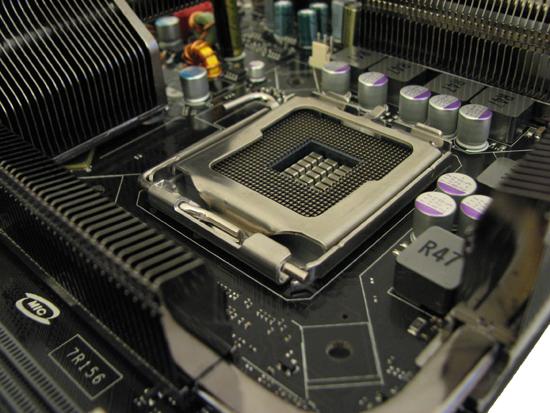
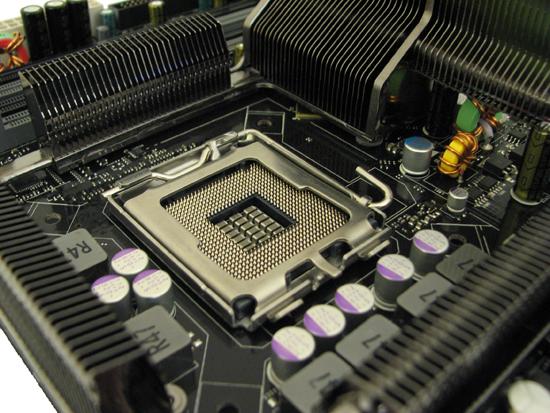
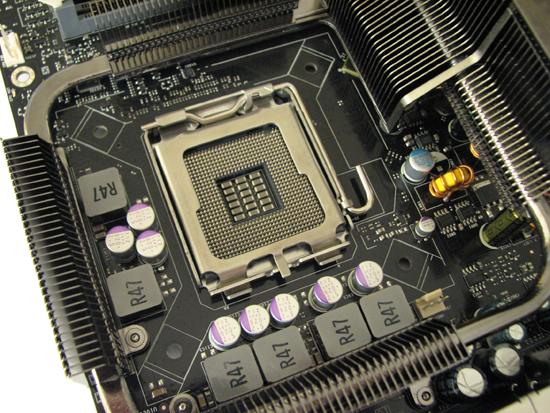
If fact, we submit to you that it's much easier (and cheaper) to slap a few more power delivery phases on a motherboard than it is to create an actual high-performance solution. The quality of a particular power delivery system is primarily dependent on the overall robustness of the design. Design considerations include proper power and ground plane placement; effective signal routing and decoupling measures; selection, location and rated capacity of correctly matched components; and the overall adherence to sound engineering principles. Because of this, the proper design and implementation of a well-developed 5-phase solution can often outperform a lesser 8-phase solution.
The EVGA 790i also uses a true 6-phase PWM controller, where many other boards may make use of 4-phase controllers designed in such a way as to appear to be native 8-phase solutions. Supply-side capacitance has been significantly increased and the main +12V input capacitance has gone way up from only 470uF to 2000uF. This helps overclocking as some cheaper PSUs have higher allowable tolerances when it comes to input current ripple. We say this knowing full well that beyond a certain point additional capacitance matters very little. Often times larger capacitors are used in order to take advantage of their lower equivalent series resistance (ESR), a specification that has a great deal to do with how quickly the capacitor can react to sudden load changes and provide current precisely when needed.
| Motherboard PWM Comparison | ||||
| Intel Spec |
780i | 790i | Notes | |
| Loadline (mohm) | 1 +/- 0.1 | 0.93 | 1.01 | Higher loadline values create more droop |
| Max Icc (A) | 125 | 165 | 220 | High current output supports higher overclocks |
| Max Overvoltage (V) | 1.6 | 1.8 | 2.0 | Higher voltages allow for extreme overclocking |
| Output Ripple (mV) | 10p-p | 9p-p | 6p-p | Less peak-to-peak ripple means "cleaner" power and more stable overclocks |
| Thermal Drift (mV) | +/- 4 | +/- 3 | +/- 2 | Tighter tolerances means that the circuit is less susceptible to variations in component temperatures |
| Phase Jitter (ns) | no spec | 390 | 180 | Less jitter means smoother, more stable power delivery |
| Efficiency | 75% | 82.4% | 83.6% | Higher efficiency allows for cooler components at higher currents and less energy used by the system |
We have listed a few of the more important PWM specifications in order to compare the differences between the 780i and 790i processor power systems. These are just a couple of the more measurable improvements made to ensure ample processor power delivery under even the most demanding situations and to help minimize the detrimental effects of supply-line switching noise and de-stabilizing output ripple. Overclocking places tremendous demands on the power delivery system and without this strong foundation, even your best efforts are sure to fail (particularly in the case of long-term overclocking).
NVIDIA also recognized the need for a more capable power subsystem cooling solution due to the tremendous current draw of 45nm CPUs experienced during aggressive overclocking. The heatpipe has been extended to encompass both sets of MOSFET banks, including an extra segment of fins used to close the circle and provide additional surface area for maximum heat dissipation. The heatsink assembly is made entirely of aluminum, except for the steel casing used to hold it together, and the included fan can be used to provide active cooling when pushing the board to its absolute limits. The fan speed can also be manually adjusted in the BIOS if you find the whine at full-speed to be a little over the top.
Originally published at https://www.anandtech.com/show/2482 (Wayback Machine).