
NVIDIA's 790i Arrives: SLI Rides Again
- Posted in
- CPUs
"PWShort" and "Broadcast" Communication Technologies
The NVIDIA nForce 790i (Ultra) SLI chipset will introduce a couple new data transfer technologies created in order to reduce some of the typical latencies experienced by GPU-to-GPU communications and generally improve bandwidth utilization whenever possible. "Posted-Write Shortcut" (PWShort) and "Broadcast" allows NVIDIA-based system with multiple GPUs to accelerate some of the standard functionality that has, in some configurations, resulted in performance bottlenecks.
Posted-Write Shortcut
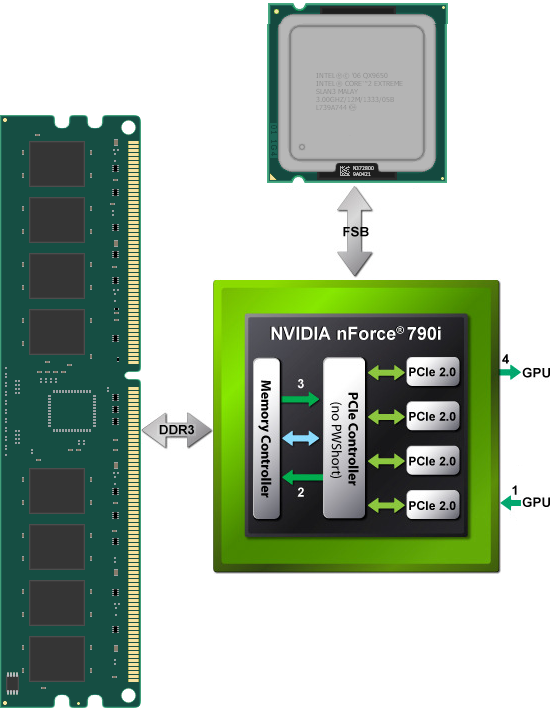
In a 2-way SLI configuration, with the cards installed in the two PCI Express 2.0 slots, the 790i SPP handles the routing of some portion of the traffic between each GPU as well as requests for access to main system memory and communications to and from the CPU. Traffic can also be relayed between cards by way of the SLI bridge. Typically, data sent from one GPU to the other would travel by way of the PCIe controller. This would forward the packet on to the memory controller where the message would be decoded, parsed, and eventually returned to the PCIe controller for final disposition. This is a somewhat inefficient use of both memory controller and PCIe controller resources, not to mention the need for a tremendous amount of additional bandwidth needed to support what should be a simple GPU-to-GPU transfer.
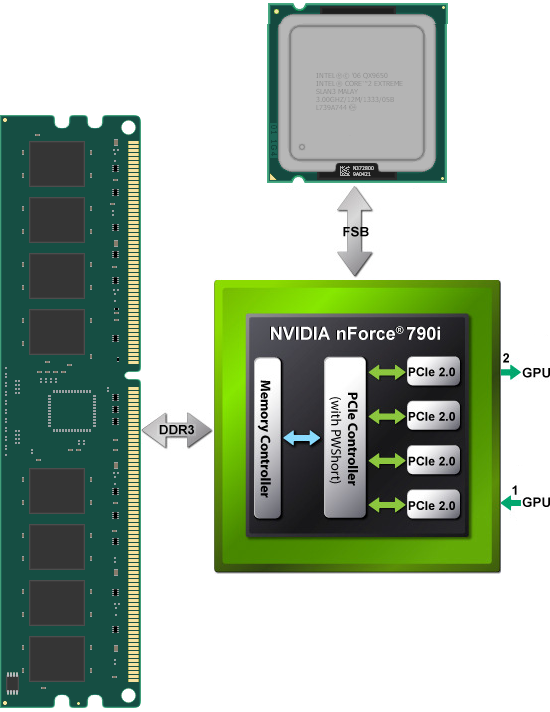
The nForce 790i SPP now includes the ability to peek inside each data packet coming from any device serviced by the chipset's PCIe controller; it can then forward the message directly to its final destination if the intended target is indeed the tandem GPU. Most of these types of communications are data transfers required to keep the two cards' frame buffers synchronized so that each GPU is always reading and modifying the most recent video information. The improved point-to-point data interface made possible by PWShort technology acts to greatly reduce the latency of these types of transfers and ensure more efficient use of the memory-to-PCIe controller link resources.
Broadcast
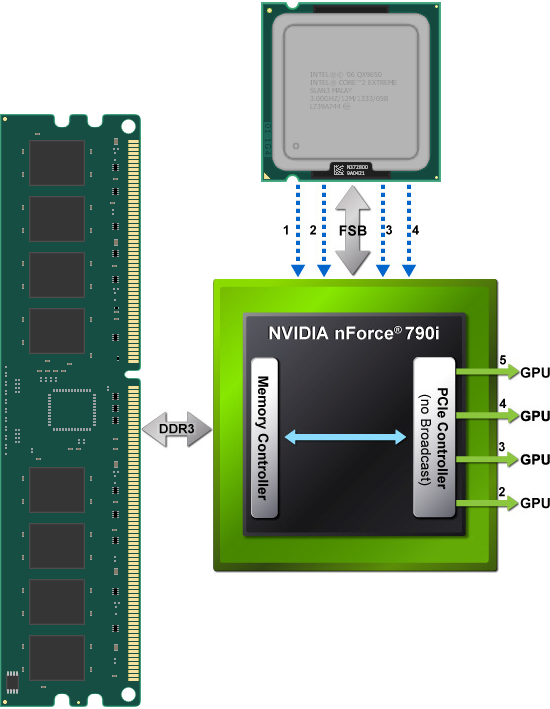
With systems containing multiple GPUs, the CPU often needs to send the same data to each GPU - for example, when texture, geometry, or other common rendering data must be transfer over the FSB, ultimately intended for receipt by all GPUs. Normally the CPU must send a separate set of data packages in order to target each GPU. This causes FSB congestion due to the increased CPU-to-GPU traffic, which could be better used for other purposes such as main memory read or write requests or cache coherency with quad-core CPUs.
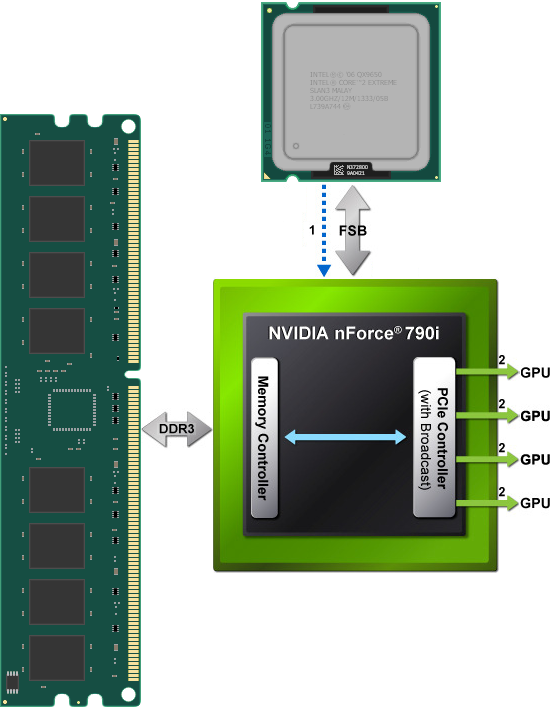
In addition to the direct link technology previously explained, Broadcast technology allows only one message to be sent by the CPU where it is then received, replicated, and broadcasted to all GPUs, eliminating the need for multiple, near-identical transfers over the FSB. This allows for more timely access to other resources that must share this common interface. We're not exactly sure how the SPP can control what the CPU does and does not send over the FSB, and it seems likely that the system drivers also have changes to accommodate this new technology; either way, there's definitely more to this than we have shared so far. We will be sure to pass along anything we learn.
790i users with single GPU systems should not see any appreciable gains due to these new technologies. In both cases, they are aimed at improving communication efficiencies associated with multi-GPU configurations. It's also difficult for us to quantify exactly what kind of impact these new features have on overall system performance. Isolating and attributing gains to either of these innovations is exceedingly difficult, since we can't just turn these features on and off at whim. While 2-way SLI stands to benefit, we can't help but think the PWShort and Broadcast technologies stand to benefit 3-way and 4-way SLI configurations even more; perhaps we will see better scaling with additional GPUs on 790i.
Originally published at https://www.anandtech.com/show/2482 (Wayback Machine).