
ASUS P5E3 Deluxe Overclocking: DDR3 Takes Front Stage
- Posted in
- CPUs
Overclocked Gaming Performance
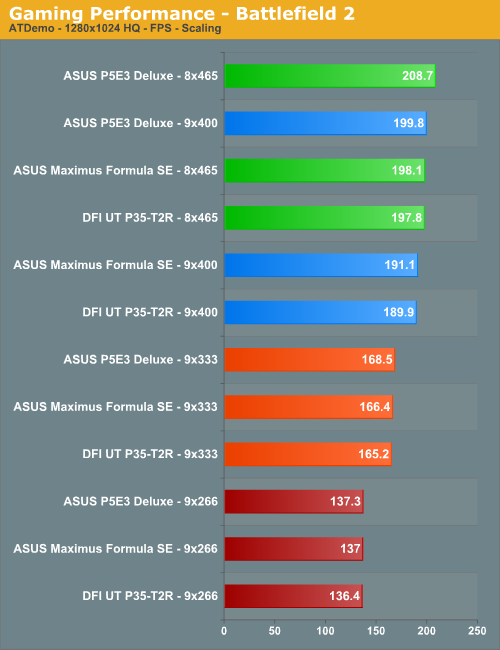
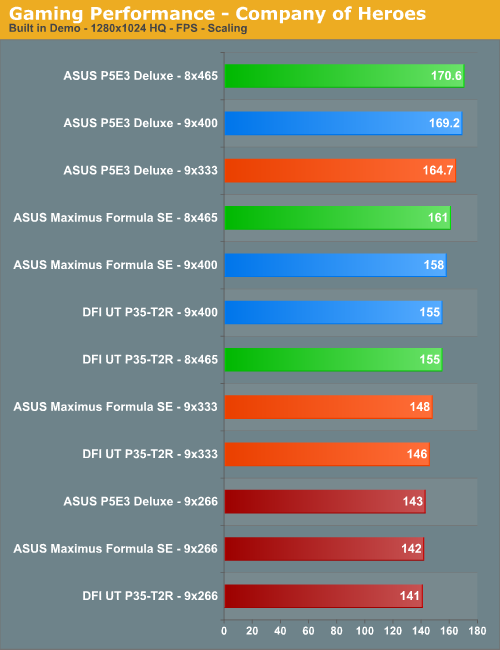
Making use of a somewhat seasoned engine, Battlefield 2 proves once again that good graphics performance isn't always just about high-end graphics cards. Benchmarking at lower FSB levels, where our DDR3 performs more like equivalently binned DDR2, we find similar performance results. However, making use of the superior 2:1 memory divider and running our DDR3 at a full 1.8GHz and higher shows it's rewards. Whereas the ASUS Maximus Formula SE and DFI UT P35-T2R linger just below the 200 FPS mark, the ASUS P5E3 Deluxe proves it has the power to push through this ceiling even while operating at a lower overall CPU speed. Somewhat like Battlefield 2, Company of Heroes shows its ability to make efficient use of the additional bandwidth provided by the ASUS P5E3 Deluxe by quickly becoming GPU limited at around 3GHz on the CPU. Once again, the DDR3 board proves the more capable gaming machine.
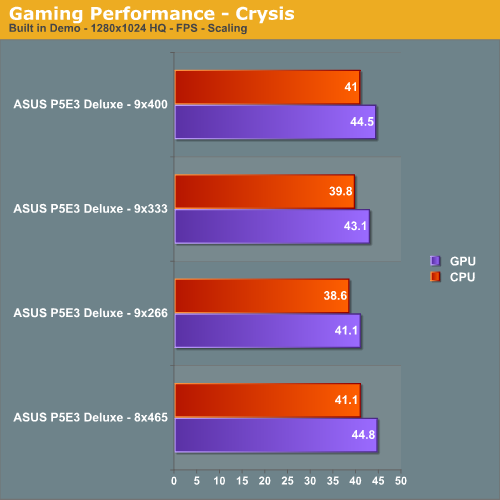
Our third and final gaming performance test involves one of the most highly anticipated releases of all time - Crysis. Until now we were hesitant to provide any benchmarking results based on this engine as our testing policy here at AnandTech generally discourages the use of beta products or pre-release software when categorizing the performance of retail products. With Crysis, the results come from the use of separate CPU and GPU benchmark scripting routines included with the game.
Our Crysis results are both good and bad, depending on how you look at them. The bad news is that our system, consisting of an Intel Q6600 at 3.6GHz (9x400), DDR3 running at DDR-1600, 6-6-6-12 timings, and a single MSI 8800GTX Ultra @ 660/1150 only managed to squeak out an average of ~44 FPS at a rather low resolution of 1280x1024. The good news, of course, is that these numbers didn't seem to change too much even when we dropped the CPU back to the stock 9x266 setting, placing our DDR3 memory squarely in DDR2 territory at DDR-1066, 4-4-4-12. This should give hope to those out there that may not have the most robust hardware available. All Crysis really wants is some serious GPU power.
Originally published at https://www.anandtech.com/show/2381 (Wayback Machine).