
ASUS P5E3 Deluxe Overclocking: DDR3 Takes Front Stage
- Posted in
- CPUs
Overclocking Performance Comparison
All results were taken running memory ratios of 2:1 for final DRAM speeds of DDR-1066 @ 4-4-4-12, DDR-1333 @ 5-5-5-12, DDR-1600 @ 6-6-6-15, and DDR-1860 @ 8-8-8-15, respectively. This way we are able to capture any performance gain possible by taking advantage of the increased memory bandwidth provided by the DDR3 memory. Obviously, the DDR2 used in the testing of the ASUS Maximum Formula SE and the DFI UT P35-T2R needed to make use of lower dividers in order to maintain memory frequency within an achievable range.
Synthetic Graphics Performance
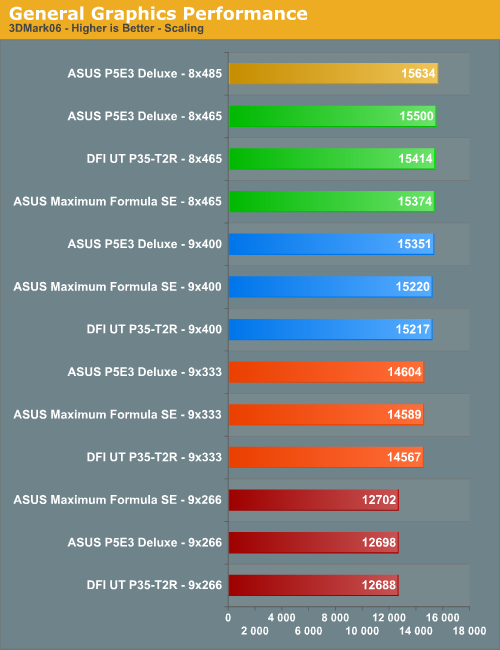
A close examination of the graphics results leads us to believe that, while nice to look at, DDR3 will do little to nothing in improving your overall gaming experience. This should come as no big surprise to anyone as we've known for a while that today's games are very much GPU dependent, especially at higher resolutions. The large performance gain in 3DMark06 seen when overclocking from 9x266 to 9x333 is a strong indication that the system was previously bottlenecked by the CPU when running at the stock 2.4GHz speed. Once we eclipse the 3GHz barrier though we start to see ever diminishing returns as we continue to push the processor higher and higher. This tells us that the system has now become GPU-bound and we can attribute any small gains in scores to the points we gain in the two CPU tests alone. Although the ASUS P5E3 Deluxe did manage to maintain a small lead across all phases of the graphics testing, the difference is hardly sizeable enough to justify the cost of DDR3, although this board will allow you to extract its full potential.
CPU Performance
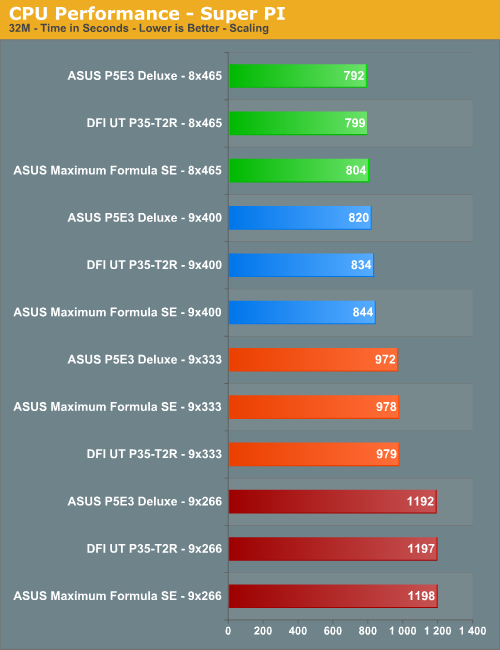
We chose Super PI for testing the CPU/memory subsystem performance. Rather than run short sub-15 second tests that didn't do much to stress the memory we opted to run the longer 32M test. Small gains of approximately 1-3% are hardly groundbreaking. Nevertheless, the ASUS P5E3 Deluxe managed to maintain the performance lead in all test runs. The largest single score improvement was achieved during the 9x400 run with the MCH performance-optimized using a Static Read Control Delay of 6. In this case, tightening the sub-timings and setting Command Rate 1N may have been enough to bring the total time down to less than 800 seconds. We will continue testing this DDR3 and report additional results later.
Rendering Performance
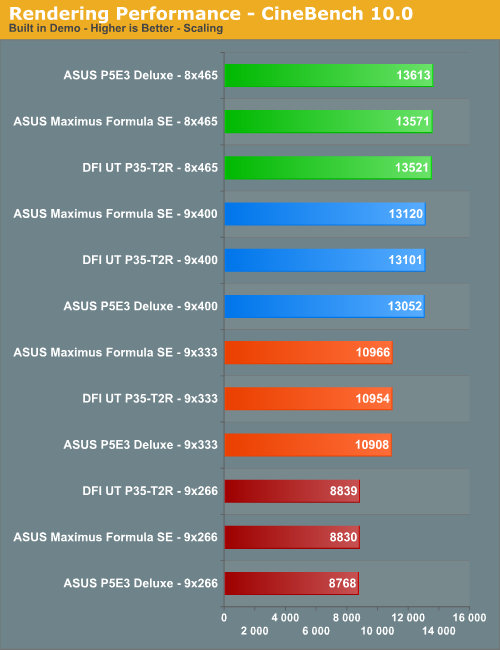
CINEBENCH R10 is a great all-out CPU performance benchmark that scales wonderfully with the number of CPU cores in the system. As such, there is little to no gain seen by running the higher memory speeds provided by our DDR3. We will include Intel 45nm quad-core results in the next article.
File Compression Performance
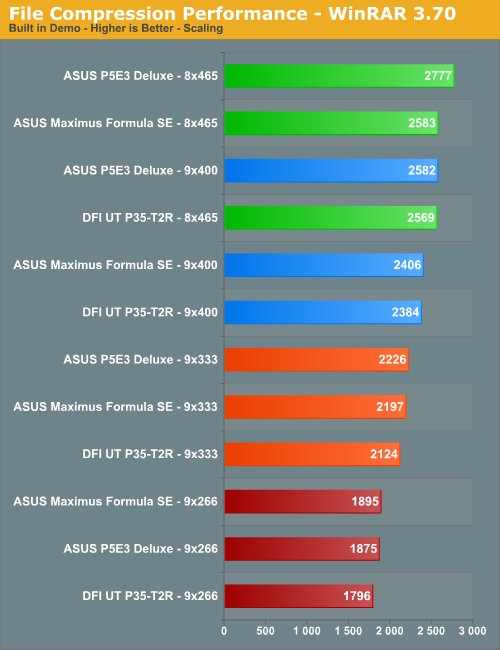
Judging by the results of the built-in file compression benchmark provided in WinRAR 3.70 there is some additional performance available by providing the CPU with additional bandwidth - this makes sense, as file compression is quite data intensive, especially considering the amount of memory flip operations performed by this program. Here we see a solid 7% performance lead by the ASUS P5E3 Deluxe when running at 8x465.
All results were taken running memory ratios of 2:1 for final DRAM speeds of DDR-1066 @ 4-4-4-12, DDR-1333 @ 5-5-5-12, DDR-1600 @ 6-6-6-15, and DDR-1860 @ 8-8-8-15, respectively. This way we are able to capture any performance gain possible by taking advantage of the increased memory bandwidth provided by the DDR3 memory. Obviously, the DDR2 used in the testing of the ASUS Maximum Formula SE and the DFI UT P35-T2R needed to make use of lower dividers in order to maintain memory frequency within an achievable range.
Synthetic Graphics Performance
A close examination of the graphics results leads us to believe that, while nice to look at, DDR3 will do little to nothing in improving your overall gaming experience. This should come as no big surprise to anyone as we've known for a while that today's games are very much GPU dependent, especially at higher resolutions. The large performance gain in 3DMark06 seen when overclocking from 9x266 to 9x333 is a strong indication that the system was previously bottlenecked by the CPU when running at the stock 2.4GHz speed. Once we eclipse the 3GHz barrier though we start to see ever diminishing returns as we continue to push the processor higher and higher. This tells us that the system has now become GPU-bound and we can attribute any small gains in scores to the points we gain in the two CPU tests alone. Although the ASUS P5E3 Deluxe did manage to maintain a small lead across all phases of the graphics testing, the difference is hardly sizeable enough to justify the cost of DDR3, although this board will allow you to extract its full potential.
CPU Performance
We chose Super PI for testing the CPU/memory subsystem performance. Rather than run short sub-15 second tests that didn't do much to stress the memory we opted to run the longer 32M test. Small gains of approximately 1-3% are hardly groundbreaking. Nevertheless, the ASUS P5E3 Deluxe managed to maintain the performance lead in all test runs. The largest single score improvement was achieved during the 9x400 run with the MCH performance-optimized using a Static Read Control Delay of 6. In this case, tightening the sub-timings and setting Command Rate 1N may have been enough to bring the total time down to less than 800 seconds. We will continue testing this DDR3 and report additional results later.
Rendering Performance
CINEBENCH R10 is a great all-out CPU performance benchmark that scales wonderfully with the number of CPU cores in the system. As such, there is little to no gain seen by running the higher memory speeds provided by our DDR3. We will include Intel 45nm quad-core results in the next article.
File Compression Performance
Judging by the results of the built-in file compression benchmark provided in WinRAR 3.70 there is some additional performance available by providing the CPU with additional bandwidth - this makes sense, as file compression is quite data intensive, especially considering the amount of memory flip operations performed by this program. Here we see a solid 7% performance lead by the ASUS P5E3 Deluxe when running at 8x465.
Originally published at https://www.anandtech.com/show/2381 (Wayback Machine).