
Digital Camera Buyers' Guide - Year of the SLR
- Posted in
- Digital Camera
Many predicted that 2007 would be the year of the digital SLR, and industry shipments confirm the huge growth in DSLR sales. In a time where home sales fell through the floor in the US and gas prices began to soar, digital SLR sales have grown dramatically. In the third quarter of this year digital camera sales increased 22% compared to the previous year, but industry breakdowns show DSLR sales almost doubled in the same period.
That means that this holiday season many of you will be looking for a new digital SLR camera to replace an aging point-and-shoot digital or an earlier DSLR. While there haven't been many new entry-level models in the last year, the $1000 "advanced amateur" models of last year are today's entry-level DSLR. Several manufacturers have also redefined "entry-level" SLR down to $400 and have very capable models selling for that price, including a lens.
Only a few new models have appeared in "Entry-level" this year. We will cover these in a look at entry-level choices. However, the last few months have seen a deluge of new "prosumer" digital SLRs aimed at the photo hobbyist, advanced amateur, and even some pro photographers on a budget. The important thing about the advanced amateur and prosumer DSLR markets is the influence those cameras will eventually have on entry-level models. For that reason, we will explore some of the most interesting features of the new prosumer models.
The digital SLR market has also seen the downward push of pro or near-pro models into the consumer space. A prime example of that is the Canon EOS 5D full-frame SLR. When it was introduced a couple of years ago it was hailed as a true bargain at around $3500. If you look around today, you will find this popular semi-pro model has dropped to a $2499 list price and you can actually find the 5D for around $2000 if you shop carefully. That is certainly close to the $1400 to $1800 prosumer price range, providing an additional option for photo hobbyists or pros looking for a good buy.
If you are shopping for a digital camera but you're not really a photo hobbyist, you might want to start with our overview of digital photography in Digital Photography from 20,000 Feet. In that introduction, we cover the terms and concepts used in this DSLR Buyers' Guide. If you're already a photo hobbyist then dive in.
To put the current DSLR market in perspective, the full-frame (24mmx36mm) sensor and the Olympus 4/3 sensor (13.5mmx18mm or half the diagonal of full-frame 35mm) represent the two ends of the current DSLR market. Full-frame DSLRs use traditional 35mm lenses, so you don't need to worry about multipliers. 4/3 is a digital-only standard supported by Olympus, Leica, Panasonic, Sigma, Fuji, and Sanyo. Lenses designed for 4/3 will work on any 4/3 camera and they are not designed to be used with larger or smaller sensors. Since the sensor diagonal is half the size of 35mm, the 4/3 lenses behave like 35mm lenses that are twice their focal length.
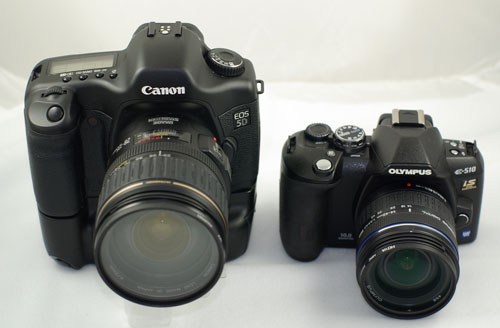
You can see these two ends in a Canon 5D with an optical image-stabilized 28-135mm lens sitting beside the diminutive Olympus E-510 with a 14-42mm lens and body-integral (mechanical) image-stabilization. The full-frame Canon 1Ds Mark III, 1D Mark III and upcoming Nikon D3 are even larger than the EOS 5D, but you get the idea. Similarly, the Olympus E-410 is even smaller than the E-510.
However, the majority of today's digital SLRs fall in between these two standards, using a very nonstandard sensor somewhere around APS-C size (22mmx15mm). This is why we have a range of lens multipliers on today's DSLR cameras, depending on brand. Nikon, Sony, Pentax, and Samsung are at 1.5x, Canon is at 1.6x, and the specialized Sigma Foveon sensor is at 1.74x. These multipliers represent how 35mm lenses will appear on these cameras - because they mainly use 35mm lenses. That means an 18-70mm lens on a 1.5x camera would appear like a 27mm-105mm lens on a 35mm film camera. There are also dedicated lenses for these in-between sensors with names like DX. They work fine on the digital SLR, but they are not usable on full-frame DSLR or 35mm film cameras.
It isn't as complicated as it sounds, since you mainly will pick your camera brand and stick with it, buying camera maker lenses or those compatible with the DSLR you choose. However, understanding the larger picture also helps in making informed long-term buying decisions.
Originally published at https://www.anandtech.com/show/2384 (Wayback Machine).