
Intel "Harpertown" Xeon vs. AMD "Barcelona" Opteron
- Posted in
- IT Computing
AMD Quad-Core Opteron (Barcelona)
The new quad-core Opteron from AMD is the first true (x86) quad-core processor that features one die with four cores. Barcelona is based on a 65nm fabrication process, and rumor has it late next year AMD will move to a 45nm process. More than just four cores on one die, the new quad-core Opteron features several micro-architectural changes from the previous dual-core Socket-F platform. Below are the main highlights of quad-core Opteron.
Independent Dynamic Core Technology
AMD has always been strong with their performance-per-watt numbers, and with this new technology AMD can alter the frequency of each core individually. This should allow AMD to more tightly control their power levels thus decreasing overall power consumption and lowering TCO.
AMD CoolCore Technology
This unique technology evaluates which parts of the die (cores/memory or both) are required by the application, and can cut power to unused transistor areas to reduce power consumption and lower heat generation.
SSE128
The previous generation Opteron had to use two clock cycles to execute 128-bit SSE operations. Barcelona can now execute 128-bit SSE operations in a single clock cycle.
2MB L3 Shared Cache
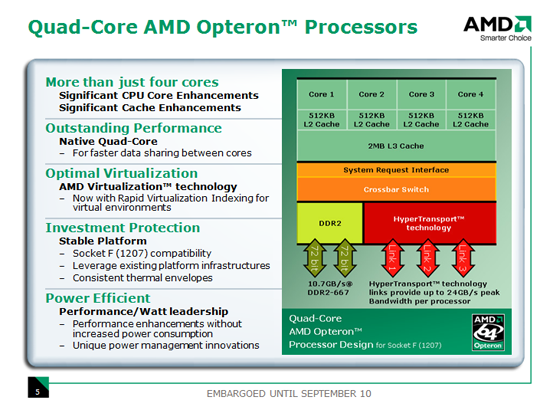
In order to keep up with multi-threaded applications, AMD added 2MB of L3 cache that all four cores share. The cache breakdown for the new Barcelona is as follows: 64KB L1 cache (64K each for data and instructions) and 512KB L2 cache per core, and then the 2MB L3 shared cache.
Drop-in to existing Socket-F
Barcelona is based on the previous generation Socket-F platform, allowing most modern Socket-F servers (with a BIOS update) to drop in a quad-core Barcelona part. We can attest to this fact, as our S3992 Tyan Board received a BIOS upgrade and was off to the races with Barcelona.
The new quad-core Opteron from AMD is the first true (x86) quad-core processor that features one die with four cores. Barcelona is based on a 65nm fabrication process, and rumor has it late next year AMD will move to a 45nm process. More than just four cores on one die, the new quad-core Opteron features several micro-architectural changes from the previous dual-core Socket-F platform. Below are the main highlights of quad-core Opteron.
Independent Dynamic Core Technology
AMD has always been strong with their performance-per-watt numbers, and with this new technology AMD can alter the frequency of each core individually. This should allow AMD to more tightly control their power levels thus decreasing overall power consumption and lowering TCO.
AMD CoolCore Technology
This unique technology evaluates which parts of the die (cores/memory or both) are required by the application, and can cut power to unused transistor areas to reduce power consumption and lower heat generation.
SSE128
The previous generation Opteron had to use two clock cycles to execute 128-bit SSE operations. Barcelona can now execute 128-bit SSE operations in a single clock cycle.
2MB L3 Shared Cache
In order to keep up with multi-threaded applications, AMD added 2MB of L3 cache that all four cores share. The cache breakdown for the new Barcelona is as follows: 64KB L1 cache (64K each for data and instructions) and 512KB L2 cache per core, and then the 2MB L3 shared cache.
Drop-in to existing Socket-F
Barcelona is based on the previous generation Socket-F platform, allowing most modern Socket-F servers (with a BIOS update) to drop in a quad-core Barcelona part. We can attest to this fact, as our S3992 Tyan Board received a BIOS upgrade and was off to the races with Barcelona.
Originally published at https://www.anandtech.com/show/2330 (Wayback Machine).