
Intel "Harpertown" Xeon vs. AMD "Barcelona" Opteron
- Posted in
- IT Computing
What's new with the Harpertown Xeon
Although Harpertown represents a "tick" (or minor update according to Intel's nomenclature), a lot has changed. Harpertown not only includes a variety of micro-architecture changes, but it also is also based on a 45nm manufacturing process. You'll notice that most of the tweaks that Intel has introduced focus on keeping the processor from going out to main memory. Below is a list of the main highlights of what's new:
45nm
The new Xeon is a 45nm part, which lowers power consumption, reduces die size (and increases transistor count), and helps Intel reach higher clock speeds. Harpertown will top off at 3.2GHz at launch, but higher clock speeds are rumored to follow. For an in-depth look at Intel's 45nm process, read the following article.
1600MHz FSB
With the new Stoakley platform, the Front Side Bus (FSB) now tops out at 1600MHz. This bus increase should help Intel fight off their bus speed bottleneck woes awhile longer until QuickPath (Intel's on-die memory controller) makes its debut.
12MB L2
Each set of two cores has a total of 6MB of L2, which brings the total L2 cache up to 12MB. Again, this will allow Intel to stay out of memory as long as possible which should increase performance.
New SSE4 Instructions
Harpertown includes Intel Streaming SIMD Extensions 4 (SSE4) instructions, the largest unique instruction set addition since the original SSE Instruction Set Architecture (ISA).
High-K Process Technology
In order to extend Moore's Law, Intel uses a new material in their transistors which is a combination of high-k gate dielectrics and metal gates. This new technology increases the switching speed of the transistors and helps reduce power consumption to allow Intel to continue to deliver faster processors that consume less power.
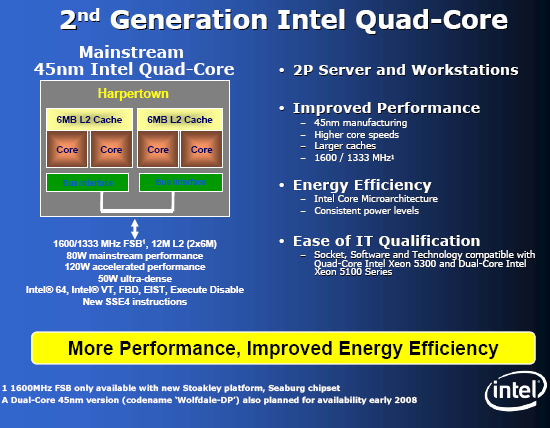
Although Harpertown represents a "tick" (or minor update according to Intel's nomenclature), a lot has changed. Harpertown not only includes a variety of micro-architecture changes, but it also is also based on a 45nm manufacturing process. You'll notice that most of the tweaks that Intel has introduced focus on keeping the processor from going out to main memory. Below is a list of the main highlights of what's new:
45nm
The new Xeon is a 45nm part, which lowers power consumption, reduces die size (and increases transistor count), and helps Intel reach higher clock speeds. Harpertown will top off at 3.2GHz at launch, but higher clock speeds are rumored to follow. For an in-depth look at Intel's 45nm process, read the following article.
1600MHz FSB
With the new Stoakley platform, the Front Side Bus (FSB) now tops out at 1600MHz. This bus increase should help Intel fight off their bus speed bottleneck woes awhile longer until QuickPath (Intel's on-die memory controller) makes its debut.
12MB L2
Each set of two cores has a total of 6MB of L2, which brings the total L2 cache up to 12MB. Again, this will allow Intel to stay out of memory as long as possible which should increase performance.
New SSE4 Instructions
Harpertown includes Intel Streaming SIMD Extensions 4 (SSE4) instructions, the largest unique instruction set addition since the original SSE Instruction Set Architecture (ISA).
High-K Process Technology
In order to extend Moore's Law, Intel uses a new material in their transistors which is a combination of high-k gate dielectrics and metal gates. This new technology increases the switching speed of the transistors and helps reduce power consumption to allow Intel to continue to deliver faster processors that consume less power.
Originally published at https://www.anandtech.com/show/2330 (Wayback Machine).