
AMD's Opteron hits 3.2GHz
- Posted in
- IT Computing
Render Servers
To get a better idea on how the different server platforms compare, we did some rendering too. Most of our tests (MySQL, DB2, and SPECjbb2005) are very integer intensive; render tests are floating point intensive. We start with a simple Cinebench 9.5 benchmark (on Windows 2003 32-bit), which is based on Maxon's Cinema 4D rendering engine.
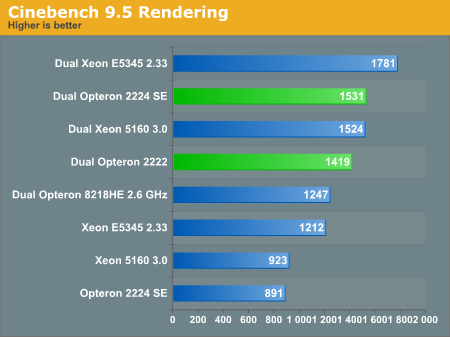
Cinebench runs almost perfectly within the caches of all CPUs. The Opteron 2224 does pretty well thanks to its strong x87 FPU. As we have noted before, the Opteron scales slightly better than its Intel Competitor. This gets even clearer when you look at the performance of one core. One Opteron 3.2GHz core scores 472 and gets 3.24 times faster when you quadruple the number of cores. One Intel core at 3GHz scores 499 and gets 3.05 times faster with 4 cores. We admit we are nitpicking, but it is interesting nevertheless.
3DS Max 9
Cinebench is popular because it is an easy benchmark, 3DS Max is a very popular application. We tested with 3DS Max version 9, which has been improved to work better with multi-core systems. We used the "architecture" scene, which has been a favorite benchmarking scene for years. All tests were done with 3ds max's default scanline renderer, SSE enabled, and we rendered at HD 720p (1280x720) resolution. We measured the time it takes to render 10 frames from 20 to 29. All results are reported in seconds, lower being better.

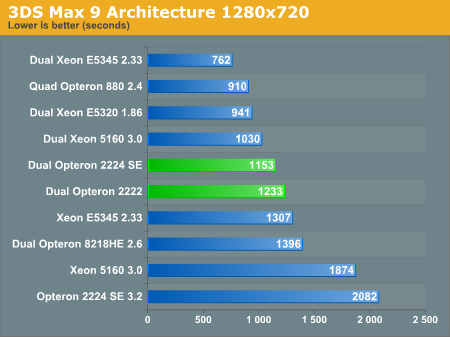
As this test has been our standard test for a while, we added a few results from previous tests. As you increase the resolution, multi-core scaling gets better. The reason is that there's a certain amount of overhead required to split a scene into multiple parts. At lower resolutions, the splitting process ends up taking a significant amount of time, so the extra cores are not fully able to stretch their legs.
To get a better idea on how the different server platforms compare, we did some rendering too. Most of our tests (MySQL, DB2, and SPECjbb2005) are very integer intensive; render tests are floating point intensive. We start with a simple Cinebench 9.5 benchmark (on Windows 2003 32-bit), which is based on Maxon's Cinema 4D rendering engine.
Cinebench runs almost perfectly within the caches of all CPUs. The Opteron 2224 does pretty well thanks to its strong x87 FPU. As we have noted before, the Opteron scales slightly better than its Intel Competitor. This gets even clearer when you look at the performance of one core. One Opteron 3.2GHz core scores 472 and gets 3.24 times faster when you quadruple the number of cores. One Intel core at 3GHz scores 499 and gets 3.05 times faster with 4 cores. We admit we are nitpicking, but it is interesting nevertheless.
3DS Max 9
Cinebench is popular because it is an easy benchmark, 3DS Max is a very popular application. We tested with 3DS Max version 9, which has been improved to work better with multi-core systems. We used the "architecture" scene, which has been a favorite benchmarking scene for years. All tests were done with 3ds max's default scanline renderer, SSE enabled, and we rendered at HD 720p (1280x720) resolution. We measured the time it takes to render 10 frames from 20 to 29. All results are reported in seconds, lower being better.
As this test has been our standard test for a while, we added a few results from previous tests. As you increase the resolution, multi-core scaling gets better. The reason is that there's a certain amount of overhead required to split a scene into multiple parts. At lower resolutions, the splitting process ends up taking a significant amount of time, so the extra cores are not fully able to stretch their legs.
Originally published at https://www.anandtech.com/show/2294 (Wayback Machine).