
AMD's Opteron hits 3.2GHz
- Posted in
- IT Computing
MySQL Configuration
To get an idea what a typical SLES 10 user will experience, we simply used the MySQL version which is supported by the latest SLES 10 SP1, i.e. MySQL 5.0.26. Unfortunately, this means that we see the typically bad scaling. Therefore we focus on the single CPU, dual core results. It doesn't make sense to use a quad Xeon 5345 here: more than two CPUs give negative scaling as we have reported before. The 2.33GHz Xeon 5345 scored between 700 and 750 queries per second as a result of this. For those who are surprised by this: notice that Intel's own benchmarks use four parallel runs of the Sysbench MySQL benchmark to get higher scores out of MySQL. All testing was done with InnoDB as our storage engine in MySQL 5.0.26. Here is our MySQL configuration:
The "query cache" was off, as we wanted to test worst case performance. Our test database is still the same 1GB database. The workload consists of more than 90% selects, mostly a "read intensive" workload. All numbers are expressed in queries per second (Y-axis), and the X-axis shows the number of concurrent accesses.
MySQL results
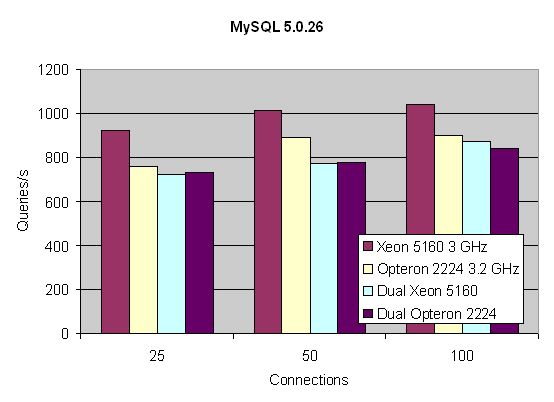
The Xeon 5160 keeps a 10-14% lead on the Opteron 2224. Our time was limited, and you'll see other versions of MySQL pop up in later reviews. The first results seem to indicate that the difference between the Opteron and Xeon gets smaller.
To get an idea what a typical SLES 10 user will experience, we simply used the MySQL version which is supported by the latest SLES 10 SP1, i.e. MySQL 5.0.26. Unfortunately, this means that we see the typically bad scaling. Therefore we focus on the single CPU, dual core results. It doesn't make sense to use a quad Xeon 5345 here: more than two CPUs give negative scaling as we have reported before. The 2.33GHz Xeon 5345 scored between 700 and 750 queries per second as a result of this. For those who are surprised by this: notice that Intel's own benchmarks use four parallel runs of the Sysbench MySQL benchmark to get higher scores out of MySQL. All testing was done with InnoDB as our storage engine in MySQL 5.0.26. Here is our MySQL configuration:
| MySQL Configuration | |
| default-storage-engine | InnoDB |
| skip-external-locking | |
| skip-locking | |
| key_buffer | 256M |
| . | |
| table_cache | 64 |
| max_allowed_packet | 1M |
| thread_stack | 128K |
| . | |
| sort_buffer_size | 2M |
| read_buffer_size | 2M |
| innodb_buffer_pool_size | 1G |
| . | |
| thread_concurrency | 16 |
| innodb_thread_concurrency | 16 |
| innodb_additional_mem_pool_size | 8MB |
| read_rnd_buffer_size | 8MB |
| thread_cache | 64 |
| max_heap_table | 256MB |
| tmp_table | 128MB |
| . | |
| innodb_log_file_size | 250MB |
| innodb_table_locks | 0 |
| innodb_flush_log_at_trx_commit | 0 |
| max_user_connections | 2000 |
| max_connections | 2000 |
The "query cache" was off, as we wanted to test worst case performance. Our test database is still the same 1GB database. The workload consists of more than 90% selects, mostly a "read intensive" workload. All numbers are expressed in queries per second (Y-axis), and the X-axis shows the number of concurrent accesses.
MySQL results
The Xeon 5160 keeps a 10-14% lead on the Opteron 2224. Our time was limited, and you'll see other versions of MySQL pop up in later reviews. The first results seem to indicate that the difference between the Opteron and Xeon gets smaller.
Originally published at https://www.anandtech.com/show/2294 (Wayback Machine).