
AMD's Opteron hits 3.2GHz
- Posted in
- IT Computing
SPECjbb2005
SPECjbb2005 from SPEC (Standard Performance Evaluation Corporation) evaluates the performance of server side Java by emulating a three-tier client/server system with emphasis on the middle tier. Instead of testing with a possible disk intensive database system, SPECjbb uses tables of objects, implemented by Java Collections, rather than a separate database. A longer description can be found here.
Again, it is not our objective to show the best possible scores. Very few people will take the time to fully tune the JVM and take the risk that some of the ultra aggressive optimizations backfire. So we tested with some decent but rather generic tuning that we could use on all systems. The JVM is Sun's version 1.5.0_08, which allows us to compare scores with previous results.
We tested SPECjbb2005 with four application instances. Using NUMActl, a clever utility written by Andi Kleen, we were able to bind each Java application to each node on our Tyan server. We didn't bind instances to CPUs on the Intel platforms (though it is possible with taskset) as it gives worse performance. The parameters in bold show the actual JVM optimizations.
On the Opteron we used:
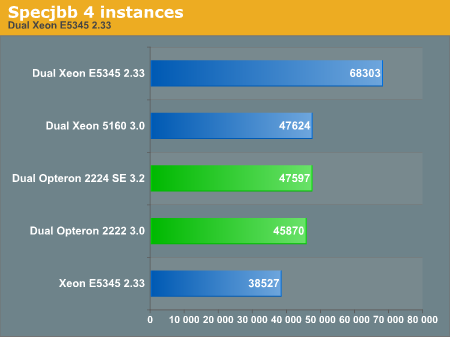
The impact of binding each instance to a specific node is less dramatic as what we have seen before, but still, the Opteron scored only 42254 without the use of numactl. The Opterons are in a neck-and-neck race with the dual core Intel's. As this kind of transactional Java application depends quite a bit on the memory interface, the slightly lower integer power of the Opteron is hidden by its faster access to the memory. Nevertheless, it is the Xeon E5345 which wins this race as the use of 4 instances allows the Xeon 53xx to scale well.
SPECjbb2005 from SPEC (Standard Performance Evaluation Corporation) evaluates the performance of server side Java by emulating a three-tier client/server system with emphasis on the middle tier. Instead of testing with a possible disk intensive database system, SPECjbb uses tables of objects, implemented by Java Collections, rather than a separate database. A longer description can be found here.
Again, it is not our objective to show the best possible scores. Very few people will take the time to fully tune the JVM and take the risk that some of the ultra aggressive optimizations backfire. So we tested with some decent but rather generic tuning that we could use on all systems. The JVM is Sun's version 1.5.0_08, which allows us to compare scores with previous results.
We tested SPECjbb2005 with four application instances. Using NUMActl, a clever utility written by Andi Kleen, we were able to bind each Java application to each node on our Tyan server. We didn't bind instances to CPUs on the Intel platforms (though it is possible with taskset) as it gives worse performance. The parameters in bold show the actual JVM optimizations.
On the Opteron we used:
numactl --cpunodebind=$node --membind=$node -- java -cp jbb.jar:check.jar -Xms2g -Xmx2g -Xmn1g -Xss128K -XX:+AggressiveOpts -XX:+UseParallelOldGC -XX:+UseParallelGC spec.jbb.JBBmain -propfile SPECjbb.props -id $xjava -classpath jbb.jar:check.jar -Xms2g -Xmx2g -Xmn1g -Xss128K -XX:+AggressiveOpts -XX:+UseParallelOldGC -XX:+UseParallelGC spec.jbb.JBBmain -propfile SPECjbb.props -id $xThe impact of binding each instance to a specific node is less dramatic as what we have seen before, but still, the Opteron scored only 42254 without the use of numactl. The Opterons are in a neck-and-neck race with the dual core Intel's. As this kind of transactional Java application depends quite a bit on the memory interface, the slightly lower integer power of the Opteron is hidden by its faster access to the memory. Nevertheless, it is the Xeon E5345 which wins this race as the use of 4 instances allows the Xeon 53xx to scale well.
Originally published at https://www.anandtech.com/show/2294 (Wayback Machine).