
AMD's Opteron hits 3.2GHz
- Posted in
- IT Computing
Software Rendering
Some of you might remember the "Kribi" engine, an ultra-powerful real-time software rendering 3D engine. It seems like madness to invest time in a software 3D engine now that the GeForce 8800 has 128 small FPUs working at 1.35GHz, but software rendering is far from dead. The new Intel Core architecture can perform up to four 64-bit FP (3 sustained) instructions per clock cycle, and now we have cheap quad cores at 2.4GHz. That is a lot of FP power too, if you carefully optimize for it. That is exactly what the people of zVisuel in Lausanne, Switzerland have been doing. There are quite a few advantages for using software rendering. For example, the end result looks the same on every PC and it runs (although potentially faster or slower depending on hardware) on every PC. That is a big advantage for companies where many people use portables.
If you are still not convinced that real-time software rendering can offer great results, take a look at this movie.
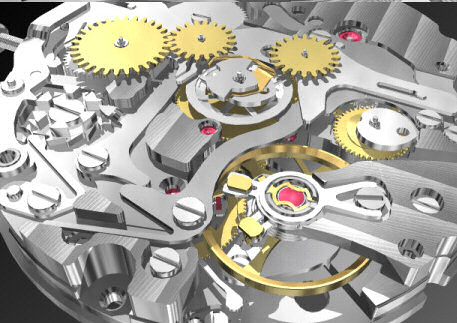
An example what the zVisuel Kribi 3D Engine can create
Eric Bron provided us with a benchmark which is based on real world use by zVisuel's clients. The first benchmark does not use antialiasing.
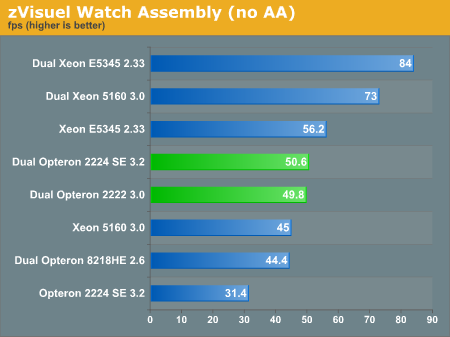
As we explained here, the new Core architecture has theoretically twice the SSE2 power of the Athlon X2. Extremely carefully optimized SSE2 applications such as the 3D engine of zVisuel show that this leads to a 70% IPC advantage in practice. This shows very nicely why AMD needs the new K10 family: in this case the Athlon 64 architecture is starting to show its age.
We performed the same benchmark, but now antialiasing was applied.
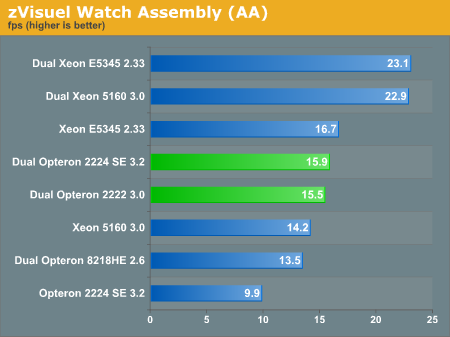
AA clearly makes the application more memory intensive. The two quad core Xeons are only 38% faster than one CPU, while they were 50% faster in the previous benchmark. This helps the Opteron to make the gap a little smaller: the Xeon 3GHz is 48% faster clock for clock, instead of 70%.
Some of you might remember the "Kribi" engine, an ultra-powerful real-time software rendering 3D engine. It seems like madness to invest time in a software 3D engine now that the GeForce 8800 has 128 small FPUs working at 1.35GHz, but software rendering is far from dead. The new Intel Core architecture can perform up to four 64-bit FP (3 sustained) instructions per clock cycle, and now we have cheap quad cores at 2.4GHz. That is a lot of FP power too, if you carefully optimize for it. That is exactly what the people of zVisuel in Lausanne, Switzerland have been doing. There are quite a few advantages for using software rendering. For example, the end result looks the same on every PC and it runs (although potentially faster or slower depending on hardware) on every PC. That is a big advantage for companies where many people use portables.
If you are still not convinced that real-time software rendering can offer great results, take a look at this movie.
An example what the zVisuel Kribi 3D Engine can create
Eric Bron provided us with a benchmark which is based on real world use by zVisuel's clients. The first benchmark does not use antialiasing.
As we explained here, the new Core architecture has theoretically twice the SSE2 power of the Athlon X2. Extremely carefully optimized SSE2 applications such as the 3D engine of zVisuel show that this leads to a 70% IPC advantage in practice. This shows very nicely why AMD needs the new K10 family: in this case the Athlon 64 architecture is starting to show its age.
We performed the same benchmark, but now antialiasing was applied.
AA clearly makes the application more memory intensive. The two quad core Xeons are only 38% faster than one CPU, while they were 50% faster in the previous benchmark. This helps the Opteron to make the gap a little smaller: the Xeon 3GHz is 48% faster clock for clock, instead of 70%.
Originally published at https://www.anandtech.com/show/2294 (Wayback Machine).