
AMD's Next-Generation Mobile Architecture Revealed: Griffin
- Posted in
- CPUs
Platform
Just like Intel bundles its mobile CPUs and chipsets as platforms, AMD is doing the same with Griffin. Puma is the name of Griffin's launch platform, but unlike Intel's approach the platform only consists of a Griffin CPU and an AMD chipset; wireless networking is provided by any number of third party vendors. The CPU we already know about, but the chipset is AMD's upcoming RS780.
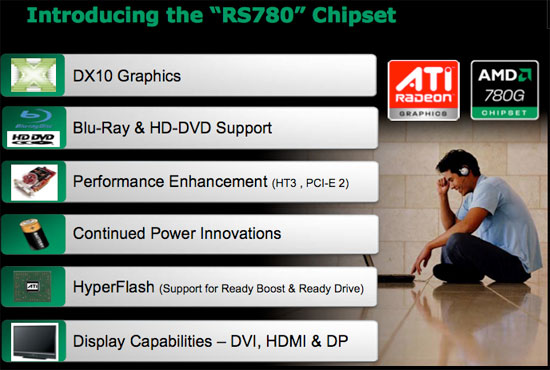
The chipset supports Hyper Transport 3 (obviously), PCI Express 2.0 (faster link speeds/higher bandwidth) and AMD's answer to Intel's Turbo Memory, Hyper Flash.
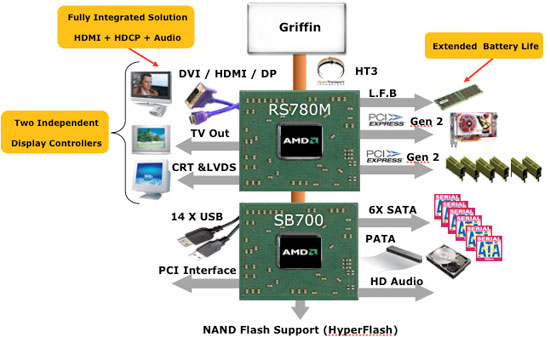
The RS780 features an integrated graphics core based on the R600 architecture, however AMD would not provide us any details at this point in time other the following two points. The integrated GPU will feature H.264 decode acceleration, which we're assuming is the same full pipeline UVD from the desktop R600.
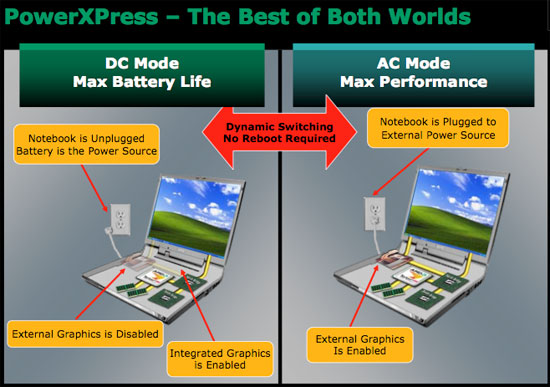
Even more interesting is the platform's support for a feature called PowerXPress. The idea is that all Puma notebooks will have integrated graphics, but they can also have optional discrete graphics for better gaming performance. AMD is confident that its integrated graphics will be lower power than any discrete graphics solution, so when you're running on battery power the external graphics core would be disabled and your display would run off of the integrated GPU. On AC power, in the max performance mode, the internal graphics gets disabled and the external GPU is operational.
According to AMD, this switchover happens seamlessly; there's no reboot required and there should be hardly any interruption in use. We have yet to see it in action and are understandably skeptical of how smooth the transition between GPUs would be, but AMD claims that it works and very well at that. AMD also mentioned that this functionality could be overridden by a control panel if need be.
Griffin will use the same S1 CPU socket as current Turion CPUs, however the pinout will be different meaning that these new chips won't be backwards compatible with current Turion notebooks.
As we mentioned above, Hyper Flash will be supported by the RS780 chipset but not over the PCI Express bus. Instead, AMD is using a proprietary interface between the South Bridge and its Hyper Flash controller. According to AMD, PCI Express is not the most power efficient interface to NAND flash so it is using an alternative. AMD expects performance of Hyper Flash to be noticeably better than Intel's Turbo Memory, but without numbers to put to that claim we can't think much of it (it's rare that a manufacturer makes claims about how slow its technology is going to be).
Originally published at https://www.anandtech.com/show/2235 (Wayback Machine).