
AMD's Next-Generation Mobile Architecture Revealed: Griffin
- Posted in
- CPUs
Final Words
AMD itself stated that it sees the future of microprocessor design as taking two approaches: one for performance and scalability, largely dictated by the server market, and one coming out of the mobile space; the desktop CPUs would scale up and down from the two design points.
We all know very well that the K8 was designed for performance and scalability, so is a new north bridge, memory controller and better power management enough to make it a mobile core? Or would Griffin have benefited from a truly ground up design, similar to what Intel did when it revamped the P6 core? It's tough to say how much more efficiency could be extracted from the K8 if AMD tried.
That being said, there are some impressive improvements to the chip that should yield significant power savings. The revised memory controller and HT interface from Barcelona are welcome additions, but the support for independent voltages per CPU core is particularly impressive.
Platform features like PowerXPress sound gimmicky today but could be significant if well implemented; unfortunately it looks like we've got at least a year to wait before we find out for sure.
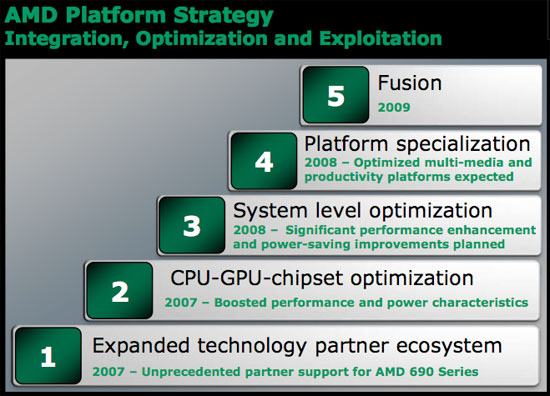
As a side note, you may remember that AMD seemed particularly cautious about sharing too much about its plans for Barcelona/Phenom. AMD stated that it didn't want to clue Intel in on what it had up its proverbial sleeve. However, with Griffin not scheduled for release as late as the middle of 2008, we can't help but wonder if all arms of AMD believe the same things, or if AMD is simply giving us excuses for why we don't get more information today.
At least we know what's coming, and Griffin/Puma look to be AMD's best attempt at mobile computing yet. Whether or not it will be enough to dent Centrino is another matter entirely.
Originally published at https://www.anandtech.com/show/2235 (Wayback Machine).