
AMD's Next-Generation Mobile Architecture Revealed: Griffin
- Posted in
- CPUs
Mobile Specific HT3
Much like Phenom, Griffin will support HyperTransport 3, offering more bandwidth between the CPU and the outside world. A major change to Griffin's HT interface however is that it is highly power optimized.
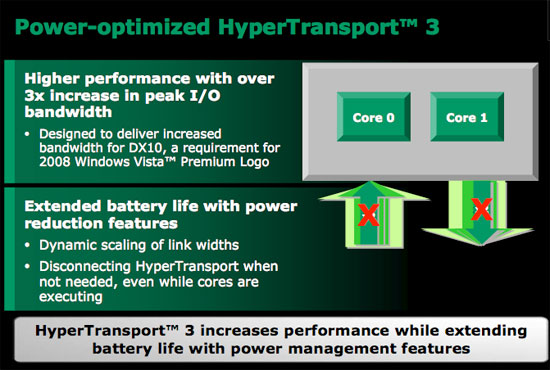
By default, a Griffin CPU has two x16 HT3.0 links (one inbound and one outbound); depending on power and bandwidth requirements, those links can be dynamically scaled down to x8, x4, x2 or completely turned off. The inbound and outbound lanes can dynamically change independent of one another (e.g. inbound could be scaled to x8 while the outbound could be turned off). Each link width change requires a HT disconnect, meaning it can't be done as frequently as a CPU frequency change, but the power savings should be substantial.
Better Thermal Control
Griffin adds better thermal control than its predecessor. The mobile K8 cores simply had a single on-die analog thermal diode that would report CPU temperature, while Griffin features two thermal sensors per core for more accurate thermal monitoring.
The current generation Turion CPUs communicate processor thermal data over the SMBUS, however an external thermal monitoring circuit is used requiring additional board real estate. Griffin supports an integrated SMBUS interface directly to the chipset, so there's no extra chip required.
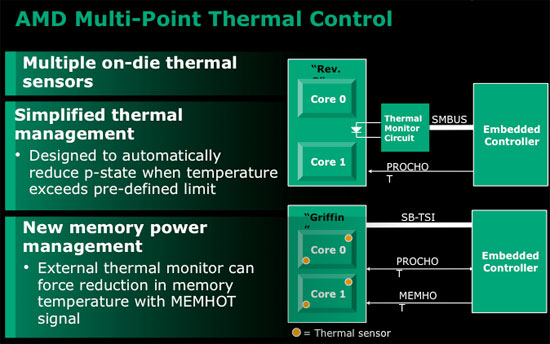
Griffin also allows monitoring of DRAM temperature (through an external temperature sensor placed near the DRAM modules) and based on pre-configured thermal limits, it can now throttle memory frequency if the modules get too hot.
Originally published at https://www.anandtech.com/show/2235 (Wayback Machine).