
Hitachi Deskstar 7K1000 in RAID 0: Is Two Terabytes really better than One?
- Posted in
- Storage
iPeak Business Application Tests
Our iPeak Winstone benchmarks offer a glimpse into how well our hard disk drives will handle general office applications, media encoding, and graphics manipulation. While the business applications that are being tested tend to be more CPU bound at times, the performance of the hard drive can and will make a difference in the more disk intensive video and graphics applications where large media files are typically being edited.
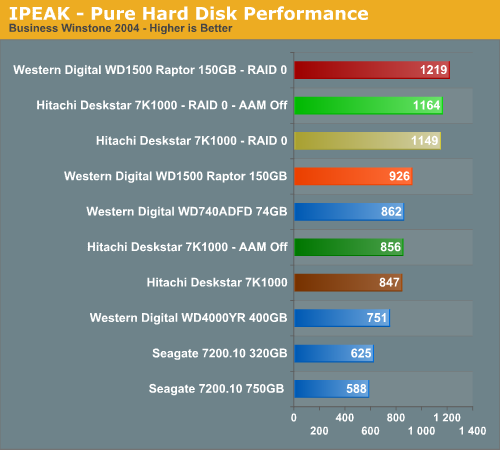
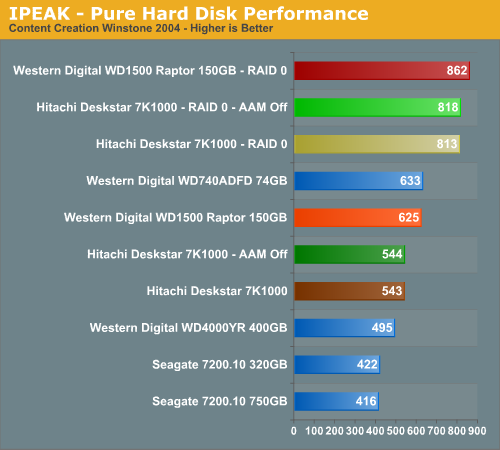
As expected the WD1500 Raptor drives finish at the top in our business application tests as its 10k RPM spindle speed and optimized cache play an important role in its ability to sustain high transfer rates, especially in the Content Creation benchmark where transfer block sizes are significantly larger and more random than in the Business application benchmark. This is true with either a single drive or RAID 0 setup although we see the 7K1000 trailing the WD1500 by less the 5% in these tests. While RAID 0 has the theoretical capability to improve throughput by up to 100% before system overhead, we only see a 31% to 35% improvements in these pure hard disk benchmarks.
iPeak General Task Tests
The iPeak based General Task benchmarks are designed to replicate utility based application tasks that typically are disk intensive and represent common programs utilized on the majority of personal computers. While the WinRAR program is very CPU intensive it will typically stress the storage system in short bursts. Our antivirus benchmark will stress the storage system with continual reads and sporadic write requests while the defragmentation process is split between continual read and write requests.
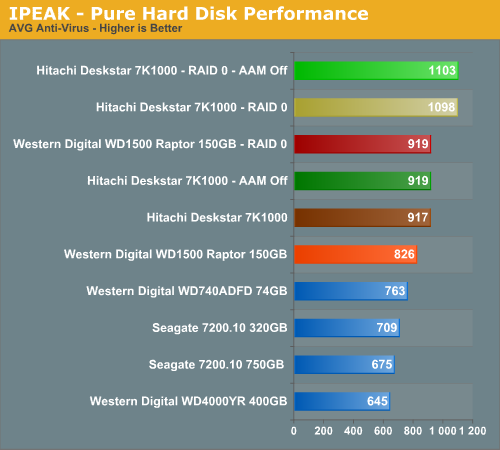
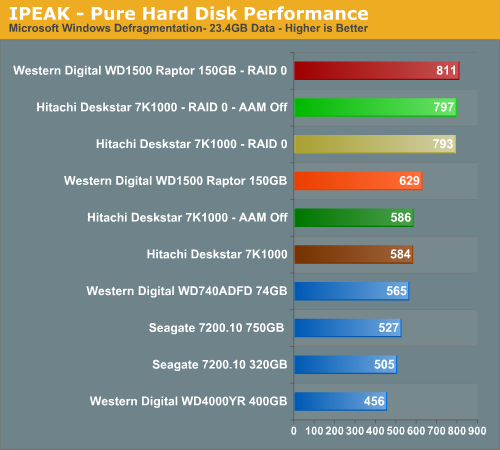
The 7K1000 performs extremely well in the Anti-Virus and Defragmentation test where its 32 MB cache benefits read operations with results that mirror the PCMark 2005 tests. This holds true with the RAID 0 configuration although we only see a 20% improvement in the AVG test results. Also of interest is that in the AVG test we see the Raptor RAID 0 setup score the same as the single drive 7K1000 configuration.
The Raptor holds a small advantage in the Windows defragmentation test in both the RAID 0 and single drive results. The rotational speed of the Raptors just cannot be beat in this test, but the 7K1000s score extremely well due to their cache size.
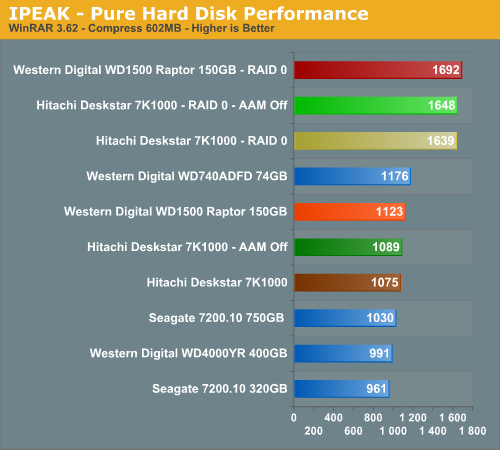
This is especially true in the WinRAR tests where the rotational and access speeds of the Raptors outperformed the 7K1000 setups in both configurations. In this test, write speeds are very important and we see the RAID 0 setups scoring around 50% better, though we expected better performance based upon the PCMark05 results. However, keep these pure performance results in mind as they will not be repeated in our actual WinRAR tests.
Our iPeak Winstone benchmarks offer a glimpse into how well our hard disk drives will handle general office applications, media encoding, and graphics manipulation. While the business applications that are being tested tend to be more CPU bound at times, the performance of the hard drive can and will make a difference in the more disk intensive video and graphics applications where large media files are typically being edited.
As expected the WD1500 Raptor drives finish at the top in our business application tests as its 10k RPM spindle speed and optimized cache play an important role in its ability to sustain high transfer rates, especially in the Content Creation benchmark where transfer block sizes are significantly larger and more random than in the Business application benchmark. This is true with either a single drive or RAID 0 setup although we see the 7K1000 trailing the WD1500 by less the 5% in these tests. While RAID 0 has the theoretical capability to improve throughput by up to 100% before system overhead, we only see a 31% to 35% improvements in these pure hard disk benchmarks.
iPeak General Task Tests
The iPeak based General Task benchmarks are designed to replicate utility based application tasks that typically are disk intensive and represent common programs utilized on the majority of personal computers. While the WinRAR program is very CPU intensive it will typically stress the storage system in short bursts. Our antivirus benchmark will stress the storage system with continual reads and sporadic write requests while the defragmentation process is split between continual read and write requests.
The 7K1000 performs extremely well in the Anti-Virus and Defragmentation test where its 32 MB cache benefits read operations with results that mirror the PCMark 2005 tests. This holds true with the RAID 0 configuration although we only see a 20% improvement in the AVG test results. Also of interest is that in the AVG test we see the Raptor RAID 0 setup score the same as the single drive 7K1000 configuration.
The Raptor holds a small advantage in the Windows defragmentation test in both the RAID 0 and single drive results. The rotational speed of the Raptors just cannot be beat in this test, but the 7K1000s score extremely well due to their cache size.
This is especially true in the WinRAR tests where the rotational and access speeds of the Raptors outperformed the 7K1000 setups in both configurations. In this test, write speeds are very important and we see the RAID 0 setups scoring around 50% better, though we expected better performance based upon the PCMark05 results. However, keep these pure performance results in mind as they will not be repeated in our actual WinRAR tests.
Originally published at https://www.anandtech.com/show/2212 (Wayback Machine).