
EVGA nForce 650i Ultra: Performance on a Budget
- Posted in
- Motherboards
EVGA 650i Ultra Basic Features
The EVGA BIOS offers a decent set of options available for tweaking the board with specific emphasis placed on the available memory settings. However, with memory voltages limited to 2.10V we found it difficult to take advantage of the memory options with a vast majority of our modules. Only our high end modules from OCZ, Corsair, and Patriot were able to operate at 1T command rates with absolute stability. We found in memory testing that switching to manual settings and changing the tCAS, tRCD, tRP, tRAS, and command rate was required to ensure optimum performance.
While we understand NVIDIA's reluctance to open up the BIOS options on a board designed for the budget market we do think they made a mistake in this area. Our performance results generated by the board would indicate that a couple of additional voltage options, improved electricals, and an increase to 2.20V for the memory would have transformed this board from very good to exceptional status in the sub-$100 market.
EVGA offers full support for NVIDIA's nTune system utility and we only had a couple of minor problems with it during testing. You need to use the PCI-E slider to change the SPP voltage while the ability to change the FSB voltage is not available. Otherwise, the utility is one of the better vendor supplied programs available, although it's not quite as polished as the uGuru technology from abit.
| EVGA nForce 650i Ultra | |
| Market Segment: | Budget Performance - $99 |
| CPU Interface: | Socket T (Socket 775) |
| CPU Support: | LGA775-based Pentium 4, Celeron D, Pentium D, Pentium EE, Core 2 Duo, Core 2 Extreme |
| Chipset: | NVIDIA 650i Ultra SPP (C55) + nF430 MCP (MCP51) |
| Bus Speeds: | Auto, 400 to 2500 QDR (100~625) in 1MHz increments |
| Memory Ratios: | Auto, Sync., 1:1, 5:4, 3:2 |
| Memory Speed: | 400MHz~1400MHz in various increments |
| PCI Express: | 100MHz~200MHz in 1MHz Increments |
| LDT Frequency: | 1x, 2x, 3x, 4x, 5x |
| Core Voltage: | Auto, 0.80000V to 1.60000 in 0.00625V increments |
| FSB Options: | Auto, Linked, Unlinked |
| CPU Clock Multiplier: | Auto, 6x-11x in 1X increments - Core 2 Duo, downwards unlocked, Core 2 Extreme 6x-50X |
| DRAM Voltage: | Auto, 1.80V to 2.10V in .10V increments |
| DRAM Timing Control: | Optimal, Manual - 10 DRAM Timing Options |
| NB Voltage: | Auto, 1.20V to 1.50V in .10V increments |
| FSB Voltage: | Auto, 1.20V to 1.40V in .10V increments |
| Memory Slots: | Four 240-pin DDR2 DIMM Slots Dual-Channel Configuration, DDR2-400, 533, 667, 800 Regular Unbuffered Memory to 8GB Total |
| Expansion Slots: | 1 - PCIe X16 (x16 electrical) 2 - PCIe x1 3 - PCI Slot 2.2 |
| Onboard SATA/RAID: | 4 SATA 3Gbps Ports - nF430 MCP (RAID 0,1, 0+1, 5, JBOD) |
| Onboard IDE: | 1 ATA133/100/66 Port (2 drives) - nF430 MCP |
| Onboard USB 2.0/IEEE-1394: | 8 USB 2.0 Ports - 4 I/O Panel - 4 via Headers Firewire 400 - not supported |
| Onboard LAN: | NVIDIA Gigabit Ethernet - PCIe - 1 x Marvell 88E1116 PHY - 1 port via 430 MCP |
| Onboard Audio: | Realtek ALC885 - 8-channel HD audio codec |
| Power Connectors: | ATX 24-pin, 8-pin EATX 12V |
| I/O Panel: | 1 x PS/2 Keyboard 1 x PS/2 Mouse 1 x Audio Panel 1 x RJ45 4 x USB 2.0/1.1 |
| BIOS Revision: | Award 731N1P01 |
| Board Revision: | ILL 1.0 |
The EVGA BIOS offers a decent set of options available for tweaking the board with specific emphasis placed on the available memory settings. However, with memory voltages limited to 2.10V we found it difficult to take advantage of the memory options with a vast majority of our modules. Only our high end modules from OCZ, Corsair, and Patriot were able to operate at 1T command rates with absolute stability. We found in memory testing that switching to manual settings and changing the tCAS, tRCD, tRP, tRAS, and command rate was required to ensure optimum performance.
While we understand NVIDIA's reluctance to open up the BIOS options on a board designed for the budget market we do think they made a mistake in this area. Our performance results generated by the board would indicate that a couple of additional voltage options, improved electricals, and an increase to 2.20V for the memory would have transformed this board from very good to exceptional status in the sub-$100 market.
 |
| Click to enlarge |
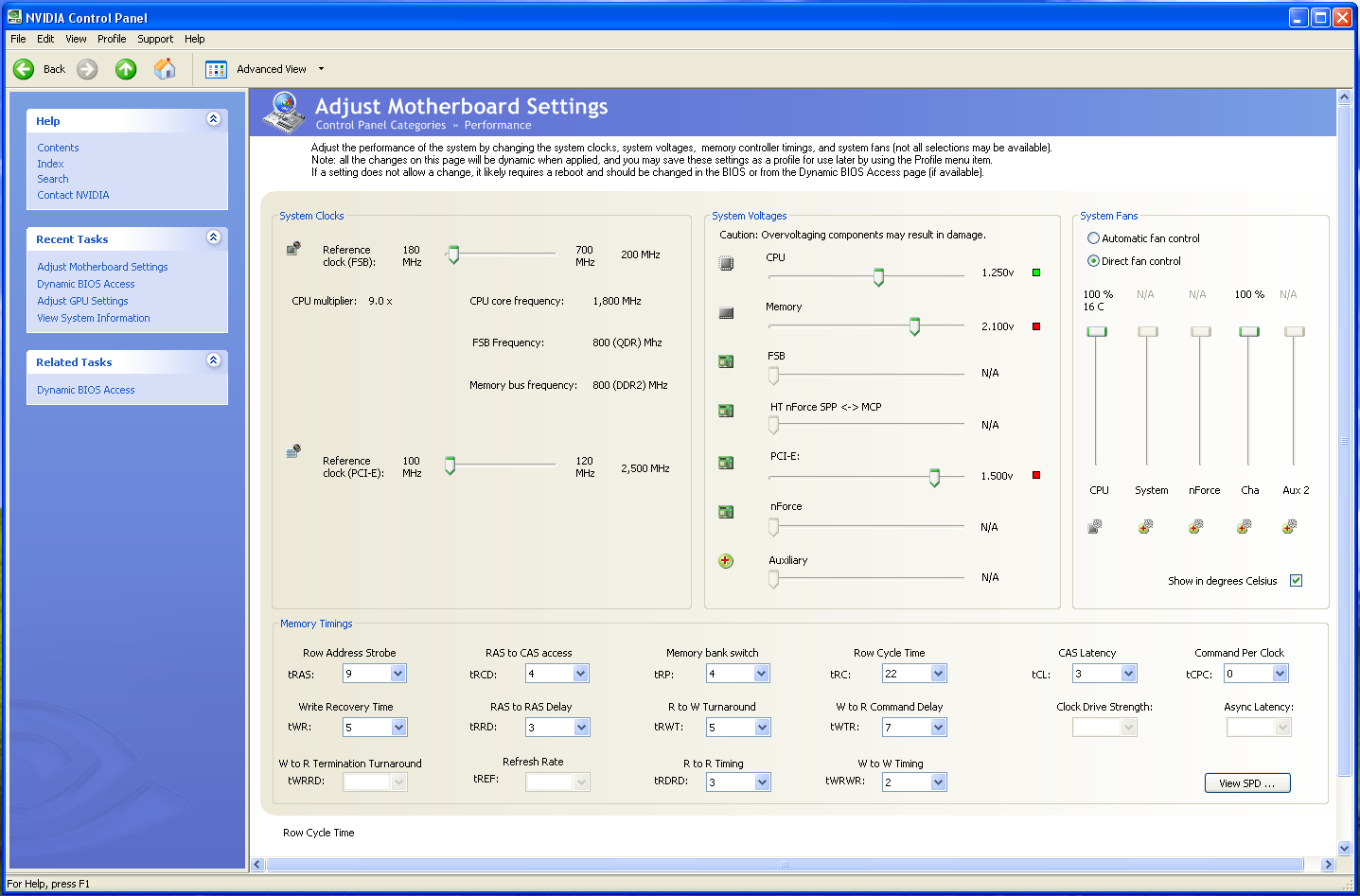
EVGA offers full support for NVIDIA's nTune system utility and we only had a couple of minor problems with it during testing. You need to use the PCI-E slider to change the SPP voltage while the ability to change the FSB voltage is not available. Otherwise, the utility is one of the better vendor supplied programs available, although it's not quite as polished as the uGuru technology from abit.
Originally published at https://www.anandtech.com/show/2207 (Wayback Machine).