
EVGA 680i LT SLI: NVIDIA's 680i Cost Reduced
- Posted in
- CPUs
Overclocking - E6300
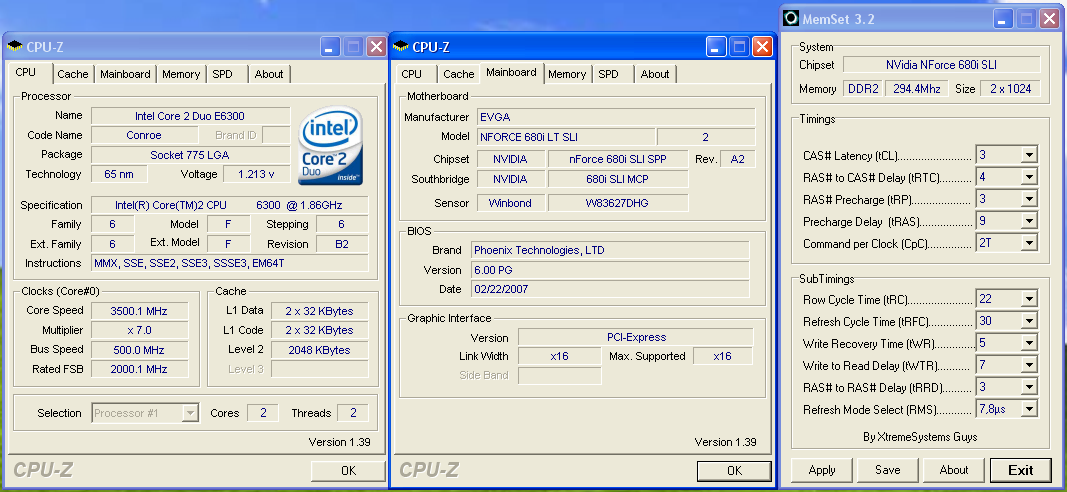
We were easily able to reach a final benchmark stable setting of 7x500 FSB resulting in a clock speed of 3500MHz. We were able to run our OCZ Flex PC2-9200 and Corsair PC2-8888 at the reported timings with a 1T Command Rate enabled with 2.30V. However, when overclocking we had to run our standard OCZ Flex PC2-6400 at 2T command rates due to the next voltage step being 2.30V, a setting that is not recommended for the ProMOS chips (2.250V is our recommended limit for 24/7 operation). Vdroop was very acceptable on this board during overclocking with an average drop of .02 ~.03V during load testing with our E6300.
Testing with our new OCZ Flex PC2-6400 CAS3 (standard memory installed) and G.Skill F2-6400CL4D-2GBHK modules based on the ProMOS IC chips resulted in great success on this board. The OCZ Flex PC2-6400 was able to run at DDR2-800 speeds with timings at 3-4-3-9 2T at 2.15V and the G.Skill F2-6400CL4D at 4-3-3-8 2T at 2.15V on our other NVIDIA boards but we had to use the 2.20V setting. The remaining memory timings are set to Auto as is standard in our testing and manually setting these timings resulted in minimal performance gains. We did notice in 4GB testing that we had to change our OCZ Flex PC2-6400 CAS3 memory timings to 3-4-4-12 2T at 2.20V for stable 24/7 operation in a variety of applications.
Overclocking - E6600
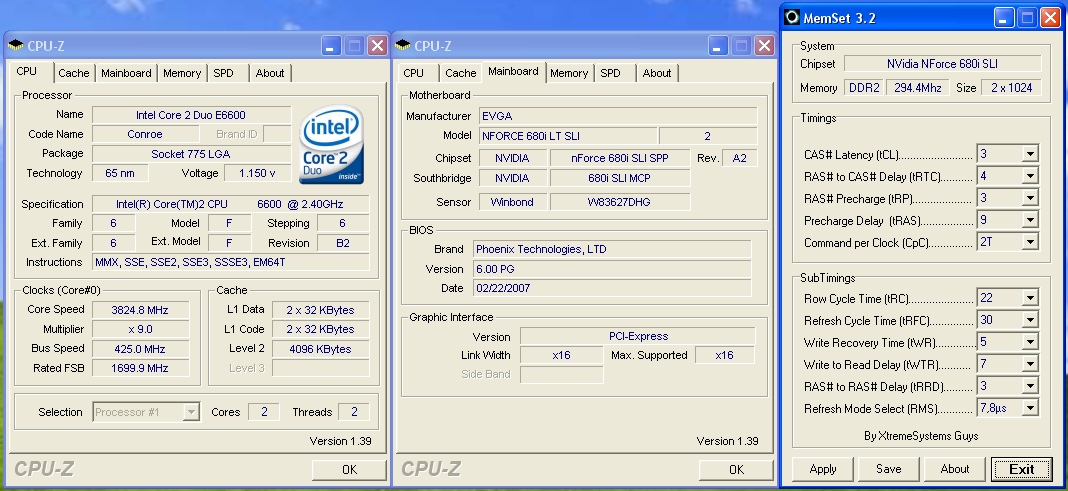
After trying numerous settings and voltages we finally found a benchmark stable setting of 9x425 FSB resulting in a clock speed of 3825MHz. We did find the typical FSB hole around 416FSB that continued until 422FSB. We were able to post and complete benchmark testing at 432FSB but could not pass dual Prime95 at that setting. Vdroop was acceptable during overclocking with an average drop of .03 ~.04V during load testing with our E6600. We generally found that without decent airflow around the CPU and memory locations that our maximum FSB was near 410 MHz with this configuration.
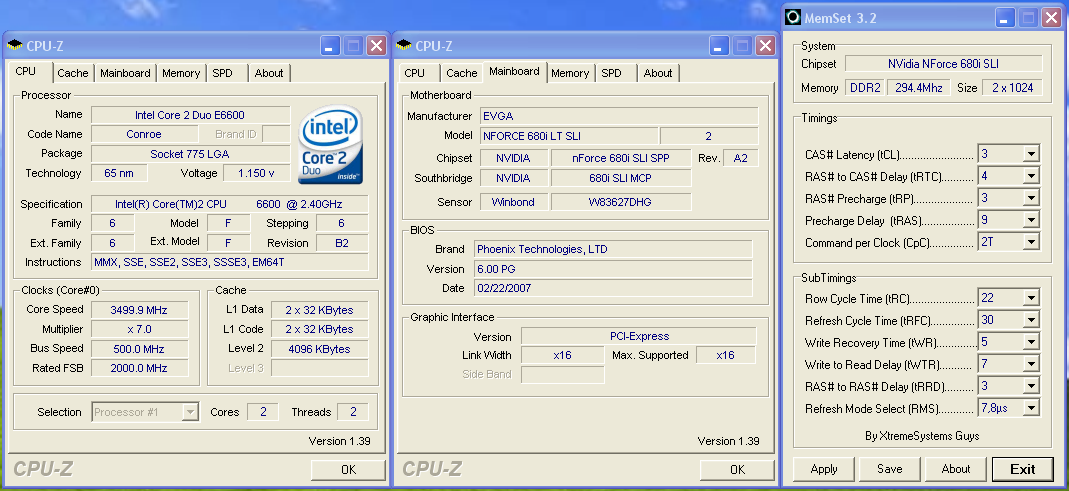
We dropped the multiplier on our E6600 to seven and were able to reach 500 FSB. We entered XP at 7x518 but the board was not stable due to a lack of higher FSB/SPP/MCP voltages. At first we thought the board was locked at 500FSB but once again we found FSB holes but this time they ranged from 502 to 516. We jokingly started to refer to this board as Swiss cheese during testing as everywhere we turned there was another FSB hole. If NVIDIA had offered VTT and GTL Ref Voltage options in the BIOS we are sure several of our holes could have been solved but we were still able to work around most of them.
In our overclock testing we were able to extract an 1133MHz memory speed at 5-5-5-15 2T timings with our OCZ Flex PC2-6400. This is the highest speed we have reached with this memory and at synced speeds we were able to reach DDR2-850 with timings at 3-4-4-9 2T on 2.20V. We dropped in our OCZ Flex PC2-9200 and Corsair PC2-9136 modules with both being able to reach DDR2-1275 with 5-5-4-12 2T timings at 2.30V. Memory performance and stability was excellent once the board was dialed in.
| EVGA 680i LT SLI Dual Core Overclocking Testbed |
|
| Processor: | Intel Core 2 Duo E6300 Dual Core, 1.86GHz, 2MB Unified Cache 1066FSB, 7x Multiplier |
| CPU Voltage: | 1.4500V (default 1.3250V) |
| NB Voltage: | 1.40V |
| FSB Voltage: | 1.40V |
| Cooling: | Tuniq 120 Air Cooling |
| Power Supply: | OCZ ProXStream 1000W |
| Memory: | OCZ Flex XLC PC2-6400 (2x1GB) (ProMOS Memory Chips) |
| Video Cards: | 1 x MSI 8800GTX |
| Hard Drive: | Western Digital 150GB 10,000RPM SATA 16MB Buffer |
| Case: | Cooler Master CM Stacker 830 |
| Maximum OC: | 500x7 (3-4-3-9 2T, 800MHz, 2.20V), CPU 1.4500V 3500MHz (+88% FSB/CPU) |
| . | |
 |
| Click to enlarge |
We were easily able to reach a final benchmark stable setting of 7x500 FSB resulting in a clock speed of 3500MHz. We were able to run our OCZ Flex PC2-9200 and Corsair PC2-8888 at the reported timings with a 1T Command Rate enabled with 2.30V. However, when overclocking we had to run our standard OCZ Flex PC2-6400 at 2T command rates due to the next voltage step being 2.30V, a setting that is not recommended for the ProMOS chips (2.250V is our recommended limit for 24/7 operation). Vdroop was very acceptable on this board during overclocking with an average drop of .02 ~.03V during load testing with our E6300.
Testing with our new OCZ Flex PC2-6400 CAS3 (standard memory installed) and G.Skill F2-6400CL4D-2GBHK modules based on the ProMOS IC chips resulted in great success on this board. The OCZ Flex PC2-6400 was able to run at DDR2-800 speeds with timings at 3-4-3-9 2T at 2.15V and the G.Skill F2-6400CL4D at 4-3-3-8 2T at 2.15V on our other NVIDIA boards but we had to use the 2.20V setting. The remaining memory timings are set to Auto as is standard in our testing and manually setting these timings resulted in minimal performance gains. We did notice in 4GB testing that we had to change our OCZ Flex PC2-6400 CAS3 memory timings to 3-4-4-12 2T at 2.20V for stable 24/7 operation in a variety of applications.
Overclocking - E6600
| EVGA 680i LT SLI Dual Core Overclocking Testbed |
|
| Processor: | Intel Core 2 Duo E6600 Dual Core, 2.4GHz, 4MB Unified Cache 1066FSB, 9x Multiplier |
| CPU Voltage: | 1.4750V / 1.4500 (default 1.3250V) |
| NB Voltage: | 1.40V |
| FSB Voltage: | 1.40V |
| Cooling: | Tuniq 120 Air Cooling |
| Power Supply: | OCZ ProXStream 1000W |
| Memory: | OCZ Flex XLC PC2-6400 (2x1GB) (ProMOS Memory Chips) |
| Video Cards: | 1 x MSI 8800GTX |
| Hard Drive: | Western Digital 150GB 10,000RPM SATA 16MB Buffer |
| Case: | Cooler Master CM Stacker 830 |
| Maximum CPU OC: | 425x9 (3-4-3-9 2T, 799MHz, 2.20V), CPU 1.4750V 3825MHz (+59%) |
| Maximum FSB OC: | 500x7 (3-4-3-9 2T, 800MHz, 2.20V), CPU 1.4500V 3500MHz (+88% FSB) |
| . | |
 |
| Click to enlarge |
After trying numerous settings and voltages we finally found a benchmark stable setting of 9x425 FSB resulting in a clock speed of 3825MHz. We did find the typical FSB hole around 416FSB that continued until 422FSB. We were able to post and complete benchmark testing at 432FSB but could not pass dual Prime95 at that setting. Vdroop was acceptable during overclocking with an average drop of .03 ~.04V during load testing with our E6600. We generally found that without decent airflow around the CPU and memory locations that our maximum FSB was near 410 MHz with this configuration.
 |
| Click to enlarge |
We dropped the multiplier on our E6600 to seven and were able to reach 500 FSB. We entered XP at 7x518 but the board was not stable due to a lack of higher FSB/SPP/MCP voltages. At first we thought the board was locked at 500FSB but once again we found FSB holes but this time they ranged from 502 to 516. We jokingly started to refer to this board as Swiss cheese during testing as everywhere we turned there was another FSB hole. If NVIDIA had offered VTT and GTL Ref Voltage options in the BIOS we are sure several of our holes could have been solved but we were still able to work around most of them.
In our overclock testing we were able to extract an 1133MHz memory speed at 5-5-5-15 2T timings with our OCZ Flex PC2-6400. This is the highest speed we have reached with this memory and at synced speeds we were able to reach DDR2-850 with timings at 3-4-4-9 2T on 2.20V. We dropped in our OCZ Flex PC2-9200 and Corsair PC2-9136 modules with both being able to reach DDR2-1275 with 5-5-4-12 2T timings at 2.30V. Memory performance and stability was excellent once the board was dialed in.
Originally published at https://www.anandtech.com/show/2198 (Wayback Machine).