
EVGA 680i LT SLI: NVIDIA's 680i Cost Reduced
- Posted in
- CPUs
Board Layout and Design
The board layout that NVIDIA devised for the 680i LT chipset is quite good but we would have preferred a black PCB design instead of the pedestrian green. The board easily installed into our Cooler Master CM Stacker 830 case while cable management was good for the optical and hard drives. The board features an excellent six-phase power design and a mixture of conductive polymer aluminum solid capacitors and high-quality aluminum electrolytic capacitors. There are four fan headers (one 4-pin, three 3-pin) located in easy to reach positions on the board but only the CPU fan offers automatic fan control capabilities within the BIOS. Both the SPP and MCP are actively cooled with fans that tended to have a noticeable whine on power-up and remained at 100% speed throughout testing as fan speed cannot be controlled.
Considering other boards in the price range have passive cooling solutions we have to question NVIDIA's decision on using an active cooling solution. We know this is one of the areas targeted for cost reduction but most people will find the noise obtrusive at times, and we are also concerned about the life expectancy of the fans. We do not mind active cooling solutions on chipsets that run hot or on a board designed with overclocking in mind. However, one of the main design objectives with this board was not to encroach upon the 680i boards in overclocking capabilities so this decision is slightly confusing to us.
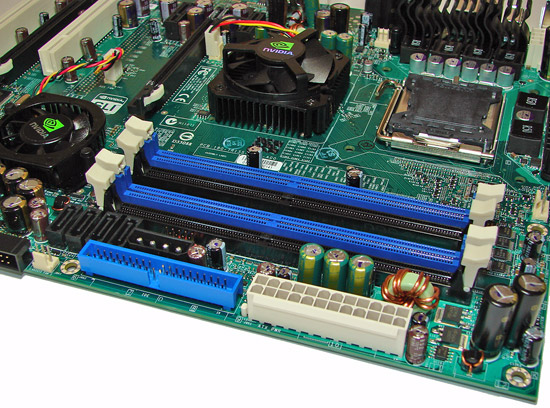
The memory slots are color coded correctly for dual channel operation. The 24-pin ATX power connector is conveniently located with the blue IDE connector on the edge of the board. We would have flipped the IDE connector to a right angle design in order to have opened up a little additional room for the four black SATA ports and 4-pin Molex connector. Unfortunately, one of the worst design decisions on this board was placing the chassis connector panel in between the Molex connector and the fourth DIMM slot.
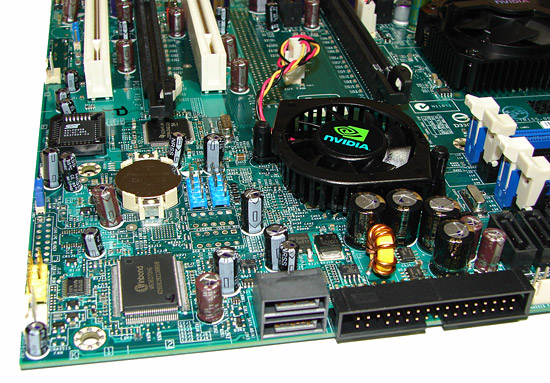
The two primary black SATA ports and the floppy drive connector are located on the edge of the board. We found the positioning of the SATA ports to be very good when utilizing the PCI or second PCI-E x16 physical slot. The MCP is actively cooled and remained fairly warm to the touch throughout testing, although additional cooling was not needed when overclocking. The fan has a low profile and we did not have any issue using our 8800GTX, but again the area around it tended to get hot after stress testing.
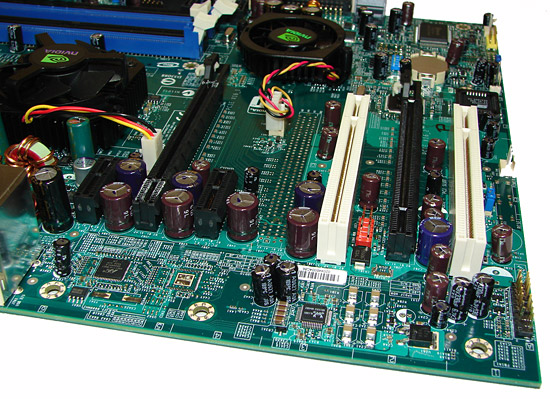
The board comes with two PCI Express x16 connectors, two PCI Express x1, and two PCI connectors. The layout of this design offers a good but not spectacular dual x16 connector design. The second PCI Express x1 slot will be physically unavailable as will the second PCI connector if you utilize a double slot card in either x16 slots. We would also have switched the first PCI and second PCI Express x16 connector in order to give the second video card additional space, as our secondary 8800GTX tended to act like a vacuum cleaner for the bottom of our case. It would have been nice if the second PCI Express x1 connector had been moved to the vacant spot where the missing third x16 slot would have been located. This would have meant that both PCI Express x1 slots would have been open even with dual-slot SLI.
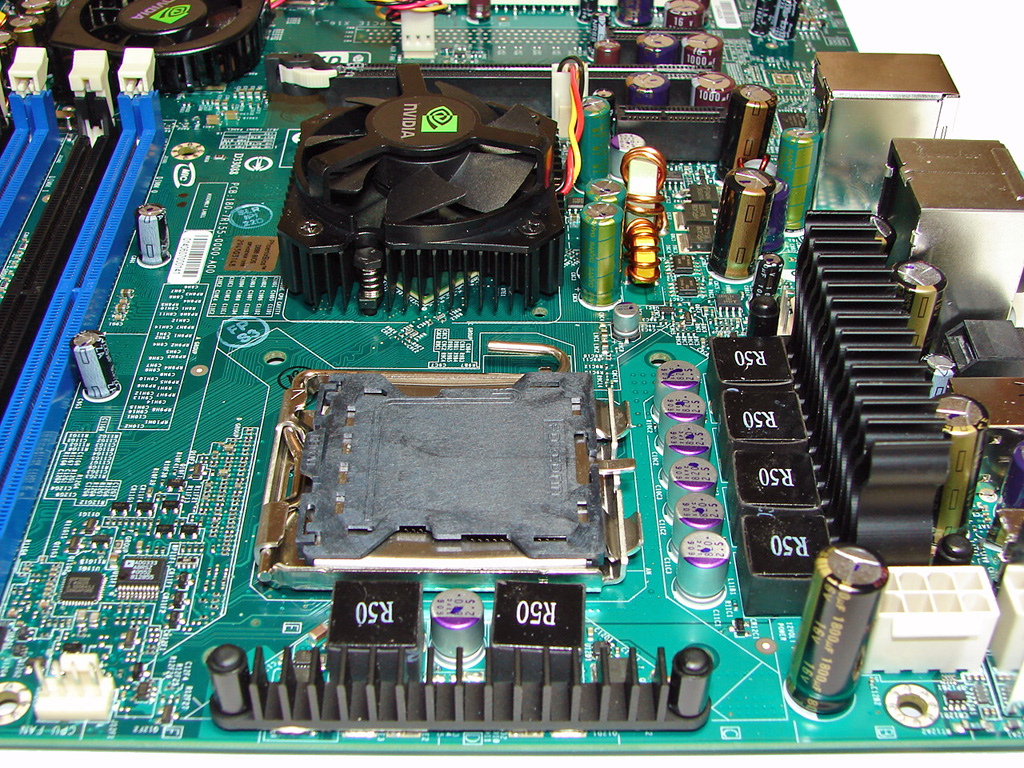
Getting back to the CPU socket area, we find an excellent amount of room for alternative cooling solutions. We utilized the stock heatsink/fan in our normal testing but also verified a few larger Socket-775 air cooling solutions would fit in this area during our overclocking tests. The 680i LT SPP chipset is actively cooled with a mid-rise heatsink/fan unit that did not interfere with any installed peripherals but was loud in our opinion. The VRM components are passively cooled and the 8-pin ATX power connector is located out of the way.
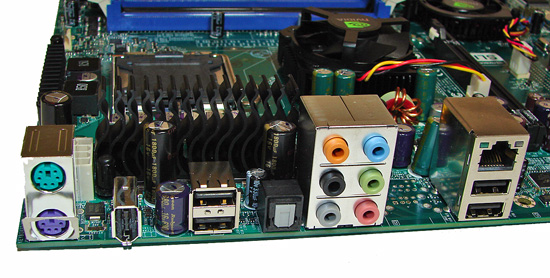
The rear panel contains the standard PS/2 mouse and keyboard ports, LAN port, and four USB 2.0 ports. The LAN port has two LED indicators representing Activity and Speed of the connection through the Marvell Gigabit PCI-E PHY. The audio panel consists of six ports that can be configured for 2, 4, 6, and 8-channel audio along with an S/PDIF optical out port. The I/O panel also features an IEEE 1394a port.
The audio subsystem is based on the Realtek ALC885 and offers 8-channel output. Realtek has had troubles recently with EAX 2.0 support but we did notice a slight improvement in the 1.61 driver set with several games, although Battlefield 2 continues to present problems for Realtek. We continue to feel that the ADI 1988B HD audio codec on the upper end ASUS boards or the Creative X-Fi chipset utilized on the new MSI 680i offer significantly better EAX audio quality in games than the Realtek HD codecs.
Overall, the feature set on this board is good but other boards in this price range offer additional USB and network ports along with passive cooling designs.
 |
| Click to enlarge |
The board layout that NVIDIA devised for the 680i LT chipset is quite good but we would have preferred a black PCB design instead of the pedestrian green. The board easily installed into our Cooler Master CM Stacker 830 case while cable management was good for the optical and hard drives. The board features an excellent six-phase power design and a mixture of conductive polymer aluminum solid capacitors and high-quality aluminum electrolytic capacitors. There are four fan headers (one 4-pin, three 3-pin) located in easy to reach positions on the board but only the CPU fan offers automatic fan control capabilities within the BIOS. Both the SPP and MCP are actively cooled with fans that tended to have a noticeable whine on power-up and remained at 100% speed throughout testing as fan speed cannot be controlled.
Considering other boards in the price range have passive cooling solutions we have to question NVIDIA's decision on using an active cooling solution. We know this is one of the areas targeted for cost reduction but most people will find the noise obtrusive at times, and we are also concerned about the life expectancy of the fans. We do not mind active cooling solutions on chipsets that run hot or on a board designed with overclocking in mind. However, one of the main design objectives with this board was not to encroach upon the 680i boards in overclocking capabilities so this decision is slightly confusing to us.
The memory slots are color coded correctly for dual channel operation. The 24-pin ATX power connector is conveniently located with the blue IDE connector on the edge of the board. We would have flipped the IDE connector to a right angle design in order to have opened up a little additional room for the four black SATA ports and 4-pin Molex connector. Unfortunately, one of the worst design decisions on this board was placing the chassis connector panel in between the Molex connector and the fourth DIMM slot.
The two primary black SATA ports and the floppy drive connector are located on the edge of the board. We found the positioning of the SATA ports to be very good when utilizing the PCI or second PCI-E x16 physical slot. The MCP is actively cooled and remained fairly warm to the touch throughout testing, although additional cooling was not needed when overclocking. The fan has a low profile and we did not have any issue using our 8800GTX, but again the area around it tended to get hot after stress testing.
The board comes with two PCI Express x16 connectors, two PCI Express x1, and two PCI connectors. The layout of this design offers a good but not spectacular dual x16 connector design. The second PCI Express x1 slot will be physically unavailable as will the second PCI connector if you utilize a double slot card in either x16 slots. We would also have switched the first PCI and second PCI Express x16 connector in order to give the second video card additional space, as our secondary 8800GTX tended to act like a vacuum cleaner for the bottom of our case. It would have been nice if the second PCI Express x1 connector had been moved to the vacant spot where the missing third x16 slot would have been located. This would have meant that both PCI Express x1 slots would have been open even with dual-slot SLI.
 |
| Click to enlarge |
Getting back to the CPU socket area, we find an excellent amount of room for alternative cooling solutions. We utilized the stock heatsink/fan in our normal testing but also verified a few larger Socket-775 air cooling solutions would fit in this area during our overclocking tests. The 680i LT SPP chipset is actively cooled with a mid-rise heatsink/fan unit that did not interfere with any installed peripherals but was loud in our opinion. The VRM components are passively cooled and the 8-pin ATX power connector is located out of the way.
The rear panel contains the standard PS/2 mouse and keyboard ports, LAN port, and four USB 2.0 ports. The LAN port has two LED indicators representing Activity and Speed of the connection through the Marvell Gigabit PCI-E PHY. The audio panel consists of six ports that can be configured for 2, 4, 6, and 8-channel audio along with an S/PDIF optical out port. The I/O panel also features an IEEE 1394a port.
The audio subsystem is based on the Realtek ALC885 and offers 8-channel output. Realtek has had troubles recently with EAX 2.0 support but we did notice a slight improvement in the 1.61 driver set with several games, although Battlefield 2 continues to present problems for Realtek. We continue to feel that the ADI 1988B HD audio codec on the upper end ASUS boards or the Creative X-Fi chipset utilized on the new MSI 680i offer significantly better EAX audio quality in games than the Realtek HD codecs.
Overall, the feature set on this board is good but other boards in this price range offer additional USB and network ports along with passive cooling designs.
Originally published at https://www.anandtech.com/show/2198 (Wayback Machine).