
Thermalright Ultra 120: Elegant, Fanless and Efficient Cooling
- Posted in
- Cases/Cooling/PSUs
Noise
For many enthusiasts upgrading cooling the goal is maximum stable overclock, and they will live with the inconvenience of a louder system. For other users silence is the most important factor, and these users will forgo maximum overclocking if that increases system noise levels. As demonstrated on page 4, the Ultra 120 can easily cool a Core 2 Duo at stock speeds without a fan. The fanless configuration is also effective at cooling a C2D that has been mildly overclocked at stock voltage. Certainly this "no-fan" or passive-cooling configuration is the lowest noise level that can be achieved with the Ultra 120.
We also Measured noise levels with the Thermalright Ultra 120 with the Scythe S-Flex SFF21F fan. To test idle and load noise levels, a Zalman fan controller was used to dial in the lowest and highest fan speeds. The difference in noise levels between low and high speed settings on the Scythe fan were very small
There are virtually no power supplies that do not have a fan. While Zalman and a few others do make an expensive fanless power supply, we have not seen a fanless unit larger than 500W, or one that would be used for seriously overclocking a system. With that in mind the noise level of the system with all fans turned off except the Power Supply was measured. The power supply used for the cooling test bed was the OCZ PowerStream 520, which is one of the quieter of the high performance power supplies. The noise level of the Power Supply was 38.3dB from 24" (61cm) and 47dB from 6" (152mm). The measured noise level of the test room is 36.4dB, which would be considered a relatively quiet room with a noise floor slightly below the OCZ PowerStream 520 PSU.
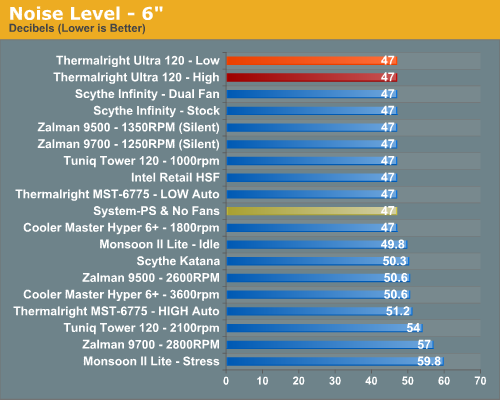
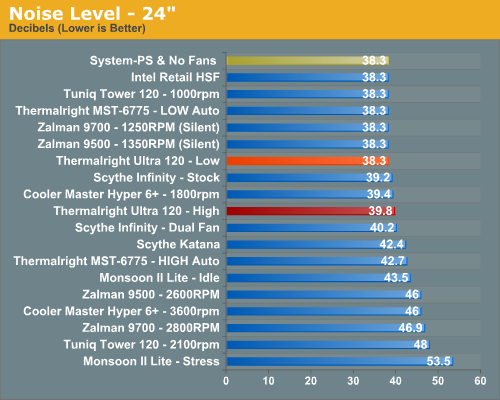
Measured noise levels in this chart should be considered worst case. Measurements were taken with an open side of a mid tower case 6" from the open HSF and 24" from the open HSF. Real world would be a completely closed case with a further reduction in noise.
While the Tuniq matches the Ultra 120 for low noise at low speeds - also below the noise floor of the system - the S-Flex is significantly quieter than the stock Tuniq fan at high speeds. At 24" the S-Flex measures 39.8dB compared to 48dB for the Tuniq. At 6" the S-Flex is at the system floor of 47 DB at high speed compared to the Tuniq at 54 dB. Of course one way to lower the noise of the Tuniq fan on high is to replace the Tuniq 120mm fan with the Scythe S-Flex. High speed noise levels of the Tuniq should then be comparable to the Ultra 120 with the S-Flex fan.
The noise results with the Thermalright Ultra 120 with a Scythe S-Flex fan are impressive. At both high and low speeds, measured from 6" or 24" the Ultra 120 was below the system noise floor in almost all measurements. This is even more surprising when you consider the air flow with the SFF21F is a very high 63.7CFM.
Any 120mm fan should be mountable on the Ultra 120 as long as the fan uses open holes for mounting; the fan can be any thickness. We know the Scythe S-Flex and Noctua fans will mount properly on this heatsink, and you can chose from a wide variety of fans in both product lines. These range from ultra-quiet 8dB-A fans all the way to the 28dB-A fan used in these tests. Considering how quiet the S-Flex measured in our tests, users can opt for higher CFM with assurance that the fan will still remain quiet.
While the Ultra 120 and the Tuniq Tower 120 performed virtually the same in cooling and overclocking, the Ultra 120 with the S-Flex fan proved quieter than the Tuniq when the fans were running at highest speed. Considering the Ultra 120 is also effective as a fanless cooler at stock speeds, the Ultra 120 comes out as the low-noise leader among the coolers we have tested at AnandTech. You can likely lower noise levels of the Tuniq to those of the Ultra 120 by replacing the Tuniq fan with a Scythe S-Flex fan like the one used in our cooling tests with the Ultra 120, although that would increase the total price of the Tuniq.
For many enthusiasts upgrading cooling the goal is maximum stable overclock, and they will live with the inconvenience of a louder system. For other users silence is the most important factor, and these users will forgo maximum overclocking if that increases system noise levels. As demonstrated on page 4, the Ultra 120 can easily cool a Core 2 Duo at stock speeds without a fan. The fanless configuration is also effective at cooling a C2D that has been mildly overclocked at stock voltage. Certainly this "no-fan" or passive-cooling configuration is the lowest noise level that can be achieved with the Ultra 120.
We also Measured noise levels with the Thermalright Ultra 120 with the Scythe S-Flex SFF21F fan. To test idle and load noise levels, a Zalman fan controller was used to dial in the lowest and highest fan speeds. The difference in noise levels between low and high speed settings on the Scythe fan were very small
There are virtually no power supplies that do not have a fan. While Zalman and a few others do make an expensive fanless power supply, we have not seen a fanless unit larger than 500W, or one that would be used for seriously overclocking a system. With that in mind the noise level of the system with all fans turned off except the Power Supply was measured. The power supply used for the cooling test bed was the OCZ PowerStream 520, which is one of the quieter of the high performance power supplies. The noise level of the Power Supply was 38.3dB from 24" (61cm) and 47dB from 6" (152mm). The measured noise level of the test room is 36.4dB, which would be considered a relatively quiet room with a noise floor slightly below the OCZ PowerStream 520 PSU.
Measured noise levels in this chart should be considered worst case. Measurements were taken with an open side of a mid tower case 6" from the open HSF and 24" from the open HSF. Real world would be a completely closed case with a further reduction in noise.
While the Tuniq matches the Ultra 120 for low noise at low speeds - also below the noise floor of the system - the S-Flex is significantly quieter than the stock Tuniq fan at high speeds. At 24" the S-Flex measures 39.8dB compared to 48dB for the Tuniq. At 6" the S-Flex is at the system floor of 47 DB at high speed compared to the Tuniq at 54 dB. Of course one way to lower the noise of the Tuniq fan on high is to replace the Tuniq 120mm fan with the Scythe S-Flex. High speed noise levels of the Tuniq should then be comparable to the Ultra 120 with the S-Flex fan.
The noise results with the Thermalright Ultra 120 with a Scythe S-Flex fan are impressive. At both high and low speeds, measured from 6" or 24" the Ultra 120 was below the system noise floor in almost all measurements. This is even more surprising when you consider the air flow with the SFF21F is a very high 63.7CFM.
Any 120mm fan should be mountable on the Ultra 120 as long as the fan uses open holes for mounting; the fan can be any thickness. We know the Scythe S-Flex and Noctua fans will mount properly on this heatsink, and you can chose from a wide variety of fans in both product lines. These range from ultra-quiet 8dB-A fans all the way to the 28dB-A fan used in these tests. Considering how quiet the S-Flex measured in our tests, users can opt for higher CFM with assurance that the fan will still remain quiet.
While the Ultra 120 and the Tuniq Tower 120 performed virtually the same in cooling and overclocking, the Ultra 120 with the S-Flex fan proved quieter than the Tuniq when the fans were running at highest speed. Considering the Ultra 120 is also effective as a fanless cooler at stock speeds, the Ultra 120 comes out as the low-noise leader among the coolers we have tested at AnandTech. You can likely lower noise levels of the Tuniq to those of the Ultra 120 by replacing the Tuniq fan with a Scythe S-Flex fan like the one used in our cooling tests with the Ultra 120, although that would increase the total price of the Tuniq.
Originally published at https://www.anandtech.com/show/2185 (Wayback Machine).