
Tuniq Tower 120: Air Cooling to the Max
- Posted in
- Cases/Cooling/PSUs
Cooling Results
Both the retail Intel X6800 HSF and the Tuniq Tower 120 perform well at idle. Even at this base level, however, the effectiveness of the Tuniq Tower 120 is still clear.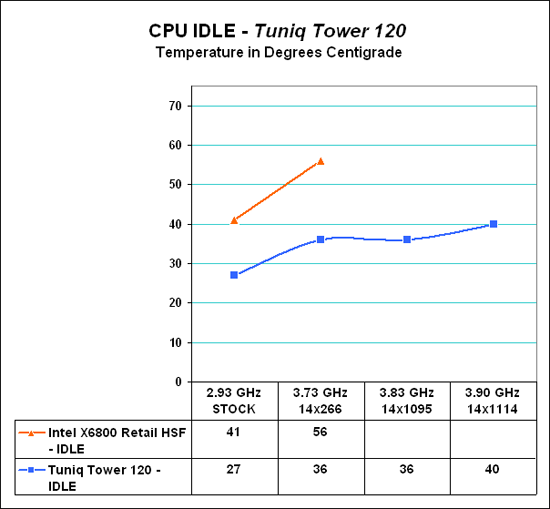
Where the very good Intel stock cooler keeps the X6800 at 41C, the Tuniq manages 27C, which is a huge difference at stock idle speeds. As the processor is pushed to its highest stable overclock using the retail HSF, the delta increases. At 3.73GHz the retail HSF is running at 56C, compared to an extremely cool 36C with the Tuniq at the same speed. The Tuniq allows the X6800 to reach even higher overclocks, to a stable 3.90 GHz. Even at the maximum overclock on this CPU with the Tuniq, idle temperature is still a modest 40C, less than the stock speed temperature of the retail Intel HSF.
It is very easy to measure the effectiveness of a cooling solution at idle - when the computer is doing nothing except running the temperature measurement program. It is more difficult, however, to effectively simulate a computer being stressed by all of the conditions it might be exposed to in different operating environments. Frankly, for most home users CPU power is most taxed with contemporary gaming. Therefore our stress test simulates running a demanding contemporary game.
The Far Cry River demo is looped for 30 minutes and the CPU temperature is captured at 4 second intervals with the NVIDIA monitor "logging" option. The highest temperature during the stress test is then reported. We did try other variations in "stressing" the CPU. One option was multi-tasking running Super Pi with the Far Cry River looping. This did almost halve gaming frame rates and push CPU utilization to near a constant 100%. The multitasking test setup, however, did not produce higher temperatures than looping the Far Cry River demo. For that reason, we settled on the simple stress test of looping a demanding Far Cry demo for 30 minutes.
Cooling effectiveness compared to the retail HSF improves even more with the Tuniq Tower 120 when measured under stress conditions. It appears the Tuniq becomes even more effective as greater demands are placed on cooling.
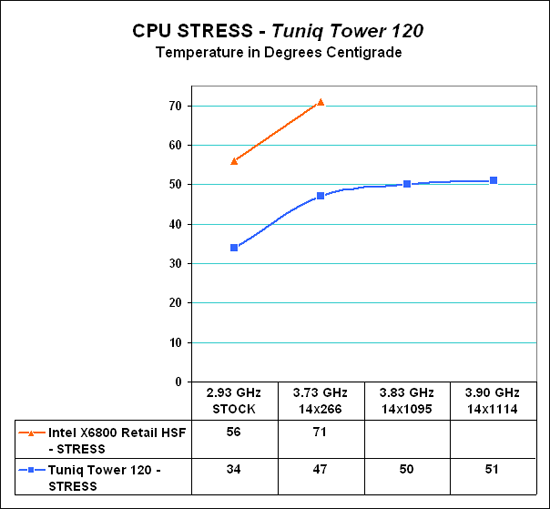
The delta under stress conditions at stock 2.93GHz speed is 22C - 56C to 34C. This compares to the delta at stock idle of 14C. As we saw with idle speeds, the difference increased as we overclocked, with a difference of 24C (71C to 47C) at the 3.73GHz overclock. With the Tuniq speed could be pushed another 170 MHz to 3.90 GHz, with the stress CPU temperature of 51C - still 5C below the stress temperature of the retail HSF at stock speeds.
It would be an understatement to say the performance of the Tuniq 120 is impressive in cooling the CPU. In all cases the Tuniq cooled the CPU better than the stock Intel retail HSF under the same conditions at stock speed. This was true even with the X6800 pushed about 1000MHz beyond the fastest available Core 2 Duo CPU.
As for the overclocking abilities of the CPU, they will vary at the top. This particular CPU does higher FSB speeds than any X6800 we have tested, but the 3.9GHz top speed is pretty average among this CPU cooled with the Tuniq Tower 120. A few of the other processors tested with the Tuniq reach just over 4 GHz, but the range has been 3.8 to 4.0GHz. Stock cooling generally tops out 200 to 400Mhz lower, depending on the CPU, on the processors tested in our lab.
Originally published at https://www.anandtech.com/show/2152 (Wayback Machine).