
Digital SLR Buyer's Guide
- Posted in
- Digital Camera
10 Megapixel SLRs Compared (continued)
HIGH ISO NOISE: From brief comparisons the Pentax and Canon XTi are the best at controlling noise at high ISO ("film") speeds. However, they approach noise reduction in very different manners. The Pentax retains edge sharpness, dynamic range and contrast at high ISO but allows the background to become grainier; the Canon reduces edge sharpness, contrast, and dynamic range to make noise less noticeable at high ISO. Since dynamic range - the range from lightest to darkest - is already a problem with all digital photography we prefer noise control that preserves the already limited dynamic range as much as possible, but some will prefer the Canon approach. Both are followed closely by the Nikon, with the Sony exhibiting the most noise at high ISO. All four are all but identical to ISO 400, but at 800 small differences start to appear. It is worth noting that while the Pentax and the Canon sensors/processors control noise well they are not as "noise-free" as the Canon 6 megapixel and 8 megapixel CMOS sensors. This should not really be a surprise since the size of the sensor is the same APS C size in the 6, 8, and 10 megapixel versions. More pixels in the same area therefore translates into a bit more noise.
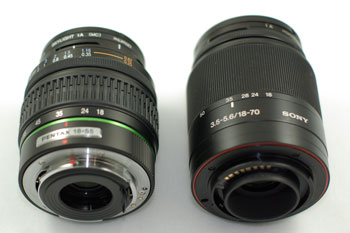
KIT LENS: While you can always upgrade to a better lens, the kit lenses that are normally packaged with the SLR are normally very good value for your money. The bare entry level lens for the Canon, Nikon, and Pentax SLRs is an 18-55mm, which is equivalent to a 28mm to 80mm lens on a traditional 35mm camera. The Sony normal lens is 18-70mm, adds the same cost to the kit as the others, but is equivalent to a 28-105mm lens for 35mm. Build quality is usually cheap on kit lenses, but the above picture compares the Sony and Pentax kit lenses. It is worth pointing out that the Pentax 18-55mm is the only kit lens with a metal lens mount as normally seen on "better" lenses - the others all have a plastic lens mount. Nikon actually has two other kit lenses in the 18-70mm and 18-135mm lenses, but these "kit" lenses add as much as $300 to the kit total, compared to an average $100 or less for the other kit lenses.
BUILD QUALITY: By far, the Pentax K10D feels the most solid and it is the heaviest of the four cameras. That can be good (build quality) or bad (increased weight) depending on your desires. The Nikon D80 is a very solid piece of equipment and is the easy number 2, followed closely by the also solid Sony A100. The extra sealing for water/dust resistance pays off in the K10D, which is easily the best quality Pentax since the *ist D, which also had a solid build quality. The Nikon and Sony build quality are about the same, except for the Sony's loud slapping mirror and louder focusing. The Canon is far behind the other three in build quality, but it still has the quietest lenses of the group with the integrated lens focusing motors. The damped mirror sound on the Pentax is very reassuring to most ears.
FLASH: Nikon and Sony (inherited from Minolta) both provide excellent distance integration in their flash offering. With Nikon D and Sony/Maxxum ADI lenses, flash photography is accurate and predictable. Pentax and Canon also have good built-in flashes and external flash units, but they are not quite the equal of the D offerings. Nikon has reasonable pricing for flashes, but Sony decided to make their Sony/Minolta flash units very expensive.
LCD(s): All four 10 megapixel cameras offer large 2.5" color preview screens. The Sony and Canon also use the screen for menus, while the Pentax and Nikon have a separate top-deck LCD that provides info on camera settings.
CONTROL: The Pentax Hyperprogram has been around for quite a while, and Pentax did a really great job with the front/rear dials and new sensitivity program line. The Nikon D80 also has both front and rear control dials, while the Sony and Canon have just one control dial. The ability of the Pentax to shift the program aperture with one dial and the shutter speed with the other while the camera is still in program mode makes shooting like you want a lot easier - the creative control of manual while still in program mode.
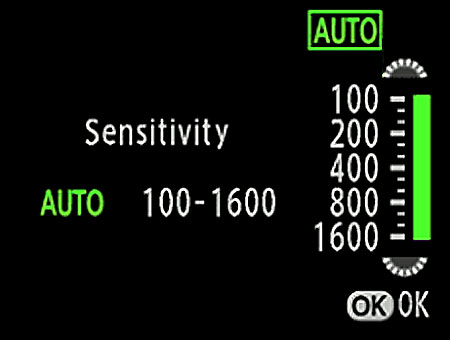
AUTO ISO: Both the Pentax and Nikon offer user selectable Auto ISO ranges - a really useful feature where the camera automatically selects "speed" based on program conditions you can manually set. Sony also offers Auto ISO, but it is limited to ISO 400 and it is not user programmable. The K10D capabilities with a manual, non-autofocus K-mount lens are icing on the cake - you can even use effective anti-shake with manual lenses after dialing in the focal length. Newer lenses automatically provide the focal length info to the camera.
PRICE: Amazon and Newegg were used to determine online prices. These prices should be available to any online shopper, but you may find even better prices if you are willing to do more searching. Conversely, local photo specialty retailers normally provide better customer support and return options than etailers, and their prices for the same item will generally be higher due to the extra service they provide. Right now the Sony A100 is the best value available with a price with 18-70mm lens of about $720. The Canon XTi is selling for about $800 with an 18-55mm lens. The moisture and dust sealed Pentax K10D with a quality 18-55 lens is $999, and the Nikon D80 with an 18-55 lens is about $1100.
Recommendations
All-in-all the Nikon D80 and Pentax K10D are the closest in build quality and depth of features. When you consider the K10D has very effective anti-shake built in, effective moisture sealing, and dust removal - and the Nikon has none of these features - the advantage definitely goes to Pentax. If you are a serious photographer you will be very happy with the Pentax K10D. If you are already committed to the Canon or Nikon lens system, then your choice is easier. However, while Canon pioneered the under $1000 digital camera market, the Canon Rebel XTi is by far the worst offering in the 10 megapixel range. It is cheaply built with poor ergonomics compared to other 10 megapixel offerings.
The Sony A100 is by far the best buy in the 10 megapixel group. Sony has reduced the suggested retail price for the kit to $899 - the same as the Canon Rebel XTi with lens. However, you can actually buy the Sony A100 for a lot less. At $720 the A100 offers a longer 18-70 lens, excellent build quality, anti-shake for any lens, compatibility with new Sony lenses and most any Minolta Maxxum lens, enhanced dynamic range, and fast operation.
HIGH ISO NOISE: From brief comparisons the Pentax and Canon XTi are the best at controlling noise at high ISO ("film") speeds. However, they approach noise reduction in very different manners. The Pentax retains edge sharpness, dynamic range and contrast at high ISO but allows the background to become grainier; the Canon reduces edge sharpness, contrast, and dynamic range to make noise less noticeable at high ISO. Since dynamic range - the range from lightest to darkest - is already a problem with all digital photography we prefer noise control that preserves the already limited dynamic range as much as possible, but some will prefer the Canon approach. Both are followed closely by the Nikon, with the Sony exhibiting the most noise at high ISO. All four are all but identical to ISO 400, but at 800 small differences start to appear. It is worth noting that while the Pentax and the Canon sensors/processors control noise well they are not as "noise-free" as the Canon 6 megapixel and 8 megapixel CMOS sensors. This should not really be a surprise since the size of the sensor is the same APS C size in the 6, 8, and 10 megapixel versions. More pixels in the same area therefore translates into a bit more noise.
KIT LENS: While you can always upgrade to a better lens, the kit lenses that are normally packaged with the SLR are normally very good value for your money. The bare entry level lens for the Canon, Nikon, and Pentax SLRs is an 18-55mm, which is equivalent to a 28mm to 80mm lens on a traditional 35mm camera. The Sony normal lens is 18-70mm, adds the same cost to the kit as the others, but is equivalent to a 28-105mm lens for 35mm. Build quality is usually cheap on kit lenses, but the above picture compares the Sony and Pentax kit lenses. It is worth pointing out that the Pentax 18-55mm is the only kit lens with a metal lens mount as normally seen on "better" lenses - the others all have a plastic lens mount. Nikon actually has two other kit lenses in the 18-70mm and 18-135mm lenses, but these "kit" lenses add as much as $300 to the kit total, compared to an average $100 or less for the other kit lenses.
BUILD QUALITY: By far, the Pentax K10D feels the most solid and it is the heaviest of the four cameras. That can be good (build quality) or bad (increased weight) depending on your desires. The Nikon D80 is a very solid piece of equipment and is the easy number 2, followed closely by the also solid Sony A100. The extra sealing for water/dust resistance pays off in the K10D, which is easily the best quality Pentax since the *ist D, which also had a solid build quality. The Nikon and Sony build quality are about the same, except for the Sony's loud slapping mirror and louder focusing. The Canon is far behind the other three in build quality, but it still has the quietest lenses of the group with the integrated lens focusing motors. The damped mirror sound on the Pentax is very reassuring to most ears.
FLASH: Nikon and Sony (inherited from Minolta) both provide excellent distance integration in their flash offering. With Nikon D and Sony/Maxxum ADI lenses, flash photography is accurate and predictable. Pentax and Canon also have good built-in flashes and external flash units, but they are not quite the equal of the D offerings. Nikon has reasonable pricing for flashes, but Sony decided to make their Sony/Minolta flash units very expensive.
LCD(s): All four 10 megapixel cameras offer large 2.5" color preview screens. The Sony and Canon also use the screen for menus, while the Pentax and Nikon have a separate top-deck LCD that provides info on camera settings.
CONTROL: The Pentax Hyperprogram has been around for quite a while, and Pentax did a really great job with the front/rear dials and new sensitivity program line. The Nikon D80 also has both front and rear control dials, while the Sony and Canon have just one control dial. The ability of the Pentax to shift the program aperture with one dial and the shutter speed with the other while the camera is still in program mode makes shooting like you want a lot easier - the creative control of manual while still in program mode.
AUTO ISO: Both the Pentax and Nikon offer user selectable Auto ISO ranges - a really useful feature where the camera automatically selects "speed" based on program conditions you can manually set. Sony also offers Auto ISO, but it is limited to ISO 400 and it is not user programmable. The K10D capabilities with a manual, non-autofocus K-mount lens are icing on the cake - you can even use effective anti-shake with manual lenses after dialing in the focal length. Newer lenses automatically provide the focal length info to the camera.
PRICE: Amazon and Newegg were used to determine online prices. These prices should be available to any online shopper, but you may find even better prices if you are willing to do more searching. Conversely, local photo specialty retailers normally provide better customer support and return options than etailers, and their prices for the same item will generally be higher due to the extra service they provide. Right now the Sony A100 is the best value available with a price with 18-70mm lens of about $720. The Canon XTi is selling for about $800 with an 18-55mm lens. The moisture and dust sealed Pentax K10D with a quality 18-55 lens is $999, and the Nikon D80 with an 18-55 lens is about $1100.
Recommendations
All-in-all the Nikon D80 and Pentax K10D are the closest in build quality and depth of features. When you consider the K10D has very effective anti-shake built in, effective moisture sealing, and dust removal - and the Nikon has none of these features - the advantage definitely goes to Pentax. If you are a serious photographer you will be very happy with the Pentax K10D. If you are already committed to the Canon or Nikon lens system, then your choice is easier. However, while Canon pioneered the under $1000 digital camera market, the Canon Rebel XTi is by far the worst offering in the 10 megapixel range. It is cheaply built with poor ergonomics compared to other 10 megapixel offerings.
The Sony A100 is by far the best buy in the 10 megapixel group. Sony has reduced the suggested retail price for the kit to $899 - the same as the Canon Rebel XTi with lens. However, you can actually buy the Sony A100 for a lot less. At $720 the A100 offers a longer 18-70 lens, excellent build quality, anti-shake for any lens, compatibility with new Sony lenses and most any Minolta Maxxum lens, enhanced dynamic range, and fast operation.
Originally published at https://www.anandtech.com/show/2142 (Wayback Machine).