
nForce 590 SLI Intel Edition: NVIDIA prepares an Intel 975X Killer
- Posted in
- CPUs
Media Encoding Performance
Our first test is quite easy - we take our original Office Space DVD and use AnyDVD Ripper to copy the full DVD to the hard drive without compression, thus providing an almost exact duplicate of the DVD. We then fired up Nero Recode 2, selected our Office Space copy on the hard drive, and performed a shrink operation to allow the entire movie along with extras to fit on a single 4.5GB DVD disc. We left all options on their defaults except we checked off the advanced analysis option. The scores reported are the time for the full encoding process and are represented in minutes, with lower numbers indicating better performance.
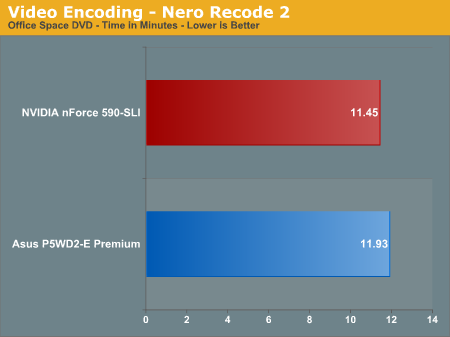
The results are very interesting as we did not expect the NVIDIA system to perform this well and to do so is very surprising considering the early build sample and limited BIOS functionality. In fact, we ran the test several times and verified our settings before accepting the test results. It appeared to us that the storage subsystem on the NVIDIA board made a difference, though as you'll see in a moment this is not the case with one of our audio benchmarks.
Audio Encoding Performance
While the media encoding prowess of the NVIDIA nForce 590 SLI was superb in our limited testing, we wanted to see how it faired on the audio side. Our audio test suite consists of Exact Audio Copy v095.b4, LAME 3.98a3, LAME MT3.97a-MS Compiler, and Nero Digital Audio. Our first task was to figure out what test CD to utilize. We needed one that contained a significant number of tracks and had over 600MB of data in order to properly stress our platforms. After rummaging around the lab once again and coming up empty handed we reverted to our INXS Greatest Hits CD. This one time '80s glory masterpiece contains 16 tracks totaling 606MB of songs that can make the sturdiest of optical drives whimper.
Our first test consists of utilizing Exact Audio Copy as the front end for different versions of LAME. We set up EAC for variable bit rate encoding, burst mode for extraction, use external program for compression, and to start the external compressor upon extraction (EAC will read the next track while LAME is working on the previous track, thus removing a potential bottleneck with the drive).
Our two versions of LAME consist of the recently released 3.98a3 and LAME MT 3.97a, which is a multi-threaded version of the LAME MP3 encoder. LAME MT was originally designed as a demonstration to show the advantages of multi-threading on the Pentium 4 with Hyper-Threading enabled. Instead of running multiple parallel threads, LAME MT generates the encoder's psycho-acoustic analysis function in a separate thread from the rest of the encoder using a simple linear pipeline. The results are presented in minutes/seconds for the encoding process, with lower numbers being better.
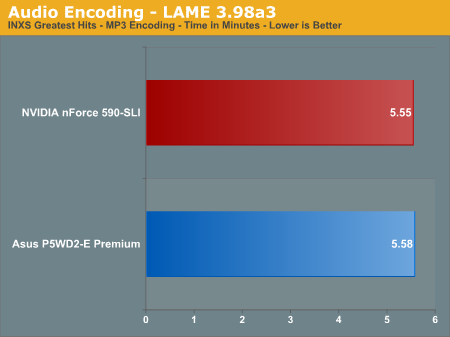
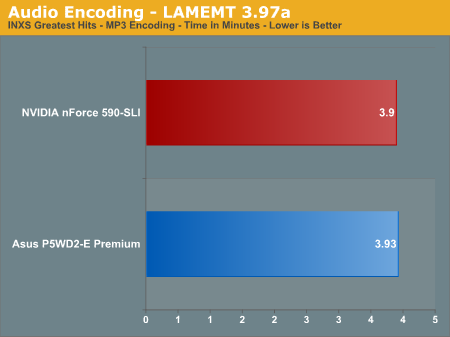
As in the media encoding section, the more intensive CPU and storage system tests seem to favor the NVIDIA platform, although very slightly. We ran these tests several times with the same results all being within the same percentage of each other. When utilizing LAMEMT we see upwards of a 35% improvement in encoding times. This once again shows the advantages of program when it is written to take advantage of multiple-core processors.
Our first test is quite easy - we take our original Office Space DVD and use AnyDVD Ripper to copy the full DVD to the hard drive without compression, thus providing an almost exact duplicate of the DVD. We then fired up Nero Recode 2, selected our Office Space copy on the hard drive, and performed a shrink operation to allow the entire movie along with extras to fit on a single 4.5GB DVD disc. We left all options on their defaults except we checked off the advanced analysis option. The scores reported are the time for the full encoding process and are represented in minutes, with lower numbers indicating better performance.
The results are very interesting as we did not expect the NVIDIA system to perform this well and to do so is very surprising considering the early build sample and limited BIOS functionality. In fact, we ran the test several times and verified our settings before accepting the test results. It appeared to us that the storage subsystem on the NVIDIA board made a difference, though as you'll see in a moment this is not the case with one of our audio benchmarks.
Audio Encoding Performance
While the media encoding prowess of the NVIDIA nForce 590 SLI was superb in our limited testing, we wanted to see how it faired on the audio side. Our audio test suite consists of Exact Audio Copy v095.b4, LAME 3.98a3, LAME MT3.97a-MS Compiler, and Nero Digital Audio. Our first task was to figure out what test CD to utilize. We needed one that contained a significant number of tracks and had over 600MB of data in order to properly stress our platforms. After rummaging around the lab once again and coming up empty handed we reverted to our INXS Greatest Hits CD. This one time '80s glory masterpiece contains 16 tracks totaling 606MB of songs that can make the sturdiest of optical drives whimper.
Our first test consists of utilizing Exact Audio Copy as the front end for different versions of LAME. We set up EAC for variable bit rate encoding, burst mode for extraction, use external program for compression, and to start the external compressor upon extraction (EAC will read the next track while LAME is working on the previous track, thus removing a potential bottleneck with the drive).
Our two versions of LAME consist of the recently released 3.98a3 and LAME MT 3.97a, which is a multi-threaded version of the LAME MP3 encoder. LAME MT was originally designed as a demonstration to show the advantages of multi-threading on the Pentium 4 with Hyper-Threading enabled. Instead of running multiple parallel threads, LAME MT generates the encoder's psycho-acoustic analysis function in a separate thread from the rest of the encoder using a simple linear pipeline. The results are presented in minutes/seconds for the encoding process, with lower numbers being better.
As in the media encoding section, the more intensive CPU and storage system tests seem to favor the NVIDIA platform, although very slightly. We ran these tests several times with the same results all being within the same percentage of each other. When utilizing LAMEMT we see upwards of a 35% improvement in encoding times. This once again shows the advantages of program when it is written to take advantage of multiple-core processors.
Originally published at https://www.anandtech.com/show/2036 (Wayback Machine).