
nForce 590 SLI Intel Edition: NVIDIA prepares an Intel 975X Killer
- Posted in
- CPUs
Synthetic Graphics Performance
The 3DMark series of benchmarks developed and provided by Futuremark are among the most widely used tools for benchmark reporting and comparisons. Although the benchmarks are very useful for providing apple to apple comparisons across a broad array of GPU and CPU configurations they are not a substitute for actual application and gaming benchmarks. In this sense we consider the 3DMark benchmarks to be purely synthetic in nature but still valuable for providing consistent measurements of performance.
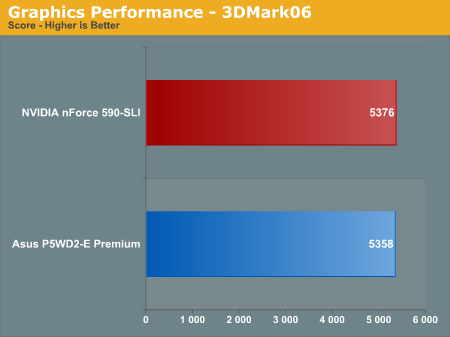
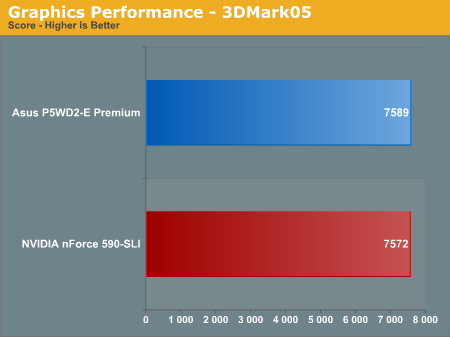
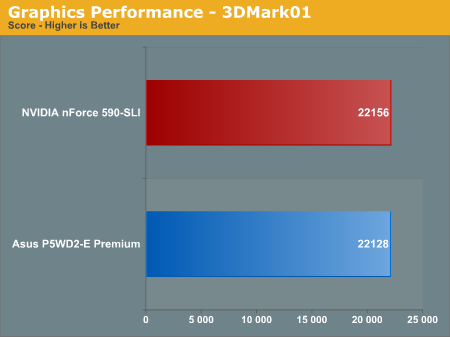
In our first tests, each platform score is so close that there is no winner here - or for the non-pessimists, both boards are winners. In the memory and CPU sensitive 3DMark01 benchmark we see the NVIDIA board has a very slight edge. Although we have not reported memory benchmark scores in this article, the NVIDIA board did perform slightly better than the i975X board at stock settings. This slight advantage will show up in our other memory sensitive benchmarks.
General System Performance
The PCMark05 benchmark developed and provided by Futuremark was designed for determining overall system performance for the typical home computing user. This tool provides both system and component level benchmarking results utilizing subsets of real world applications or programs. This benchmark is useful for providing comparative results across a broad array of Graphics subsystems, CPU, Hard Disk, and Memory configurations along with multithreading results. In this sense we consider the PCMark benchmark to be both synthetic and real world in nature while providing consistency in our benchmark results.
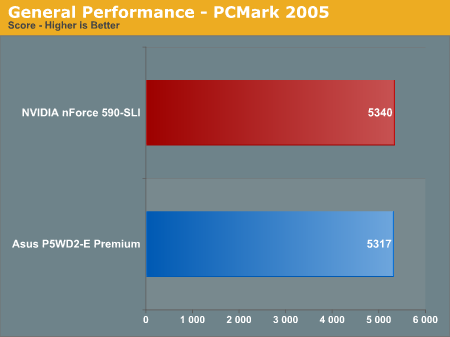
The margins are extremely close in the PCMark05 results but the NVIDIA platform continues to show an advantage over the Intel platform even though it is very slight. While looking at the individual test results, we noticed the NVIDIA board had significantly better hard disk and graphics based scores while the i975X board had better multitasking results.
The 3DMark series of benchmarks developed and provided by Futuremark are among the most widely used tools for benchmark reporting and comparisons. Although the benchmarks are very useful for providing apple to apple comparisons across a broad array of GPU and CPU configurations they are not a substitute for actual application and gaming benchmarks. In this sense we consider the 3DMark benchmarks to be purely synthetic in nature but still valuable for providing consistent measurements of performance.
In our first tests, each platform score is so close that there is no winner here - or for the non-pessimists, both boards are winners. In the memory and CPU sensitive 3DMark01 benchmark we see the NVIDIA board has a very slight edge. Although we have not reported memory benchmark scores in this article, the NVIDIA board did perform slightly better than the i975X board at stock settings. This slight advantage will show up in our other memory sensitive benchmarks.
General System Performance
The PCMark05 benchmark developed and provided by Futuremark was designed for determining overall system performance for the typical home computing user. This tool provides both system and component level benchmarking results utilizing subsets of real world applications or programs. This benchmark is useful for providing comparative results across a broad array of Graphics subsystems, CPU, Hard Disk, and Memory configurations along with multithreading results. In this sense we consider the PCMark benchmark to be both synthetic and real world in nature while providing consistency in our benchmark results.
The margins are extremely close in the PCMark05 results but the NVIDIA platform continues to show an advantage over the Intel platform even though it is very slight. While looking at the individual test results, we noticed the NVIDIA board had significantly better hard disk and graphics based scores while the i975X board had better multitasking results.
Originally published at https://www.anandtech.com/show/2036 (Wayback Machine).