
nForce 590 SLI Intel Edition: NVIDIA prepares an Intel 975X Killer
- Posted in
- CPUs
Audio Encoding Performance
Our last audio test (and we are sure our ears and those of the neighbors were ecstatic about this), utilizes Nero Digital Audio to extract all 16 tracks and convert them into an MP4 format. We changed the default quality settings to transcoder-ultra, variable bit rate, encoder quality to high, and the AAC profile to LC. We were determined to give both our platforms a workout with this test.
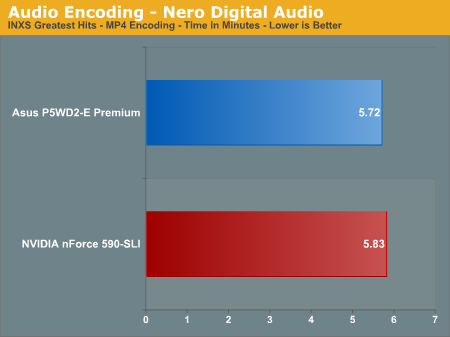
These results have us scratching our heads as this test is equally demanding of the CPU and storage system, but the Intel 975X chipset completes the task up to 7 seconds quicker in each of our benchmark runs. Even the creation of an iPEAK trace file generated the same results during playback. We did note that the hard drive access was consistent on the Intel system while the NVIDIA board had several throughput peaks but just as many lows that resulted in the slower times. The difference is only 2%, but it's still interesting given that the NVIDIA board seems to perform slightly better in some of the other storage-related testing.
File Compression Performance
In order to save space on our hard drives and ensure we had another CPU crunching utility, we will be reporting our file compression results with the latest beta version of WinRAR that fully supports multi-treaded operations and should be of particular interest for those users with dual core or multi-processor systems. Our series of file compression tests utilize WinRAR 3.60b5 to compress our test folder that contains 444 files, ten subfolders, and 602MB worth of data. All default settings are utilized in WinRAR along with our hard drive being defragmented before each test.
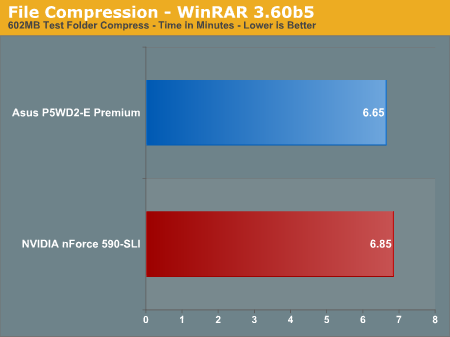
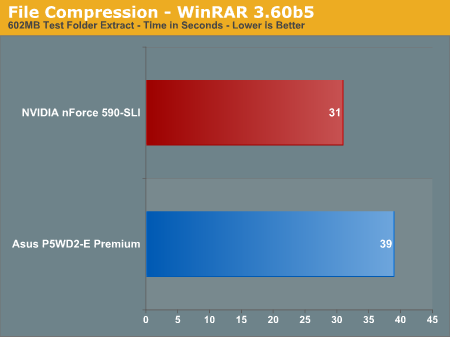
The results speak for themselves with the NVIDIA based system outperforming the Intel system in the decompression tasks by a significant margin (26% faster), but we see the Intel system finishing in front in the grueling compression test (3% faster). Once again, we ran the test several times with the same results. We noticed on our iPEAK test that the disk activity of the NVIDIA board varied somewhat, but the decompression tests are generally more limited by storage system performance whereas the compression tests stress the memory subsystem more. The board could use some additional BIOS tuning for disk activities and the memory subsystem, and hopefully NVIDIA can manage to get more storage subsystem results like the WinRAR decompression benchmark. For now, the NVIDIA board does well in the short and sequential audio tests and file decompression, while it trails slightly in file compression and certain other audio tests.
Our last audio test (and we are sure our ears and those of the neighbors were ecstatic about this), utilizes Nero Digital Audio to extract all 16 tracks and convert them into an MP4 format. We changed the default quality settings to transcoder-ultra, variable bit rate, encoder quality to high, and the AAC profile to LC. We were determined to give both our platforms a workout with this test.
These results have us scratching our heads as this test is equally demanding of the CPU and storage system, but the Intel 975X chipset completes the task up to 7 seconds quicker in each of our benchmark runs. Even the creation of an iPEAK trace file generated the same results during playback. We did note that the hard drive access was consistent on the Intel system while the NVIDIA board had several throughput peaks but just as many lows that resulted in the slower times. The difference is only 2%, but it's still interesting given that the NVIDIA board seems to perform slightly better in some of the other storage-related testing.
File Compression Performance
In order to save space on our hard drives and ensure we had another CPU crunching utility, we will be reporting our file compression results with the latest beta version of WinRAR that fully supports multi-treaded operations and should be of particular interest for those users with dual core or multi-processor systems. Our series of file compression tests utilize WinRAR 3.60b5 to compress our test folder that contains 444 files, ten subfolders, and 602MB worth of data. All default settings are utilized in WinRAR along with our hard drive being defragmented before each test.
The results speak for themselves with the NVIDIA based system outperforming the Intel system in the decompression tasks by a significant margin (26% faster), but we see the Intel system finishing in front in the grueling compression test (3% faster). Once again, we ran the test several times with the same results. We noticed on our iPEAK test that the disk activity of the NVIDIA board varied somewhat, but the decompression tests are generally more limited by storage system performance whereas the compression tests stress the memory subsystem more. The board could use some additional BIOS tuning for disk activities and the memory subsystem, and hopefully NVIDIA can manage to get more storage subsystem results like the WinRAR decompression benchmark. For now, the NVIDIA board does well in the short and sequential audio tests and file decompression, while it trails slightly in file compression and certain other audio tests.
Originally published at https://www.anandtech.com/show/2036 (Wayback Machine).