
DFI CFX3200-DR: ATI RD580 Tweak Attack
- Posted in
- Motherboards
Network
The Windows 2000 Driver Development Kit (DDK) includes a useful LAN testing utility called NTttcp. We used the NTttcp tool to test Ethernet throughput and the CPU utilization of the various Ethernet controllers used on the AMD motherboards.We set up one machine as the server; in this case, an Intel box with an Intel CSA Gigabit LAN connection. Intel CSA has a reputation for providing fast throughput and this seemed a reasonable choice to serve our Gigabit LAN clients. At the server side, we used the following Command Line as suggested by the VIA whitepaper on LAN testing:
Ntttcps -m 4,0,‹client IP› -a 4 -l 256000 -n 30000
On the client side (the motherboard under test), we used the following Command Line:Ntttcpr -m 4,0,‹server IP› -a 4 -l 256000 -n 30000
At the conclusion of the test, we captured the throughput and CPU utilization figures from the client screen.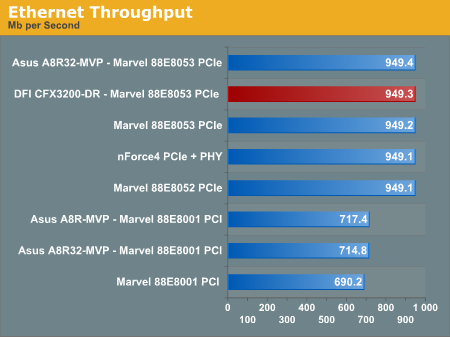
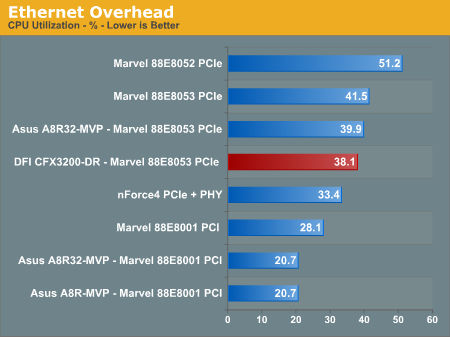
As you can clearly see the PCIe Gigabit LAN on the DFI is capable of about 35% faster speed than the performance we have measured with PCI Gigabit LAN used on some competing motherboards. DFI provides a pair of Marvell PCIe Gigabit controllers which should satisfy most end users. All of the on-board PCIe Ethernet controllers seem to exhibit high CPU utilization, but you should keep in mind that the CPU usage we measure is an extremely artificial number which measures the worst case of a continuous 1Gb transmission. With broad-band connections needing less than 100Mb Ethernet, the real-world CPU usage will be much lower than these test results.
USB and Firewire Performance
USB has been a problem area for the ATI SB450 chipset, but it has not been a major issue with the ULi M1575 Southbridge. To test performance of USB and Firewire on the DFI CFX3200-DR we ran our standard USB throughput test using an external USB hard drive. For Firewire tests an external Firewire 400 or 800 hard disk is used for testing. Our test method uses a RAM disk as our "server" since memory removes almost all overhead from the serving end. We also turn off disk caching on the USB and Firewire side by setting up the drives for "quick disconnect". Our results are then consistent over many test runs.We use just 1GB of fast 2-2-2 system memory, set up as a 450MB RAM disk and 550MB of system memory. Our stock file is the SPECviewPerf 8.01 install file which is 432,533,504 bytes (412.4961MB). After copying this file to our RAM disk, we measure the time for writing from the RAM disk to our external USB 2.0 or Firewire 400 or Firewire 800 drive using a Windows timing program written for AnandTech by Jason Clark. The copy times in seconds are then converted into Megabits per second (Mb) to provide a convenient means of comparing throughput. Higher Rates therefore mean better performance. Blue bars represent USB 2.0 performance, while green bars represent Firewire.
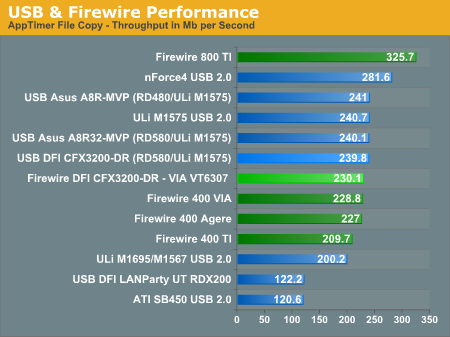
The DFI CFX3200-DR performed virtually the same in USB tests as we have measured in other recent tests of the ULi M1575. While USB performance is a bit slower than NVIDIA, it is definitely competitive with the NVIDIA results, with throughput about double the ATI SB450. This is a big improvement and the reason ASUS, ECS, MSI, Abit, and DFI are using ULi M1575 instead. This will likely change with the introduction of the updated ATI SB600, which is expected with the launch of ATI chipset motherboards for AM2.
DFI chose the excellent VIA VT6307 to power the IEEE1394 ports on the CFX3200-DR. The VIA has been tested as fastest Firewire 400 in past results - running neck and neck with the Agere Firewire chip. Performance is where we would expect for the VIA Firewire chip.
Originally published at https://www.anandtech.com/show/2002 (Wayback Machine).