
Intel Core Duo (Yonah) Performance Preview - Part II
- Posted in
- CPUs
Professional Application Performance with 3dsmax, Adobe Premier and Photoshop
We start off our page on professional application performance with an updated version of the SPECapc 3dsmax test, updated for version 7 of the application. The scenes being rendered haven't actually changed, but the reference numbers used to compute the composite scores have, so these scores aren't directly comparable to results from earlier SPECapc tests.
Compared to the Athlon 64 X2, the Core Duo comes out on top, but by a very small margin - once again we're faced with a virtual tie.
The breakdown of the rendering composite score can be found below; the scores in the table are render time in seconds, lower numbers are better:
Moving onto Adobe Premier Pro 1.5, this test is actually one that is used by Intel to showcase the performance of the Pentium 4 processor. With the Pentium 4 absent from this comparison, we were curious as to how it compared to the Core Duo and the Pentium M.
As with virtually any media encoding performance, dual-core processors do extremely well, and this case is no different with the Core Duo T2500 seriously outpacing the Pentium M 760.
The Core Duo T2500 is also able to complete the export process in about 97% of the time of the Athlon 64 X2, which once again ends up being borderline negligible for this test, but it is important to note that this advantage comes without the aid of an on-die memory controller.
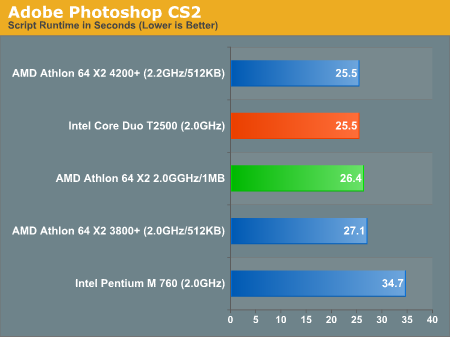
Our final test is the only other Intel-supplied test in the suite. This one used to showcase the Pentium 4's performance under Adobe Photoshop CS2 by measuring the time that it takes to run a few filters and resize/export images. The script itself is fairly realistic; however, with Photoshop filters, it is easy to favor one architecture over another, so by no means are these numbers intended to be conclusive of Photoshop CS2 performance.
We start off our page on professional application performance with an updated version of the SPECapc 3dsmax test, updated for version 7 of the application. The scenes being rendered haven't actually changed, but the reference numbers used to compute the composite scores have, so these scores aren't directly comparable to results from earlier SPECapc tests.
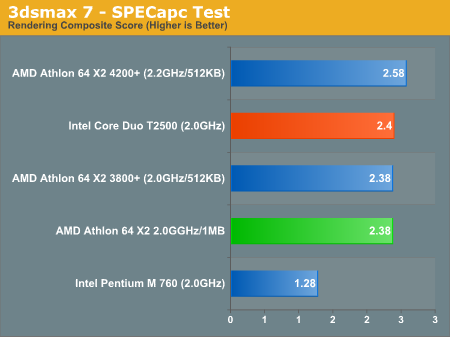
Compared to the Athlon 64 X2, the Core Duo comes out on top, but by a very small margin - once again we're faced with a virtual tie.
The breakdown of the rendering composite score can be found below; the scores in the table are render time in seconds, lower numbers are better:
| SPECapc 3dsmax 7 Breakdown | AMD Athlon 64 X2 4200+ | AMD Athlon 64 X2 3800+ | AMD Athlon 64 X2 2.0GHz/1MB | Intel Core Duo T2500 | Intel Pentium M 760 |
| 3dsmax 5 rays | 15.406 | 15.829 | 16.109 | 14.297 | 25.246 |
| CBALLS2 | 20.125 | 22.281 | 22.094 | 21.187 | 42.201 |
| SinglePipe2 | 92.844 | 101.906 | 101.922 | 107.359 | 203.492 |
| UnderWater | 142.938 | 157.219 | 156.203 | 169.188 | 316.055 |
Moving onto Adobe Premier Pro 1.5, this test is actually one that is used by Intel to showcase the performance of the Pentium 4 processor. With the Pentium 4 absent from this comparison, we were curious as to how it compared to the Core Duo and the Pentium M.
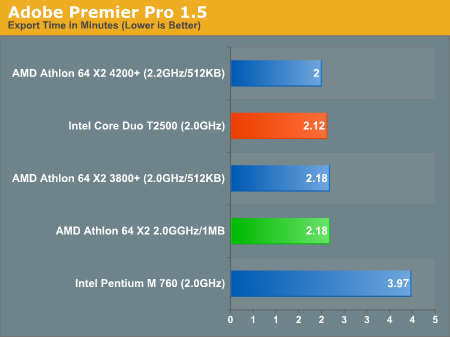
As with virtually any media encoding performance, dual-core processors do extremely well, and this case is no different with the Core Duo T2500 seriously outpacing the Pentium M 760.
The Core Duo T2500 is also able to complete the export process in about 97% of the time of the Athlon 64 X2, which once again ends up being borderline negligible for this test, but it is important to note that this advantage comes without the aid of an on-die memory controller.
Our final test is the only other Intel-supplied test in the suite. This one used to showcase the Pentium 4's performance under Adobe Photoshop CS2 by measuring the time that it takes to run a few filters and resize/export images. The script itself is fairly realistic; however, with Photoshop filters, it is easy to favor one architecture over another, so by no means are these numbers intended to be conclusive of Photoshop CS2 performance.
Originally published at https://www.anandtech.com/show/1900 (Wayback Machine).