
IDF Spring 2005 Day 1 - Gelsinger Speaks, nForce4 Intel and more
- Posted in
- Trade Shows
Our first day of IDF coverage has come to a close, and it has been quite eventful. From the barrage of multicore information, to the 64bit evangelism, down to the tech showcase, we've seen quite a bit from Intel.
It is usually a pleasure to listen to Pat Gelsinger deliver a keynote, and today was no different. The Intel VP took us through new technologies from Intel that will be introduced over the next year or two. Included in the long list of topics covered are network acceleration, advanced management features, virtualization, and, of course, multicore. We got to see a 32-way Itanium machine recognize faces in a split second, as well as another demo of Intel's virtualization technology -- this time focused on security.
On the floor of the tech showcase, we saw quite a few interesting booths. There is everything from fuel cell and battery research, to new a new server oriented chip from ATI (which we will talk more about later in the week). Also appearing is the NVIDIA nForce 4 SLI Intel Edition, brining into light the fruits of the NVIDIA/Intel cross-licensing agreement announced in November. We'll be talking more about these and other exciting exhibits over the course of IDF.
We hope you enjoy the conclusion to our coverage of IDF Spring 2005 Day 1. It's time for us to collapse into dreamland and prepare for another big day tomorrow.
Intel I/O Acceleration Technology: Improving Network Performance
When looking at network servers, a huge percentage of the overall work being done has to do with protocol overhead processing. In order to get more of the work the users is interested in done, the industry has pushed forth network hardware that handles some of the overhead of TCP/IP processing. Network cards that include a TCP Offload Engine (TOE) are able to help reduce overhead processing done on the server's CPUs.
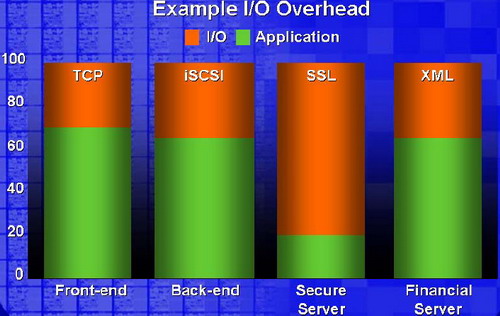
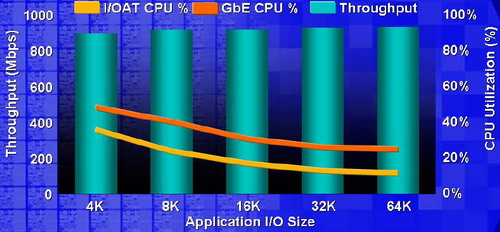
Rather than simply rely on a NIC with a TOE, Intel has found that improving the rest of the platform is actually a better way of handling network overhead (especially when looking at many small packets).
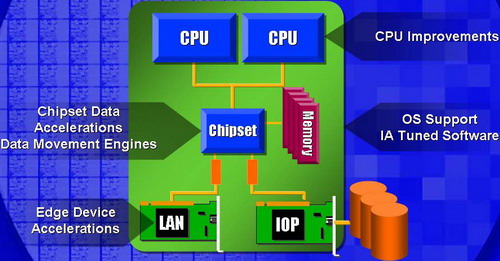
We didn't get an in depth technical look at IOAT at Pat's keynote today, but we do have a little general information. The slide we are looking at lists "CPU Improvements" and "OS Support/IA Tuned Software" as architectural enhancements behind IOAT. Making faster and more parallel processors will definitely help without needing any IOAT specific optimizations, and OS support of hardware features is usually a prerequisite for their use. Of course there could be more too these aspects of the technology, but we'll have to wait an see. The real meat likely comes in the chipset data accelerations, Data Movement Engines, and Edge Device Accelerations. We could envision enhancements to the NIC and chipset that allow for further removed overhead processing as well as optimized or prioritized movement of data through they system. We'll bring out more details as we get them.
Originally published at https://www.anandtech.com/show/1632 (Wayback Machine).