
915 Motherboard Roundup: Socket 775 for the Rest of Us
- Posted in
- Motherboards
DFI LANParty UT 915P-T12: Features and Layout
DFI has implemented Intel Speedstep in their recent BIOS updates to the LANParty UT 915P-T12.| DFI LANParty UT 915P-T12 Motherboard Specifications | |
| CPU Interface | Socket 775 Pentium 4 (Prescott) |
| Chipset | Intel 915P/ICH6 |
| BUS Speeds | 200MHz to 380MHz (in 1MHz increments) |
| DDR2 Speeds | Auto, 400, 533 |
| PCI Speeds | To CPU, 33.33, Auto |
| PCI Express Speeds | Auto, Fix 100-140 |
| Core Voltage | 0.8375V to 1.95V in 0.0125V increments |
| DRAM Voltage | 1.8V to 2.5V in 0.1V increments |
| Northbridge Voltage | 1.5V to 1.8V in 0.1V increments |
| Memory Slots | Two 240-pin DDR2 Slots OR Two 184-pin DDR Slots (Can NOT be Used together) Dual-Channel Unbuffered Memory to 2GB |
| Expansion Slots | 1 PCIe x16 Slot 2 PCIe x1 slot 3 PCI Slots |
| Onboard SATA/IDE RAID | 4 SATA 150 drives by ICH6 |
| Onboard IDE | One Standard ATA100/66 (2 drives) |
| Onboard USB 2.0/IEEE-1394 | 8 USB 2.0 ports 2 IEEE 1394 FireWire Ports by VIA VT6307 |
| Onboard LAN | 2 Gigabit LAN - Marvel 88E8053 PCIe and Marvel 88E8001 PCI |
| Onboard Audio | Karajan Module with Realtek ALC880 Codec with Independent Variable Sampling 8-Channel with SPDIF in/out |
| Tested BIOS | Award 9/20/2004 |
When DFI introduced the LANParty boards in early 2003, they were not a name with which many Enthusiasts were familiar. However, since that time, DFI has earned a solid reputation as a maker of some of the best-performing and most sought-after boards available in the Enthusiast market. Where the LANParty name is used for the top performing boards produced by DFI geared for the enthusiast, the LANParty UT name has recently come into play to identify LANParty board designed for great value. The idea behind LANParty UT is to provide all of the overclocking finesse for which DFI is known, but also to deliver it with fewer features and fewer accessories included to keep the price more reasonable.
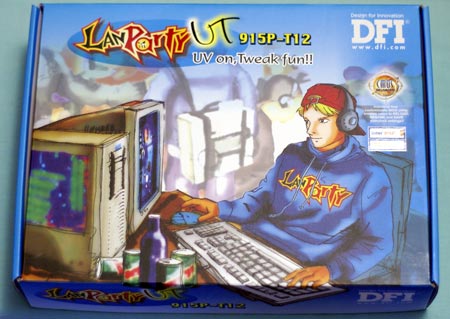
For example, you will not normally see front-panel break-out boxes and a PC Transpo harness included with a LANParty UT board, but you will normally see these features on a LANParty board. However, some things are still included in the package that you might not expect. Things like round IDE and Floppy cables in stand-out colors are still included.
The heart of any LANParty board is the performance and overclocking, and here, the options available for the enthusiast will keep most users very happy. First, the LANParty can use either DDR or DDR2 memory. This flexible arrangement allows you to carry some favorite DDR to the DFI board or to use the new DDR2 memory. Just keep in mind that you can't use both DDR and DDR2 together. The fact that you can use either, but not both memory, also limits the maximum memory usable on the UT 915P-T12.
DFI included some very high-end features that many enthusiasts will welcome. There are two Gigabit LAN ports - one based on the faster PCI Express bus and a standard Gigabit LAN that resides on the slower PCI bus. DFI also included a separate Karajan audio card for improved audio. The Karajan card isolates the High-Definition audio to improve signal-to-noise ratio, removing the biggest complaint of on-board audio, which is excessive noise. IEEE Firewire ports are also featured on the UT 915P-T12, though they are standard 1394a ports instead of the new and faster 1394b variety.
With all this attention to high-end features, you may well wonder what DFI left out. One significant omission is using the ICH6 south bridge instead of ICH6R. This will matter to some, since Intel Matrix RAID is not available, but others will say the RAID provides no real performance improvement anyway. The 2nd item is a larger surprise, however. DFI has just the one ICE port provided by the 915 chipset. This is a surprise, since the DFI reaches its highest overclock levels with IDE drives. With that being the case, it is really short-sighted to have to share an IDE drive and optical disks on a board supporting just two IDE devices. There are plenty of good performing SATA ports on the DFI, but to get to the screaming overclock stage, you will have to use IDE.
With a DFI LANParty - even the UT variety - you expect to get a wide range of overclocking controls and tweaks in the BIOS. Noteworthy on the 915P-T12 is a memory voltage range to default 1.8V to 2.5V and a similar set of DDR options to 3.2V. These are unusually wide for a motherboard and make it easier to squeeze the most performance form your memory. The CPU voltage extends all the way to 1.95V with a stock 1.3875V Prescott. This kind of range is frankly dangerous in the wrong hands, but it is high enough to satisfy mostly enthusiasts who will use water and phase-change cooling for their Prescott.
DFI also continues CMOS reloaded, which was introduced with the second generation LANParty and Infinity boards. This feature allows you to save several different custom BIOS setups, so you can easily recall custom BIOS settings for a particular overclock or settings for a different OS. Overclockers and users who run multiple operating systems will really find CMOS Reloaded to be a useful feature.
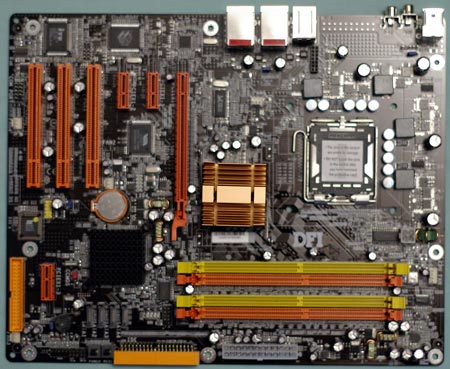
The DFI is very well laid out for most cases. The 20/24 ATX and 4-pin 12V are at board edge locations, and the single IDE is a midline board-edge connector that is best mounted before dropping the board in your case. Audio connectors like CD-IN are on the Karajan card. There are also momentary on/off and reset switches, a LANParty trademark feature on the right edge of the board. The only connector that is poorly located is the floppy connector at the bottom of the board. If you are one who still uses a floppy, this location will be a stretch - particularly in a full tower case that is likely to be used with a board such as the UT 915P-T12. While they don't stand out in the photo, DFI also includes 4 diagnostic LEDs on the board and a list of codes in the manual. They are not as easy to use as the 2-digit LEDs, but they still provide very useful info if you are having any issues with board
As we have come to expect with LANParty boards in all flavors, DFI continues to innovate with their LANParty line of boards. The LANParty UT is clearly aimed at the computer Enthusiast who cares most about pure performance. The UT boards look fine in side-window cases, but they are not as brash and showy as the regular LANParty series. The LANParty boards wouldn't sell unless they also delivered top-notch Enthusiast-level performance along with whatever else they bring to the table. Fortunately, DFI continues to lavish most of their attention on how the LANParty boards actually perform.
Originally published at https://www.anandtech.com/show/1561 (Wayback Machine).