
The TeamGroup L5 LITE 3D (480GB) SATA SSD Review: Entry-Level Price With Mainstream Performance
Burst IO Performance
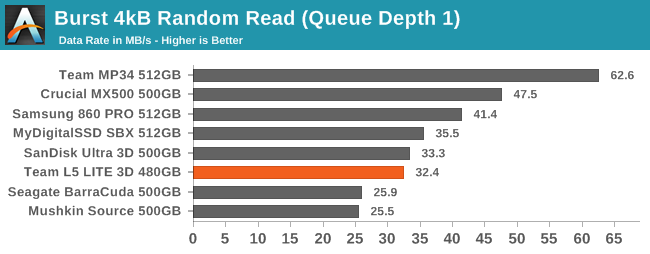
Our burst IO tests run at a queue depth of one and the amount of data transferred is limited to ensure that SLC write buffers don't fill up and controllers don't overheat. In between each burst there's enough idle time to keep the drive averaging a 20% duty cycle, allowing for some buffered writes and deferred garbage collection to be completed. The random read and write tests use 4kB operations and the sequential tests use 128kB operations. All the burst tests are confined to a 16GB portion of the drive, so DRAMless SSDs are not disadvantaged as much as they are for larger tests.
 |
|||||||||
| Random Read | Random Write | ||||||||
| Sequential Read | Sequential Write | ||||||||
The SATA SSDs in this bunch all perform very similarly on the burst sequential IO tests, though the TeamGroup L5 LITE 3D is hair slower than the rest for sequential writes. The random write performance is tied for first place among the SATA drives, but the random read performance is much slower than the Crucial MX500.
Sustained IO Performance
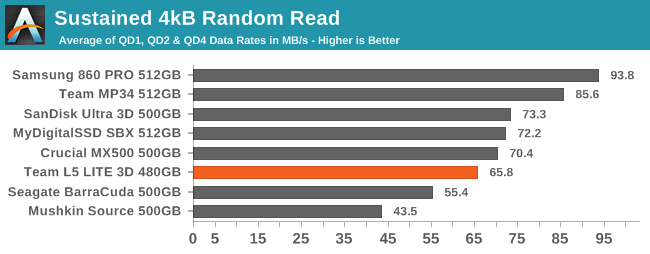
Our sustained IO tests measure performance on queue depths up to 32, but the scores reported here are only the averages for the low queue depths (1,2,4) that are most representative of real-world consumer workloads. Each queue depth is tested for up to one minute or 32GB, and the tests are confined to a 64GB span of the drive.
 |
|||||||||
| Random Read | Random Write | ||||||||
| Sequential Read | Sequential Write | ||||||||
The Team L5 LITE 3D's sustained sequential performance isn't quite the fastest among the SATA SSDs, but it does stand out for having pretty good performance when performing sequential reads on data that was written with random writes. The random write performance of the L5 LITE 3D is as good as any of the TLC SATA drives in this batch, but the random read performance is a bit slower than the top tier SATA drives.
 |
|||||||||
| Random Read | Random Write | ||||||||
| Sequential Read | Sequential Write | ||||||||
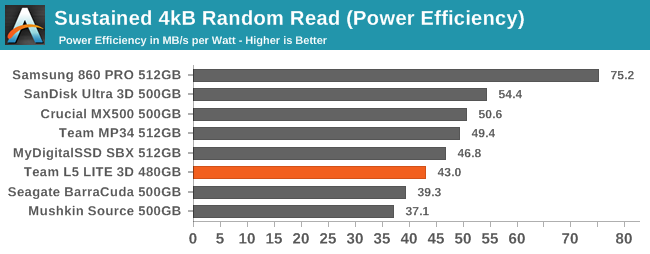
The L5 LITE 3D's power efficiency during the random write test is pretty good by TLC SATA standards, but otherwise it tends to fall short by a bit. The Mushkin Source DRAMless SATA drive turns in some great efficiency scores thanks to really low power draw (helped by the lack of DRAM), but DRAMless performance on random reads is far too low for it to remain competitive on that efficiency metric.
 |
|||||||||
| Random Read | Random Write | ||||||||
| Sequential Read | Sequential Write | ||||||||
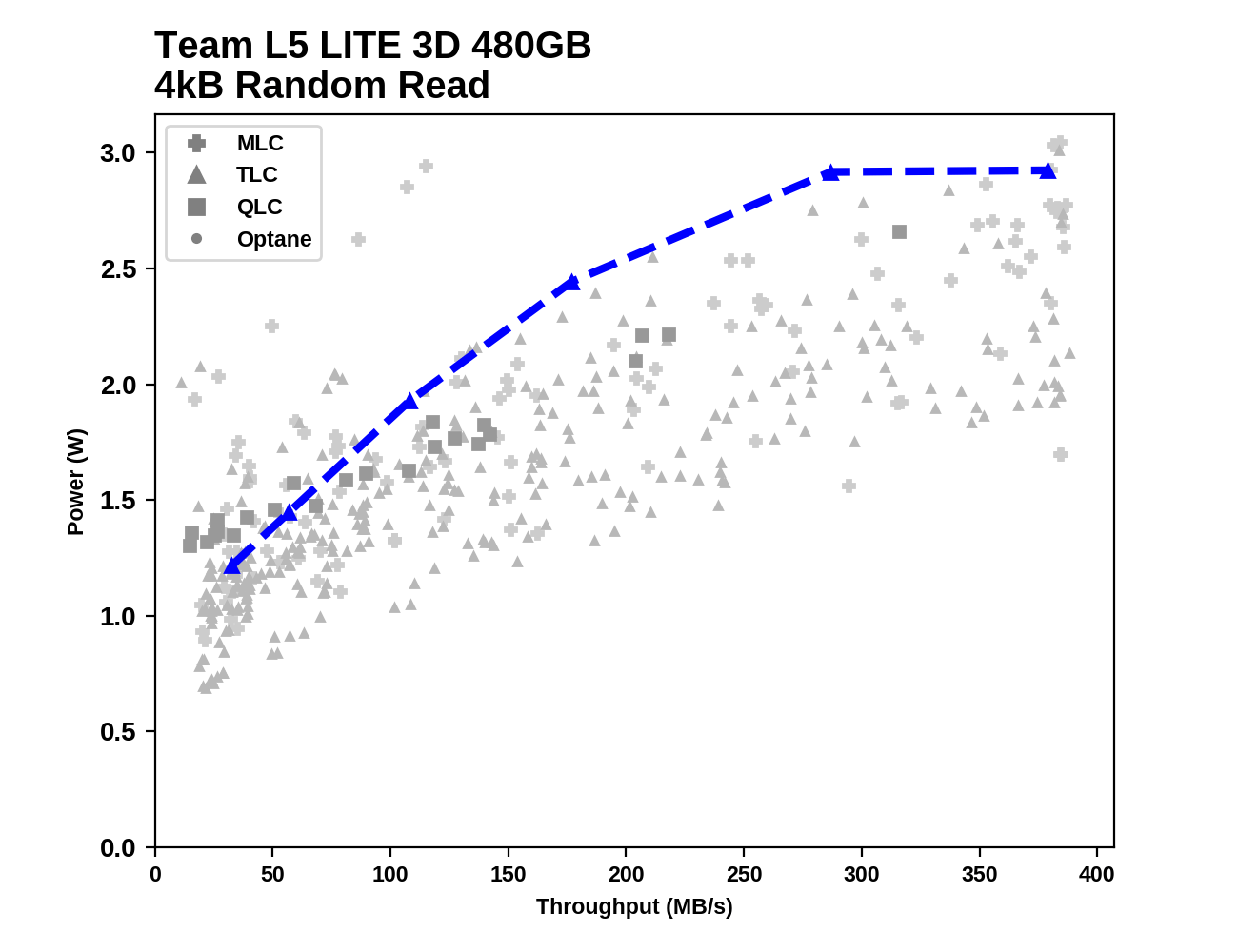
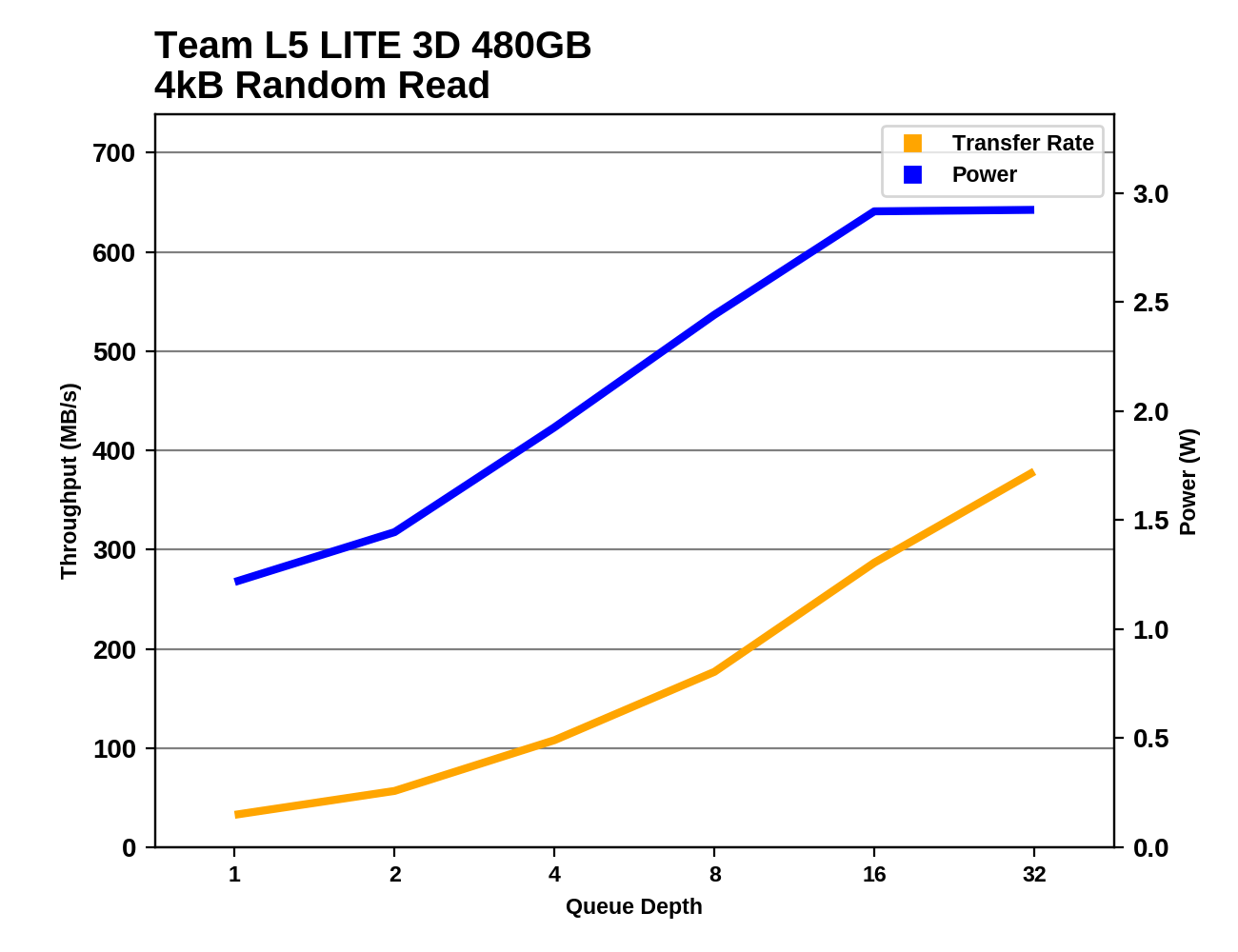
Plotting the L5 LITE 3D's performance and power at various queue depths against all the other SATA drives in our database shows that the random read power consumption starts to look excessive at medium to high queue depths. For the other workloads, the L5 LITE 3D is at least nowhere near setting a record for good power efficiency, but it does sometimes manage to be better than average.
At high queue depths, the L5 LITE 3D reaches the same SATA throughput limits as everything else for read operations, but the the write speeds top out a bit below the practical maximum for the best SATA SSDs.
 |
|||||||||
| Random Read | |||||||||
| Random Write | |||||||||
| Sequential Read | |||||||||
| Sequential Write | |||||||||
Putting the L5 LITE 3D head to head against other TLC SATA drives makes it clear that the Team drive can almost always hold its own on the performance front. The power consumption is where it loses, and sometimes by a pretty wide margin: the Mushkin Source is a full 1W ahead of the L5 LITE 3D for sequential writes, and the Crucial MX500 is ahead by about 0.5W for random reads at high queue depths.
Originally published at https://www.anandtech.com/show/14874/the-team-l5-lite-3d-sata-ssd-review (Wayback Machine).