
The TeamGroup L5 LITE 3D (480GB) SATA SSD Review: Entry-Level Price With Mainstream Performance
AnandTech Storage Bench - The Destroyer
The Destroyer is an extremely long test replicating the access patterns of very IO-intensive desktop usage. A detailed breakdown can be found in this article. Like real-world usage, the drives do get the occasional break that allows for some background garbage collection and flushing caches, but those idle times are limited to 25ms so that it doesn't take all week to run the test. These AnandTech Storage Bench (ATSB) tests do not involve running the actual applications that generated the workloads, so the scores are relatively insensitive to changes in CPU performance and RAM from our new testbed, but the jump to a newer version of Windows and the newer storage drivers can have an impact.
We quantify performance on this test by reporting the drive's average data throughput, the average latency of the I/O operations, and the total energy used by the drive over the course of the test.
 |
|||||||||
| Average Data Rate | |||||||||
| Average Latency | Average Read Latency | Average Write Latency | |||||||
| 99th Percentile Latency | 99th Percentile Read Latency | 99th Percentile Write Latency | |||||||
| Energy Usage | |||||||||
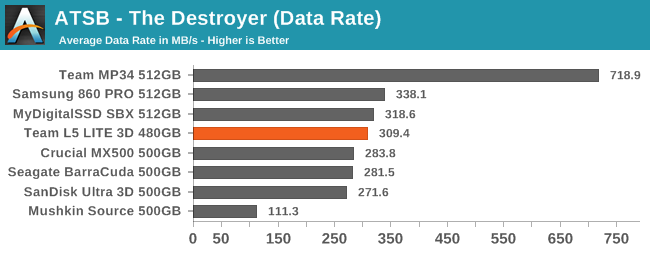
Any expectations that the TeamGroup L5 LITE 3D would perform like an entry-level SSD are shattered by the results from The Destroyer. The L5 LITE 3D has about the best overall data rate that can be expected from a TLC SATA drive. The latency scores are generally competitive with other mainstream TLC SATA drives and unmistakably better than the DRAMless Mushkin Source. Even the energy efficiency is good, though not quite able to match the Samsung 860 PRO.
AnandTech Storage Bench - Heavy
Our Heavy storage benchmark is proportionally more write-heavy than The Destroyer, but much shorter overall. The total writes in the Heavy test aren't enough to fill the drive, so performance never drops down to steady state. This test is far more representative of a power user's day to day usage, and is heavily influenced by the drive's peak performance. The Heavy workload test details can be found here. This test is run twice, once on a freshly erased drive and once after filling the drive with sequential writes.
 |
|||||||||
| Average Data Rate | |||||||||
| Average Latency | Average Read Latency | Average Write Latency | |||||||
| 99th Percentile Latency | 99th Percentile Read Latency | 99th Percentile Write Latency | |||||||
| Energy Usage | |||||||||
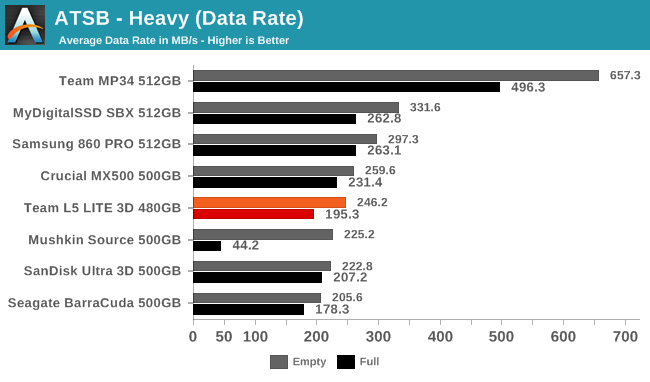
On the Heavy test, the L5 LITE 3D starts to show a few weaknesses, particularly with its full-drive performance—latency clearly spikes and overall throughput drops more than for most mainstream TLC drives. The effect is vastly smaller than the full-drive penalty suffered by the DRAMless competitor. The energy efficiency doesn't stand out.
AnandTech Storage Bench - Light
Our Light storage test has relatively more sequential accesses and lower queue depths than The Destroyer or the Heavy test, and it's by far the shortest test overall. It's based largely on applications that aren't highly dependent on storage performance, so this is a test more of application launch times and file load times. This test can be seen as the sum of all the little delays in daily usage, but with the idle times trimmed to 25ms it takes less than half an hour to run. Details of the Light test can be found here. As with the ATSB Heavy test, this test is run with the drive both freshly erased and empty, and after filling the drive with sequential writes.
 |
|||||||||
| Average Data Rate | |||||||||
| Average Latency | Average Read Latency | Average Write Latency | |||||||
| 99th Percentile Latency | 99th Percentile Read Latency | 99th Percentile Write Latency | |||||||
| Energy Usage | |||||||||
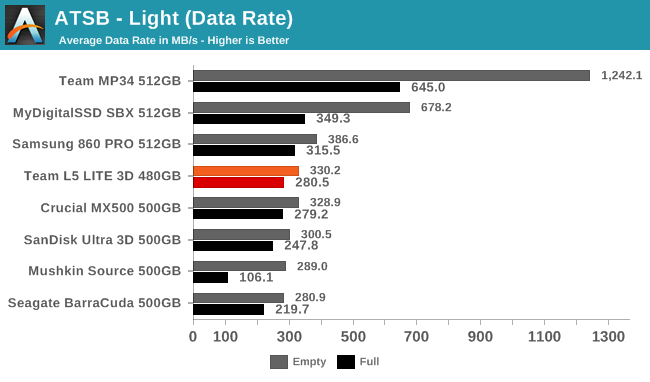
The Team L5 LITE 3D has basically the same overall performance on the Light test as drives like the Crucial MX500. A handful of the latency scores are a bit on the high side, but don't really stand out—the Seagate BarraCuda that uses the old Phison S10 controller with current 3D TLC has more trouble on the latency front, and of course the DRAMless Mushkin Source has by far the worst full-drive behavior. There is a bit of room for improvement on the L5 LITE 3D's energy efficiency, since both the Mushkin Source and Crucial MX500 are clearly better for the empty-drive test runs. The Team drive's efficiency isn't anything to complain about, though.
Originally published at https://www.anandtech.com/show/14874/the-team-l5-lite-3d-sata-ssd-review (Wayback Machine).