
The Team Group MP34 512GB SSD Review: Refining Phison's NVMe Workhorse
AnandTech Storage Bench - Light
Our Light storage test has relatively more sequential accesses and lower queue depths than The Destroyer or the Heavy test, and it's by far the shortest test overall. It's based largely on applications that aren't highly dependent on storage performance, so this is a test more of application launch times and file load times. This test can be seen as the sum of all the little delays in daily usage, but with the idle times trimmed to 25ms it takes less than half an hour to run. Details of the Light test can be found here. As with the ATSB Heavy test, this test is run with the drive both freshly erased and empty, and after filling the drive with sequential writes.
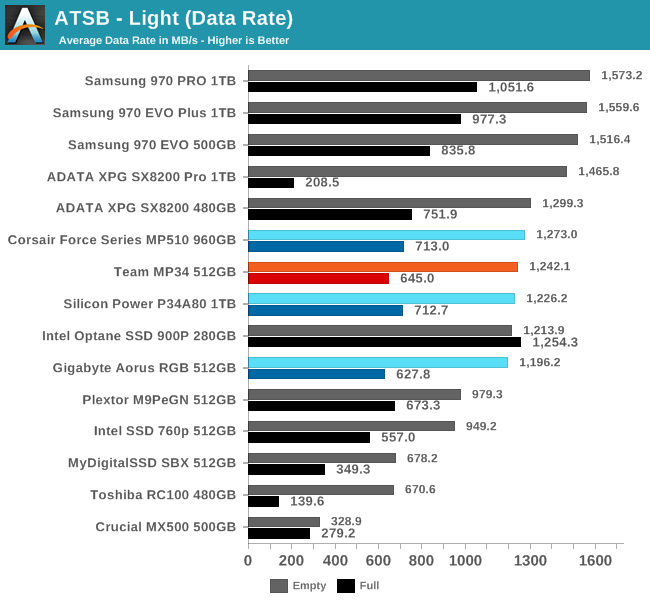
The Light test average data rates don't show any clear improvement from the new firmware used by the Team Group MP34. When the test is run on an empty drive, the overall performance is great for all of the Phison E12 drives we've tested, without much variation between firmware versions or drive capacities. The full drive test runs show a small advantage for the higher-capacity models. Samsung's drives have the highest scores in both cases, and the Silicon Motion SM2262EN provides similar empty-drive performance at the cost of horrible full-drive behavior.
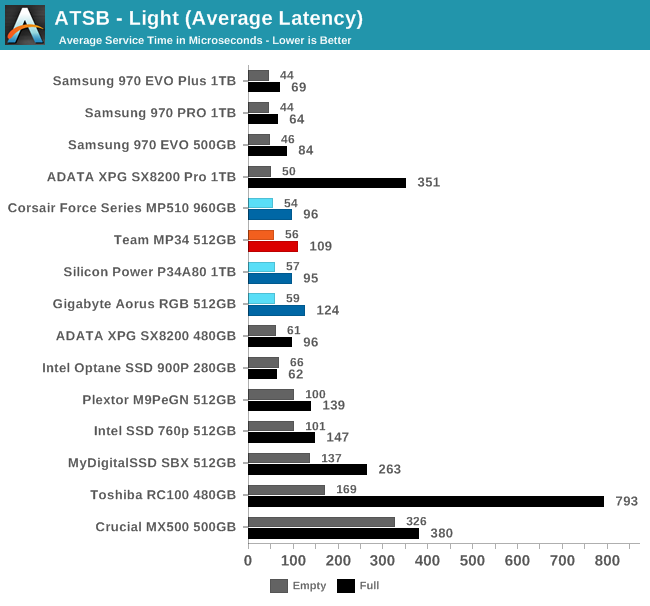
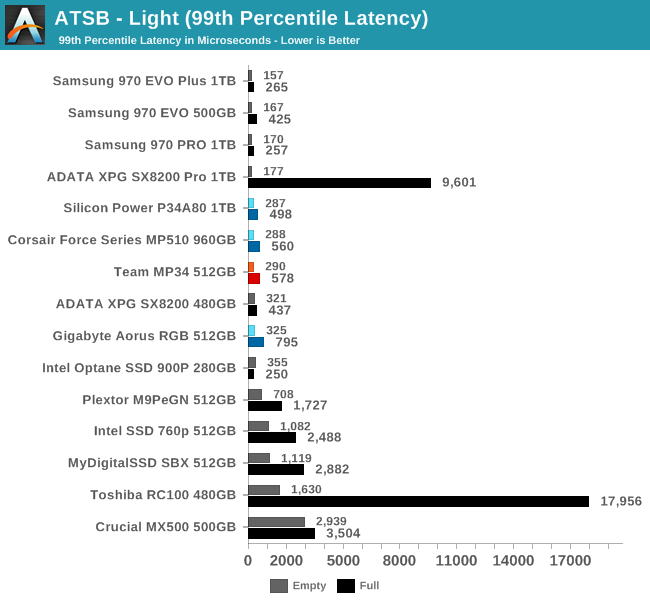
The Team MP34 shows small improvements to both average and 99th percentile latencies compared to the older Phison firmware, but these differences are insignificant compared to those with other hardware: the Phison E12 was already offering great latency by the standards of 512GB drives, and the performance loss when the test is run on a full drive is much less than some of its competition shows.
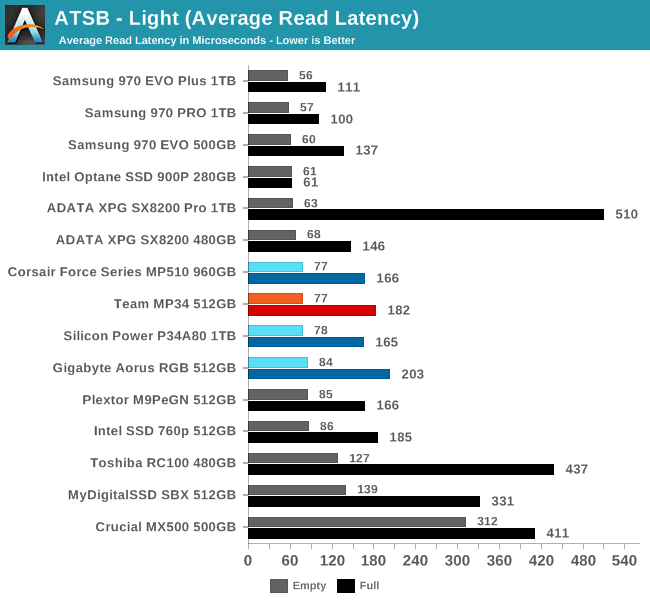
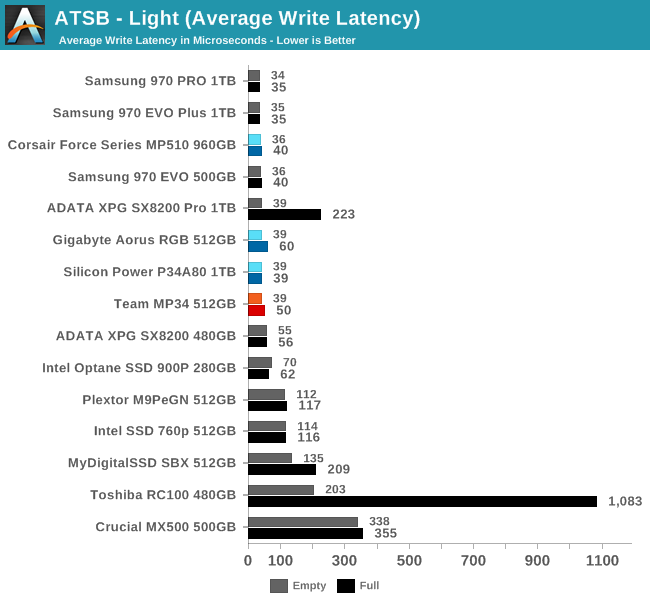
Phison may have improved both average read and write latencies by a few microseconds with their newer firmware used on the MP34, but the changes are insignificant. What is important is that they didn't make anything worse in pursuit of improvements, in contrast to Silicon Motion's SM2262EN.
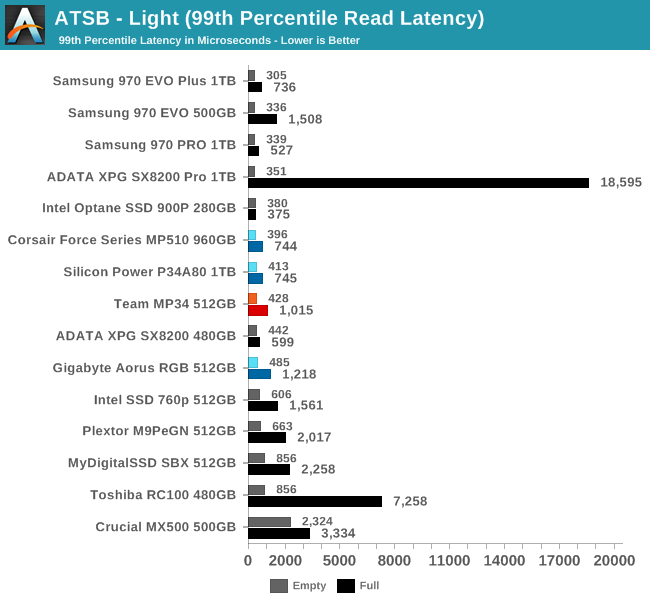
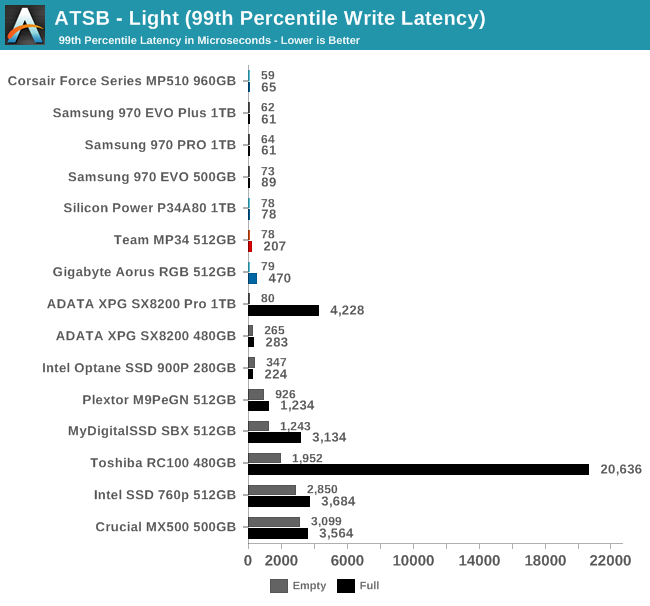
The 99th percentile write latencies for the Team MP34 are a bit better in the full-drive case than the Gigabyte Aorus 512GB, but generally speaking even for these lower capacity drives virtually all of the write operations in the Light test go straight to SLC cache with minimal latency. The 99th percentile read latency is also slightly improved, with almost all read operations completed in under 1ms even when the test is run on a full drive.
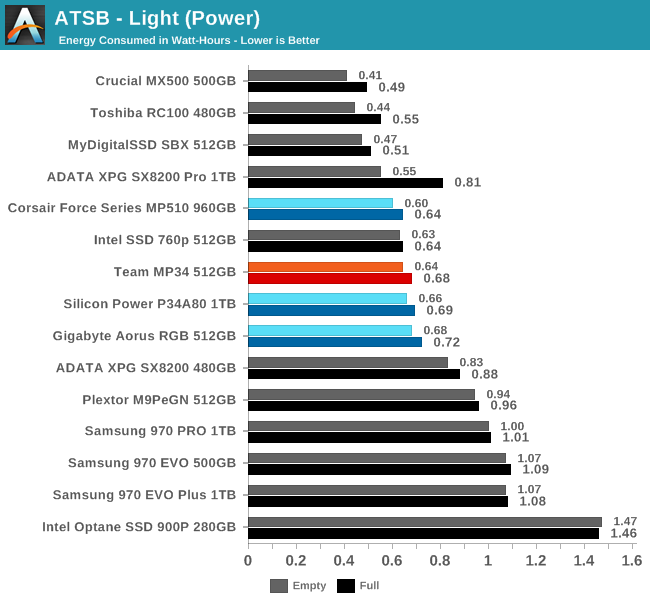
The Team MP34 and other Phison E12 drives use less energy over the course of the Light test than Samsung's drives and several other high-end NVMe drives, but ADATA's SX8200 Pro comes out ahead of the Phison drives when the test is run on an empty drive. For this test, even the entry-level NVMe drives require more energy than the Crucial MX500 SATA SSD.
Originally published at https://www.anandtech.com/show/14331/the-team-group-mp34-512gb-ssd-review (Wayback Machine).